
Freddie Carr: A week that changed the sport

How did we get to a point where nearly 20,000 paying fans turned up to watch sailing in Auckland over a single weekend? That doesn’t happen by accident. For SailGP it felt like a line in the sand – and, more broadly, a marker for where the sport has arrived.
I think we got here after two critical weeks, one in 2010 and one in 2017. These weeks shifted the sport on its axis and set the trajectory to where we are in Auckland 2026.
Cowes Week 2010
Six months after the Deed of Gift match in Valencia – when Oracle Team USA’s trimaran, helmed by a young James Spithill, defeated Alinghi to return the Cup to the United States – the focus shifted back to more conventional boats and a more familiar style of racing.
At that time I was part of Team Origin. The afterguard was exceptionally strong: Ben Ainslie, Iain Percy and Andrew Simpson, supported by experienced sailors from Emirates Team New Zealand and previous Alinghi campaigns, along with a small group of younger British sailors, myself included.
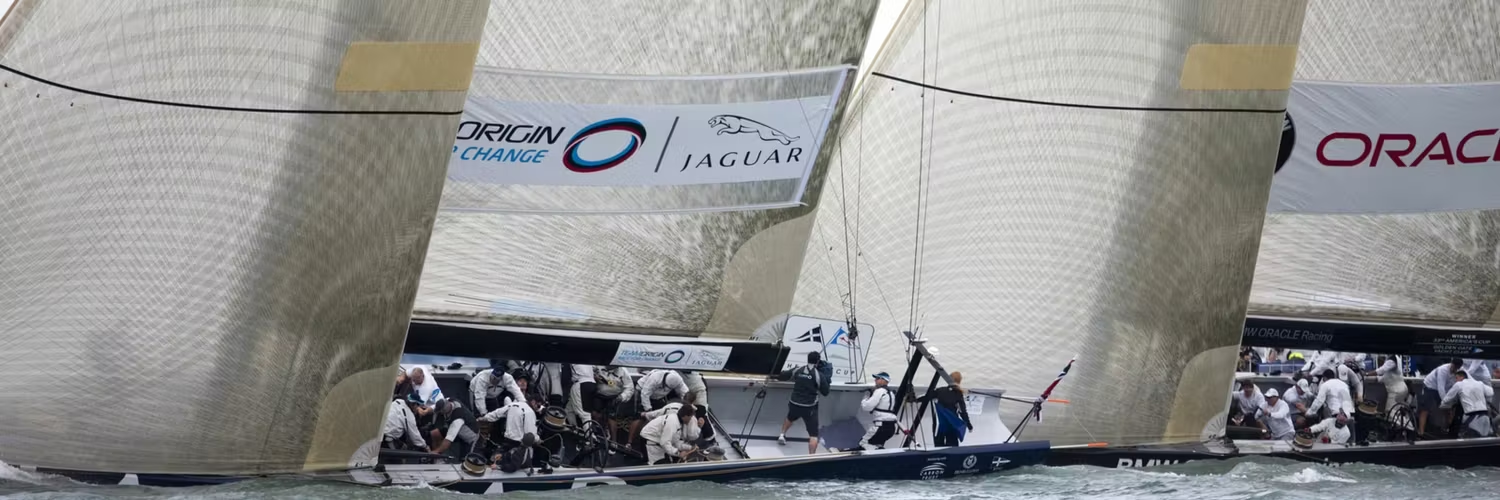
During Cowes Week in 2010 it was agreed that the defenders, Oracle Team USA, and Team Origin would sail a match-racing series in the International America’s Cup Class. Holding it in the Solent – the waters where the America’s Cup was first contested in 1851 – gave the racing a certain historical weight and was intended to build interest in the next cycle.
We won the series 10-4.
Although the scoreline suggests a margin, the racing was consistently close. The pre-starts between Ainslie and Spithill were particularly intense, with both helmsmen placing a strong emphasis on securing the right-hand side and controlling the first cross. In that class, once a boat established a lane to the right, it could be defended effectively, and several races were decided by that early positioning rather than by boat speed alone.
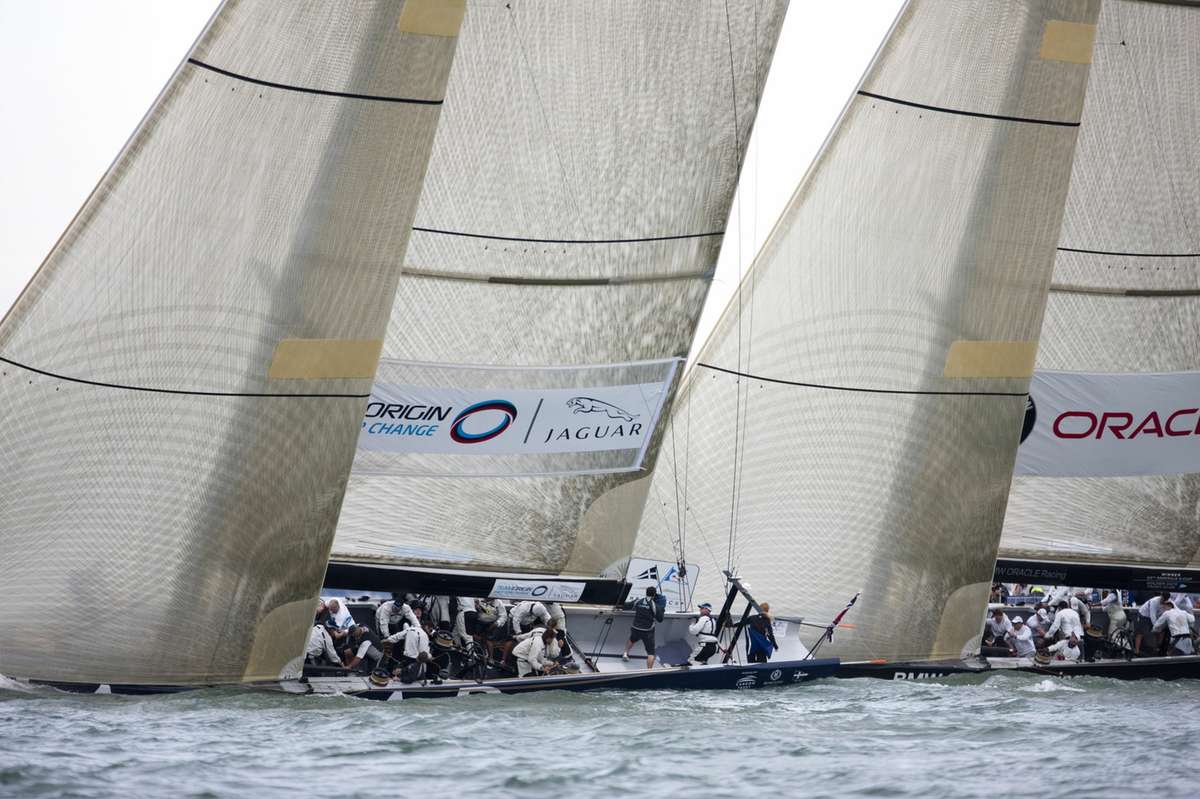
For me it represented the most complete racing I experienced in the International America’s Cup Class. After two decades of development the boats were highly refined, and small tactical advantages translated directly into control of the race.
Observing the series from ashore was Russell Coutts, CEO of Oracle Team USA, which added an additional layer of significance given his history in the event.
Looking back, it was a brief but important moment: a meeting of the current Cup holders and a British campaign with genuine depth, racing traditional match-racing yachts on the same stretch of water where the competition began.
There is a strong argument that when you put sailors from Alinghi, Emirates Team New Zealand and Oracle Team USA into the IACC boats alongside a young British cohort, you got some of the best racing the class ever produced. It didn’t carry the consequence of a Cup match, but as a pure showcase of that style of sailing it was exceptional.
And yet, just two miles to the west off the Green by the Royal Yacht Squadron, the Extreme Sailing Series was rewriting the script. Forty-foot cats, six races in 90 minutes, music, commentary, grandstands, VIP hospitality, and thousands of Cowes Week sailors drifting up from the beer tents to watch ‘stadium racing’ before we even had a name for it. The contrast could not have been sharper: 25-tonne displacement match racers refined over two decades versus lightweight catamarans sprinting metres from the shoreline.
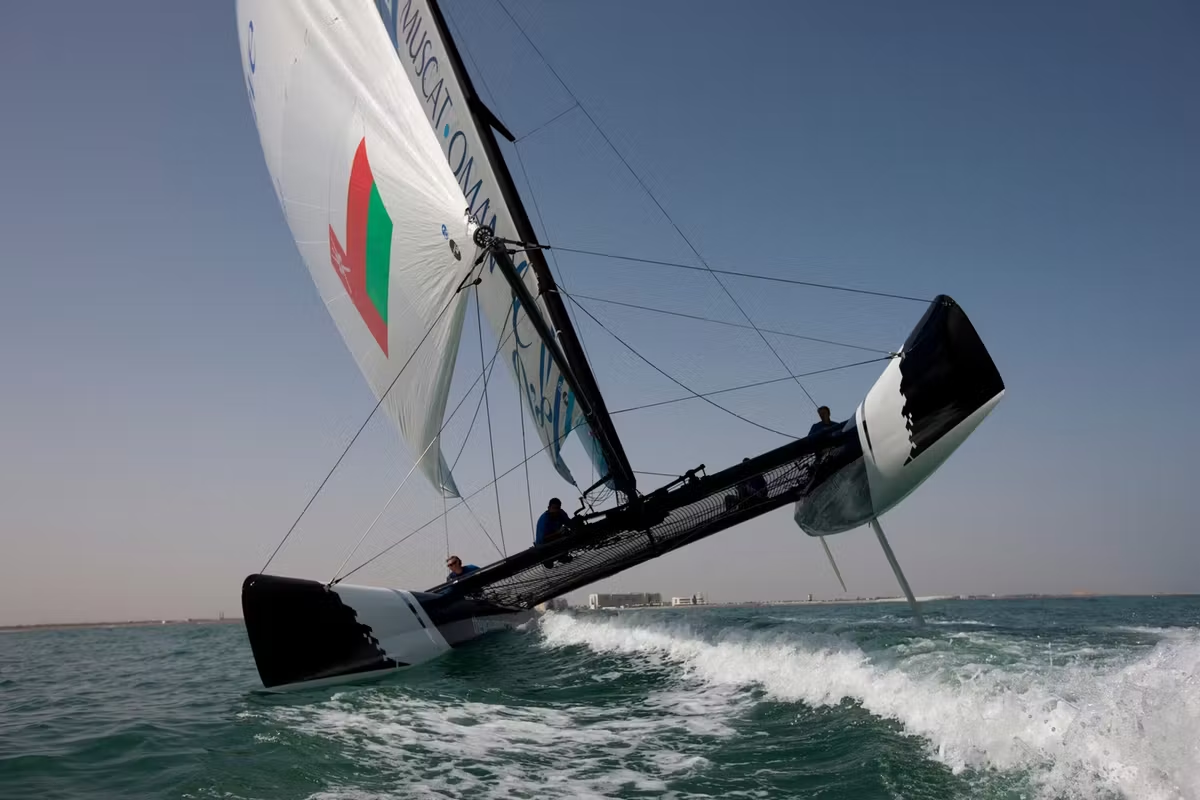
That week I was living in both worlds – racing IACC with Team Origin and lining up with the X40 for Oman Sail under offshore legend Loïck Peyron. In the space of a few days you could feel the centre of gravity shifting. The grandeur and tactical depth of traditional match racing was still unmatched, but the shoreline energy, accessibility and broadcast appeal of the cats were pulling a different, bigger audience.
It’s hard to believe that Russell Coutts didn’t notice the same thing. As Defender with Oracle Team USA he held the levers of the next Cup cycle, and six months later the AC45 was launched in Auckland. For the first time – outside the Deed of Gift anomaly – the America’s Cup proper moved into catamarans. By 2013, driven largely by Emirates Team New Zealand, those cats were foiling and the sport had fundamentally changed.
Bermuda 2017
The second hinge came before Bermuda. Five of the six teams signed the Framework Agreement – Great Britain, USA, Japan, France and Sweden – while Emirates Team New Zealand pointedly did not. No pen, no photo, and a very public dispute with the event authority over funding, venues and a mid-cycle class rule change. On paper the framework promised exactly what challengers had always lacked: a predictable calendar, cost control, a rolling world series and commercial continuity. Sensible, stable, sponsor-friendly – and almost completely at odds with the Cup’s historic volatility.
Then came the racing in Bermuda. ETNZ turned up with leg power, faster foils and a control system the others simply couldn’t match, and beat Oracle Team USA 7–1 in The Match. The framework collapsed with the result.
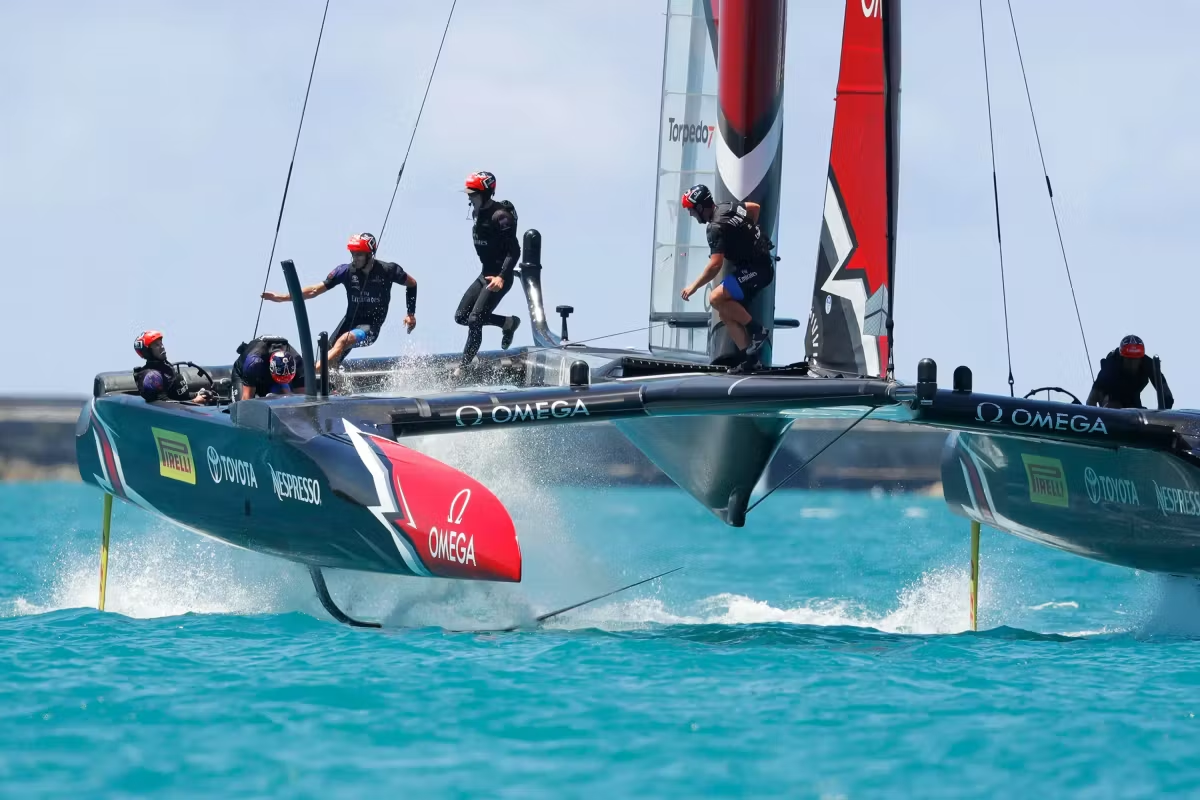
Out of that collapse, Russell Coutts and Larry Ellison doubled down on the league concept and created SailGP – effectively the Framework Agreement without the Cup. Meanwhile ETNZ, as new Defender, pivoted back to a ‘monohull’ aesthetic that was anything but traditional: a foiling 75-footer capable of 50 knots.
So here we are in 2026. SailGP is thriving on the very logic the framework tried to codify – short courses, tight schedules, broadcast certainty – while the America’s Cup has, for the first time, entered a partnership structure that looks suspiciously like a framework of its own, but has found a place to move to another level.
Two race courses in one Cowes week: one showing the pinnacle of what the sport had been, the other previewing what it was about to become.
A week that changed the sport.
Articles You Might Be Interested in
Spain’s Los Gallos head the fleet after day one in Sydney
Sydney SailGP preview: Could twilight racing around Shark Island shake things up?
Lightning threat calls off SailGP practice – again
Tom 'Mozzy' Morris: SailGP's Auckland safety review doesn't add up
'The safest is when you're pushing hard' - Billy Gooderham explains flight control
Jury verdict: Black Foils pushed too hard before Auckland crash
Podcast Ep. 8 - Sydney SailGP preview + Quentin Delapierre on safety
SailGP fixes split-fleet scoring mess