Jury verdict: Black Foils pushed too hard before Auckland crash

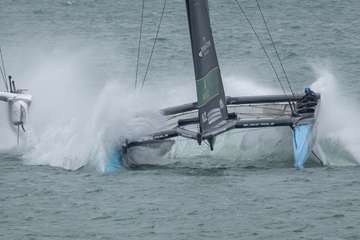
The Black Foils could have sailed their F50 more conservatively in order to avoid the loss of control that resulted in the collision with the French team at the Auckland SailGP Grand Prix earlier this month.
That’s the broad conclusion from a hearing held by a five-person International Jury last Thursday.
The verdict
The third paragraph of the International Jury’s Conclusion reads:
“Since all the teams, including NZL, were aware of the consequences of reaching the board protection limit, it was possible for NZL to have avoided passing that threshold by choosing a lower ride height and with less foil cant angle. The choice of ride height and foil cant angle is under the control of a boat and so it was reasonably possible for NZL to avoid the loss of control, and hence the contact, and therefore she broke rule 14 [Avoiding Contact].”
The Conclusion statement continues:
“Once the boats were on a collision course, there was no action that FRA could have taken to prevent the collision hence it was not reasonably possible for FRA to avoid the contact and therefore she did not break rule 14.”
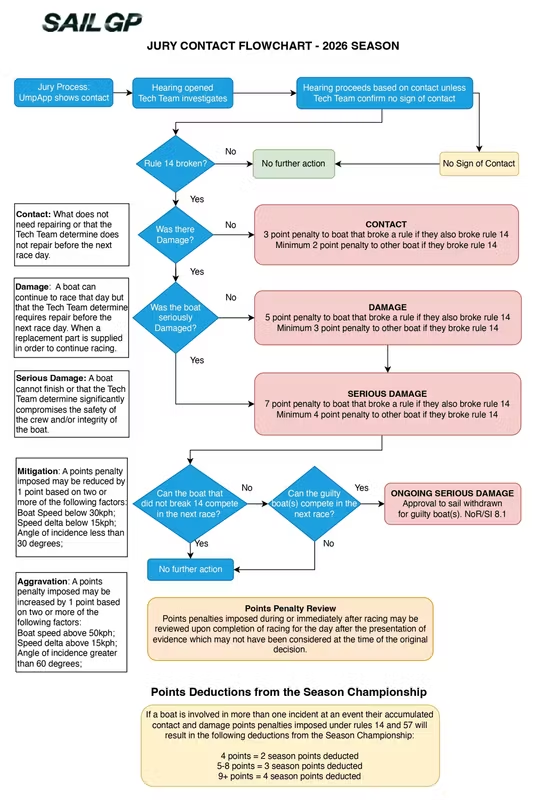
The Foil has asked the New Zealand team for a response to the findings, but clearly it will come as a huge disappointment to Peter Burling and his crew. After receiving an 8-point penalty (7 penalty points for serious damage and 1 additional point for aggravating* factors) from the incident, the Black Foils had requested a penalty points review. So the Jury opened a hearing to hear further evidence from the parties and consider whether the original decision should be changed. The Jury called in three technical experts from SailGP staff and New Zealand called witnesses from four other international teams.
The critical detail
In the Facts found from the incident, the Jury’s statement lays out the circumstances that led up to the collision as well as recording the damage to both boats and the injuries suffered by the sailors. However, it’s the final sentence in the Facts which reveals information not known to the wider world:
“Other teams sailed along the reach with reduced ride height to avoid being as close to the edge of control.”
Without seeing the comparative data for ourselves, we have to assume that the data centrally held in SailGP’s Oracle Cloud does indeed reveal a difference in ride height between the teams. It would be a surprise if there weren’t a difference. Quite often the best flight controllers are praised for being able to take the F50 to that high-riding sweet spot which generates the least drag resistance and therefore the fastest speed; but also takes them closer to the edge of control. Usually, going beyond the edge of control does not result in catastrophic consequences. But on this occasion, in the gusty, unpredictable breeze blowing off the high-rise skyline of downtown Auckland, it did.
That line in bold above, listed in the ‘Facts’, clearly shows that the Jury believes New Zealand had a choice about how to sail the boat.
Learning on the job
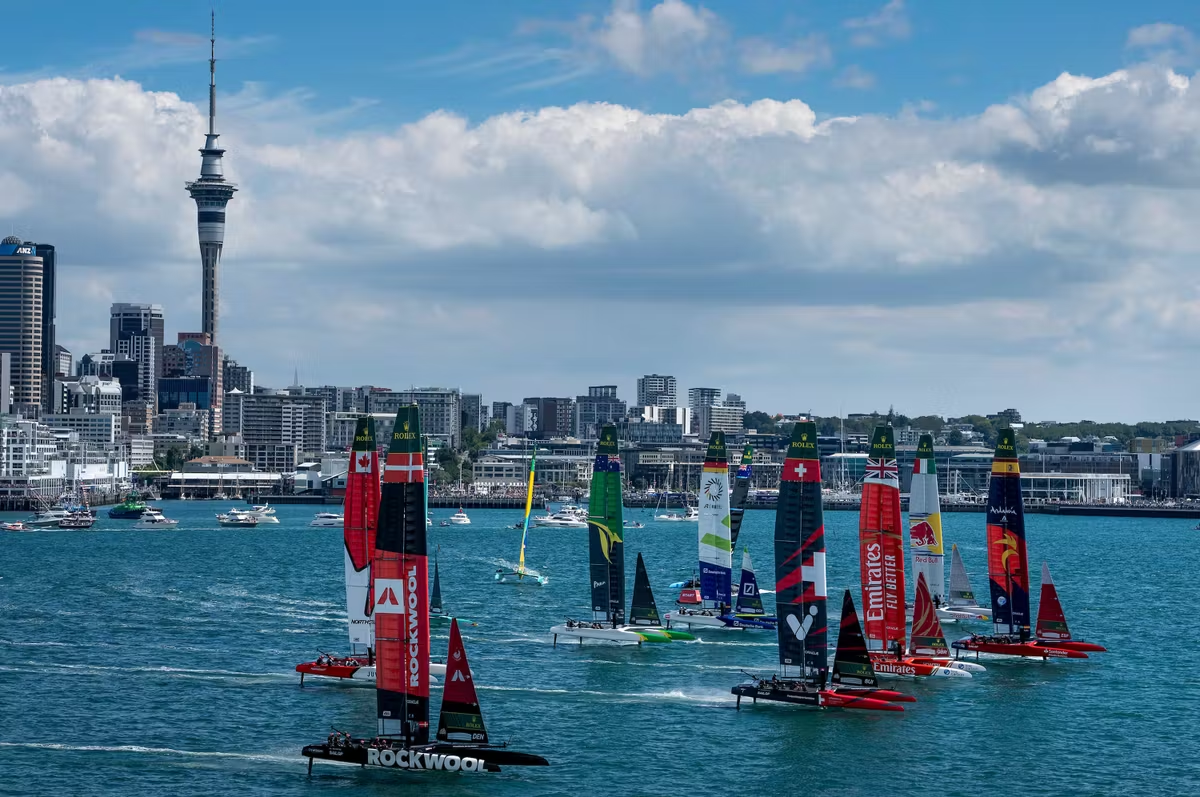
However, the final paragraph in the ‘Facts’ also offers some mitigating factors. SailGP is such a fast-moving league – not just the speed of the boats on the water – but in every aspect. Everyone – the sailors and their colleagues on all 13 teams, SailGP’s in-house engineers, boat builders, technical experts, the race management, umpires and jury – are all having to learn and develop at an incredible rate.
With training time on the F50s extremely limited, the sailors are learning their craft in the red mist of close-quarters combat. The final paragraph in the ‘Facts’ reads:
“The board protection limit, limits the board rake and hence the angle of attack of the foil based on boatspeed and a pre-defined calculated downward load on the foil currently set at 2 tonnes. This limit was increased from 1 tonne following feedback from teams on the behaviour of the boat during mark rounding manoeuvres. The systems team provides regular updates to the foil control system logic working with teams to identify improvements based on any issues encountered by boats while sailing.”
How any team manages to keep up with those significant updates and explore the subsequent changes to the behaviour of the F50 is another matter. Staying fully on top of the ever-changing handling characteristics of the boat must be enormously challenging. More and more, those of us who have never sailed an F50 are beginning to gain a greater insight into the critical interplay, telepathy, the depth of trust and understanding that it requires between the six crew members to keep the boat moving at speed whilst staying within the limits of control.
Teams must own the risk
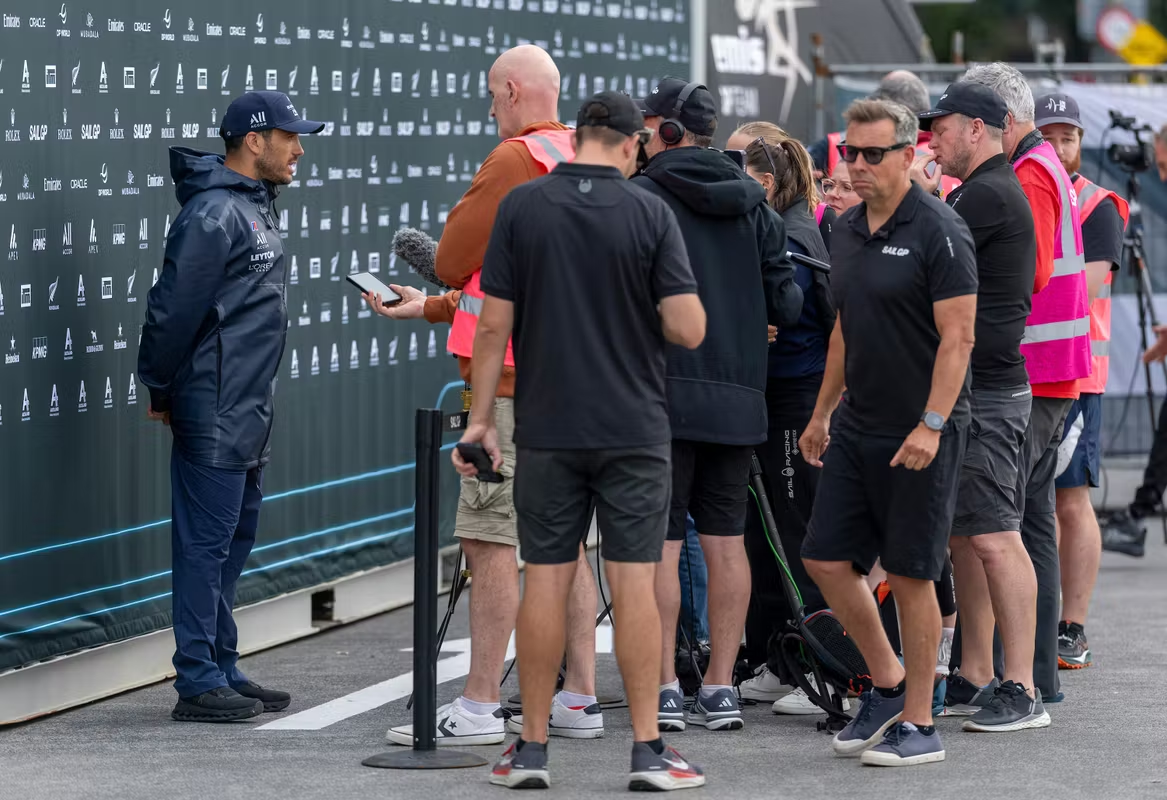
To the teams, the following statement from the ‘Facts’ is only telling the teams what they already know: “All teams are aware of the board protection limit within the logic of the foil control system and that once an F50 starts slipping to leeward there can be a reduction in the effectiveness of control inputs from the flight controller. Choosing to sail at a lower ride height and/or foil cant angle mitigates against hitting the board protection limit and the possibility of a reduction in control.”
Even if this is a statement of the bleeding obvious to an experienced F50 sailor, the fact that the Jury makes this statement shows that the ball is squarely back in the teams’ court. It’s up to each team how hard to push the boat. There is no refuge in trying to blame the hardware or software that is centrally provided and managed by SailGP.
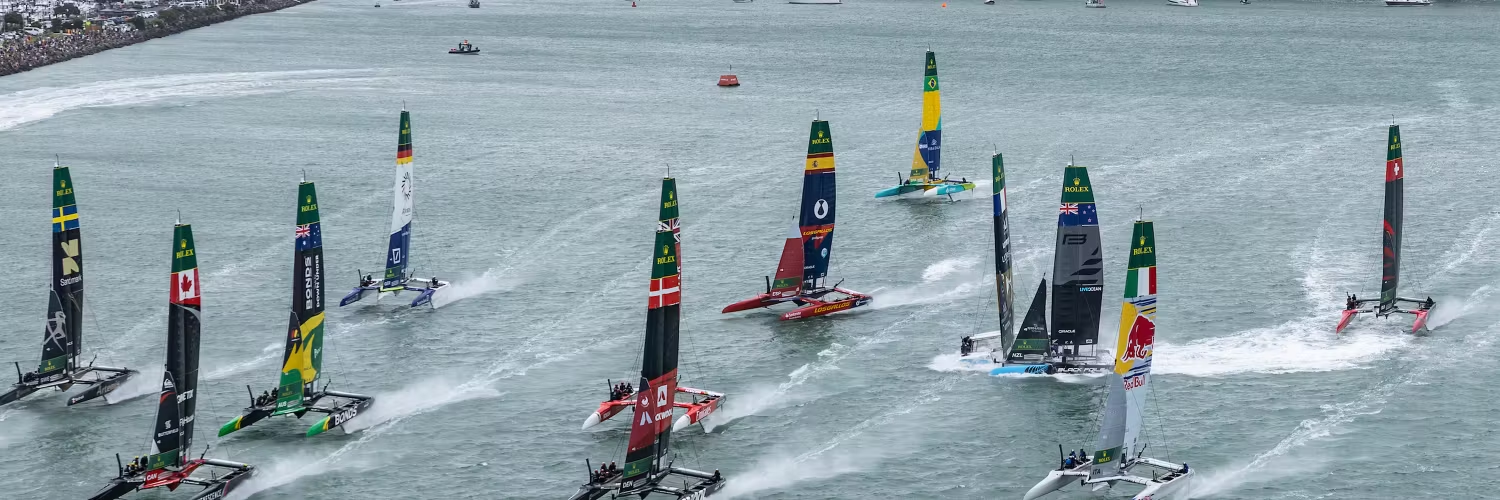
On the basis of the Jury’s findings, New Zealand suffered an avoidable loss of control. Quentin Delapierre and the French team have made no criticism of Peter Burling or anyone on the Black Foils crew. Unlike the immediate fall-out and ongoing disagreement from the port/starboard collision in Perth between New Zealand and Switzerland, there has been no war of words this time. All 13 teams know that every time they are foiling at high speed on an F50, they are riding on a knife’s edge. After the horrific collision in Auckland, the other 11 teams will be saying to themselves: “There but for the grace of God go we.”
* Aggravating factors:
A points penalty imposed may be increased by 1 point based on two or more of the following factors: Boat speed above 50kph; Speed delta above 15kph; Angle of incidence greater than 60 degrees.
Articles You Might Be Interested in
Spain’s Los Gallos head the fleet after day one in Sydney
Sydney SailGP preview: Could twilight racing around Shark Island shake things up?
Lightning threat calls off SailGP practice – again
Tom 'Mozzy' Morris: SailGP's Auckland safety review doesn't add up
'The safest is when you're pushing hard' - Billy Gooderham explains flight control
Podcast Ep. 8 - Sydney SailGP preview + Quentin Delapierre on safety
SailGP fixes split-fleet scoring mess