Tom 'Mozzy' Morris: SailGP's Auckland safety review doesn't add up

I’ve seen a race management hearing document that appears to contradict SailGP’s official safety narrative around the New Zealand–France collision in Auckland. And it also seems to back up what Pete Burling and Blair Tuke have been saying all along.
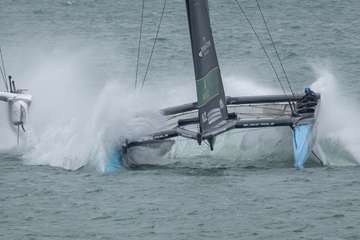
This week SailGP released their technical review of the incident that injured two sailors. In it, they put the blame on a chain of events: the New Zealand F50 riding too high on its foils, the leeward foil piercing the surface of the water, a rapid side slip and loss of control. SailGP’s Director of Performance Engineering Alex Reid said: “Control inputs from the flight controller were still being applied, but we believe the physics of the slide meant the boat could not be brought down in time.”
Burling and Tuke told a different story at their press briefing. Burling said “a system limit drastically escalated the situation”, restricting what the flight controller could do. Tuke added that the conditions “were well within the limits of the boat” and that the crew “were well in control in that reach until we got this slide going.”
Here’s where it gets interesting. The facts found in the hearing document completely contradict SailGP’s public account. They state that the New Zealand flight controller reduced the rake on the daggerboard “until the board protection limiter started to limit their rake control input.” It goes on: the board protection limit “limited the actions to reduce the angle of attack of the foil by the flight controller and the ride height continued to increase along with more of the foil coming out of the water, resulting in increased leeway.”
So the hearing is saying the limiter kicked in and overrode the crew’s control inputs, while the public safety review says those inputs were still being applied. Those two things cannot both be true at the same time.
The official review also states there was “no evidence of a mechanical or software failure in the systems.” But to me, that’s missing the point entirely (perhaps deliberately). Nobody is saying the system malfunctioned. The limiter did exactly what it was designed to do. It’s a protection system that limits the rake on the daggerboard to prevent a foil being dropped with too much negative lift – the kind of scenario that could pull the platform apart, like we saw with Brazil in Sassnitz last year.
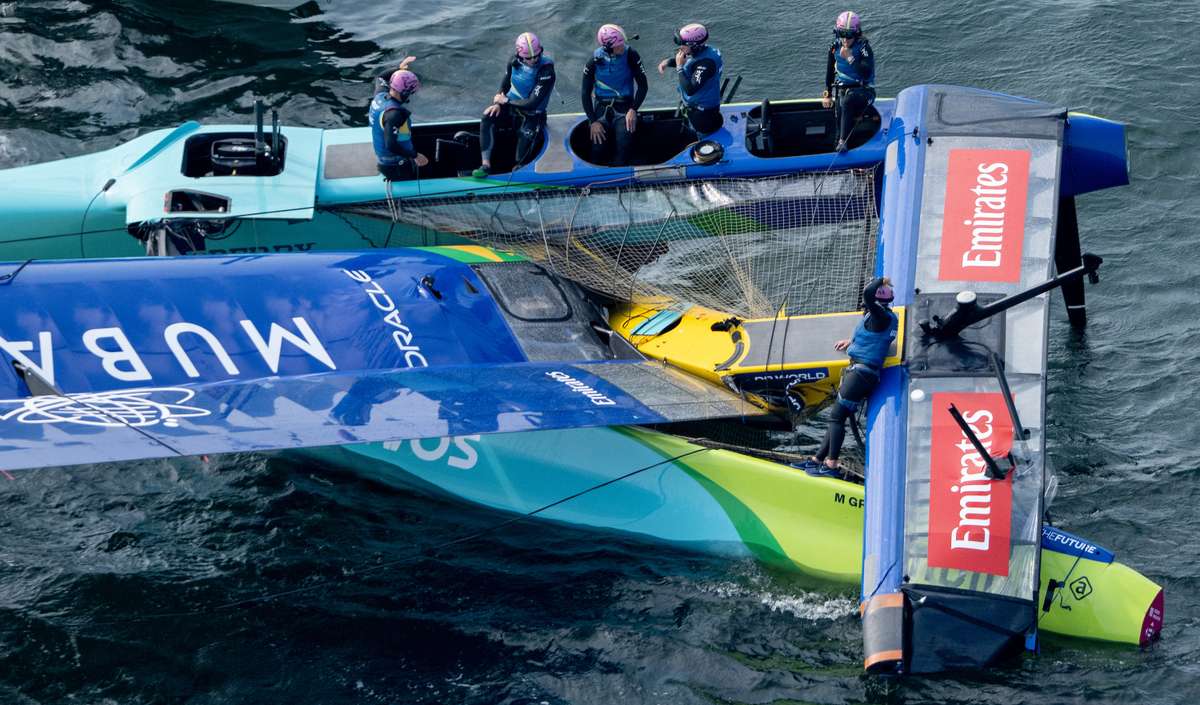
But context is key here. Why does that limiter also act on a leeward foil that is slipping sideways, where despite extreme rake angles, is never going to produce high downforce loads? Surely leeway (side slip) could be added to the board protection limit algorithm to prevent it unnecessarily limiting the crew’s ability to control the boat on what is the most dangerous leg of the course.
SailGP says it’s “assessing mitigations which could help crew better manage similar scenarios in future.” That’s good to hear. But if their own system contributed to the loss of control, that should be central to the safety review – not buried in a hearing document that the public will never see.
Articles You Might Be Interested in
Spain’s Los Gallos head the fleet after day one in Sydney
Sydney SailGP preview: Could twilight racing around Shark Island shake things up?
Lightning threat calls off SailGP practice – again
'The safest is when you're pushing hard' - Billy Gooderham explains flight control
Jury verdict: Black Foils pushed too hard before Auckland crash
Podcast Ep. 8 - Sydney SailGP preview + Quentin Delapierre on safety
SailGP fixes split-fleet scoring mess