Where's sailing's talent ladder?

“This is the Formula One of sailing.”
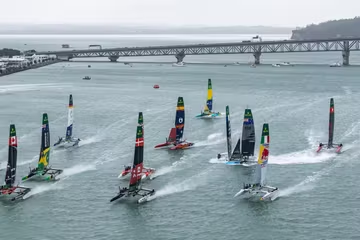
I’ve lost count of how many times that line has been wheeled out while walking guests through an America’s Cup base or hosting at a SailGP event. It’s a bit cheesy, sure – but at the very top end of the sport, it’s broadly true. On performance, budgets (well, not quite!), technology and pressure, the comparison holds up. Even so, I’m increasingly bored of saying it.
The follow-up question is almost always the same: so how do sailors get here? Until very recently, the stock answer – probably 90 per cent of the time – was Olympic success in small boats.
But the jump from a 49er or a Laser into a 75-foot foiling monohull, or a 50-foot foiling catamaran, is anything but obvious. The skillsets overlap, but they’re not linear. Which raises a bigger question: where is sailing’s version of the motorsport ladder? Where is the equivalent of single-seater racing that reliably feeds talent to the very top?
Every Formula 1 driver starts in karting. It’s where the fundamentals are learned, instincts are sharpened, and careers are built. Dinghy sailing plays a similar role – it teaches the basics better than anything else and can take you all the way to Olympic gold.
The motorsport ladder: where’s ours?
The best karters are racing internationally, and this is where F1 teams start paying attention. It’s not just about winning races – it’s about how quickly a driver learns, how they race others, and how they handle pressure. By the end of karting, most future F1 drivers are already known quantities.
The same as sailing, right? If you’re at the right end of the Olympic fleet, people are paying attention.
In motorsport, a talented karter moves into single-seaters and climbs a clearly defined ladder: Formula 4, Formula Regional, Formula 3, and then the final audition in Formula 2. By the time a driver reaches F2, the question is no longer if they can drive – it’s whether they’re ready. At the top, there are only 22 Formula 1 seats in the world. They’re brutally scarce, but the pathway to reach them is obvious, structured and well worn.
Where is the structure to jump from dinghy racing (karting) to SailGP or the America’s Cup (F1)?

The AC proving ground
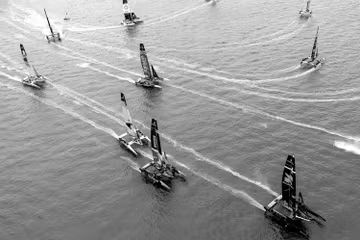
Don’t get me wrong – the America’s Cup has been trying to build a youth pathway for over a decade. In 2013, San Francisco, 12 teams raced AC45s and produced some spectacular racing. Young Pete Burling came out on top. The event was widely hailed as a success – but then we had to wait four long years for the next Youth America’s Cup in Bermuda.
In that same period, a Formula 3 driver might have done around 80 races. The contrast is brutal.
In 2017, the format returned, now in the foiling version of the AC45. The British team won, and it launched the career of Neil Hunter who has since competed in three America’s Cups and is a current SailGP champion. It showed that the Youth AC can really feed top-level talent – but only sporadically.
Then came the real standout: Marco Gardoni, the Italian prodigy fast-tracked by Max Sirena into senior racing in the AC40s. He made a senior match-race final on debut, then went on to win the Youth America’s Cup. His meteoric rise suggests a new model is possible – one that will see youth and women’s teams lining up against senior squads in AC40s this year. Finally, youth sailors of both genders are getting more than just a single shot every four years.
We need our own Formula 2
Could there be a SailGP 2? That would be the golden bullet.
Alongside the headline moment in Naples – all the syndicate heads on stage announcing the new America’s Cup Partnership – there’s another image that should excite sailing fans: Doug DeVos (co-founder of American Magic) and Andy Thompson (MD of SailGP) at the new High Performance Center in Pensacola.
Now imagine this: the world’s elite young sailors, not just training on simulators or in gym facilities, but also learning on an F50, upskilling every day – and crucially, racing each other in a feeder class designed to prepare them for the F50. Finally, a proper, structured ladder to the top. I don’t even believe this fleet would have to leave Pensacola. It doesn’t need to be a global tour broadcast on telly – it just needs to exist, with regular racing to bridge the gap.
F1 teams have close allegiances with F3 and F2 teams, which basically operate as junior finishing schools for talent. There’s an element of control over driver development, consistency in coaching and an ability to track performance closely before hopefully promoting the driver toF1.
Imagine a parallel in our world. For a fraction of a SailGP team’s annual budget, they could reap all the benefits that F1 gets from its lower-tier feeder series.
READ MORE: Coutts wants teams hunting for young blood

It’s not just about SailGP
A world-class academy isn’t just about producing stars at the very top; it’s also about preparing young sailors for life beyond elite sport. Even if a sailor never makes the final leap to SailGP, the skills learned racing high-speed boats on short courses set them up perfectly for the next level down – the Grand Prix yacht racing circuits – and a real career as a professional sailor.
I’m not sure the SailGP 2 class exists. I’ve had a fantastic few months racing an M32 in Miami. The style of racing feels a lot like SailGP – minus the foiling and the extreme speeds in a big breeze. Pulling ropes in anger on a small cat around a tight course has brought back memories of Extreme 40s and the AC45F (racing that defined modern sailing today), although I’m not convinced the skills you learn here would automatically translate to a SailGP weekend.
Digging out the pathway
What I do enjoy is talking to senior SailGP figures about this. Their level of ambition is extraordinary. I know the whole “pathway to the top” question is on their radar – and I wouldn’t be surprised to see them plugging this gap soon. Who knows… maybe even with a toned-down F50.
I genuinely believe the key figures at the top of world sailing are now aligning to fill the void. Soon, we won’t be trying to leap straight from a go-kart to a Formula 1 car – there will be a proper, structured pathway for the next generation of sailors.
Just imagine a few years from now, hosting a group of non-sailors at a SailGP or America’s Cup event, and someone asks: “How did the athletes get here?”
And I can answer, with genuine pride: “This is the Formula 1 of sailing – and there’s a clear pathway, just like motorsport.”

Articles You Might Be Interested in
United States master light winds for shock Sydney win
Spain’s Los Gallos head the fleet after day one in Sydney
Sydney SailGP preview: Could twilight racing around Shark Island shake things up?
Lightning threat calls off SailGP practice – again

Tom 'Mozzy' Morris: SailGP's Auckland safety review doesn't add up
'The safest is when you're pushing hard' - Billy Gooderham explains flight control
Podcast Ep. 8 - Sydney SailGP preview + Quentin Delapierre on safety
SailGP fixes split-fleet scoring mess