
One week in: Q&A with The Ocean Race Atlantic’s Niall Myant-Best

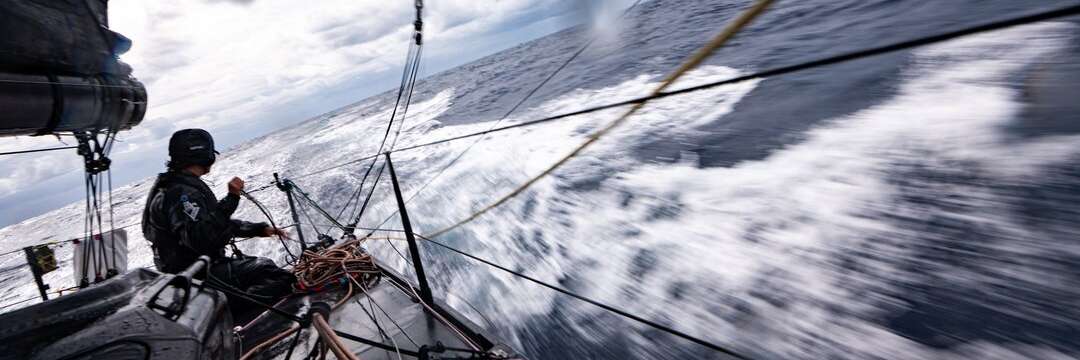
On paper the inaugural Ocean Race Atlantic looked like a quick blast east on the back of a low. In practice it has been one of the more brutal transatlantics I can remember watching.
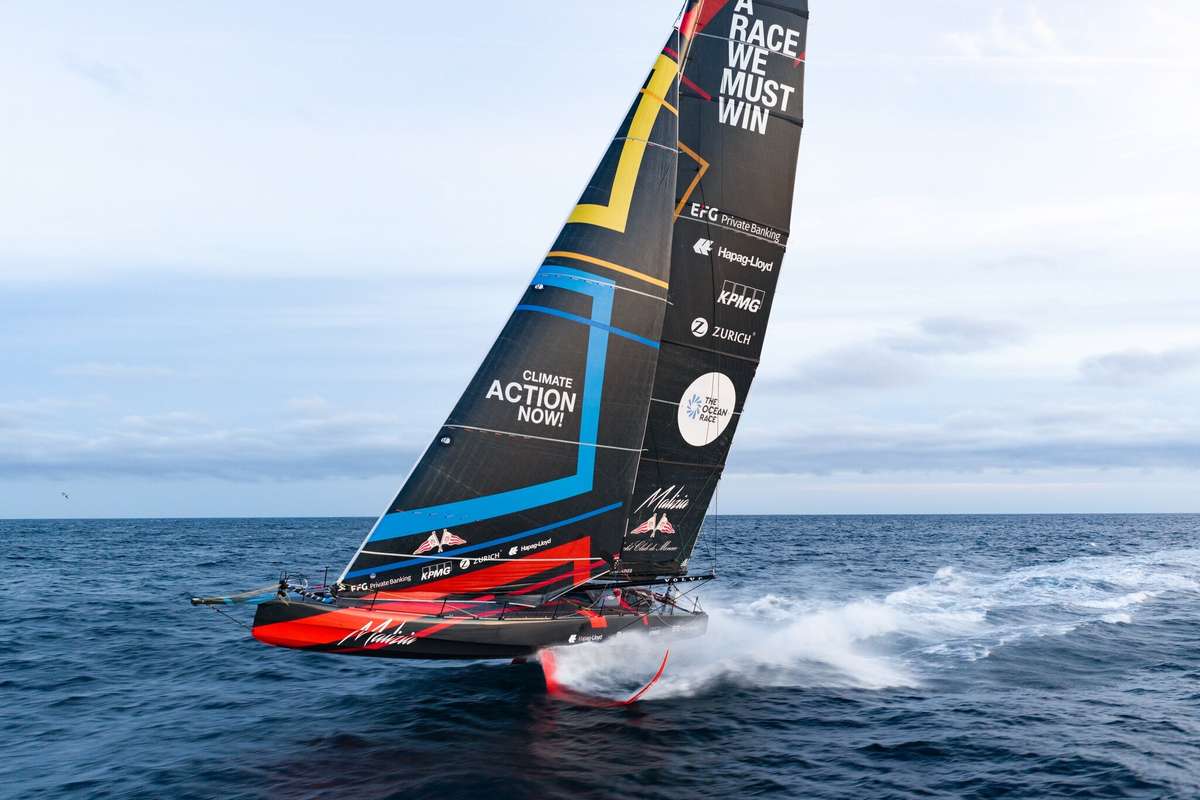
Team Malizia led from the gun and looked like the quickest boat out there – until Boris Herrmann's crew hit something at speed. The impact tore a pneumatic ram off its mounting and killed trim control on the port foil, and with a ballast tank leak to sort out as well, Malizia 4 gave up 55.7 miles in a day and slid from first to fourth.
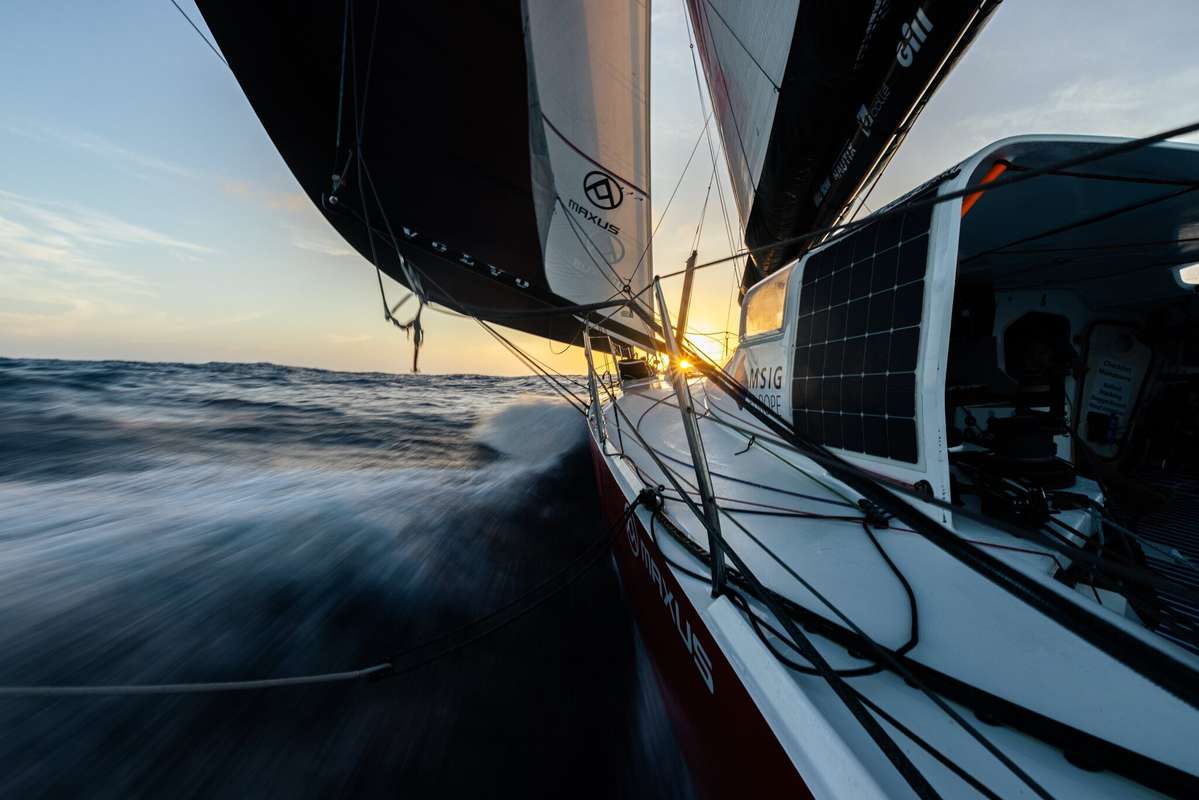
That put Francesca Clapcich's 11th Hour Racing in front – the old Malizia – still the holder of the 641-mile 24-hour record set in that very hull. Then DMG MORI Global One came through. By Monday lunchtime Kojiro Shiraishi's crew led with 1,203 miles to run, United By The Ocean and 11th Hour Racing inside 11 miles of them, all three grinding upwind towards a ridge of high pressure parked square across the road to Lorient. Further back, Oliver Heer's Embrace the Challenge was nursing a badly damaged mainsail and Conrad Colman's non-foiling MSIG Europe was hoping the weather would turn in their favour.
Plenty to unpick, so on Tuesday afternoon I caught up with Niall Myant-Best, host of The Ocean Race Atlantic, from race HQ in Alicante.
Niall, we're just about a week into The Ocean Race Atlantic. What do you know now that you didn't know a week ago?
I would say the biggest thing that we have seen in this race so far is how quickly your luck can turn, as in if you get a breakage or something like that. But in terms of the boats and in terms of the technical side, it's a reminder of how much a couple of degrees change in the wind angle or the sea state, how much that has a massive effect on what we can be expecting to see from the boats.
I am certainly a little bit disappointed in terms of the speeds that we've seen the boats go. We've got a great race and it's really tight, but part of me wanted to see that 24-hour run, see those numbers notch up. But with the sea state that we've been having, which has been a little rough and a little too on the nose, it has just been holding everybody back.
What's the best 24-hour run we've seen?
I think the best that we've had was 11th Hour Racing: 547 maybe, a slightly unofficial number! And that's a really good run. It wasn't that long ago that you'd be patting yourself on the back and thinking, wow, how far the technology has come. But we know that they can do better than that. There is still a little bit of a possibility that we might see some peak speeds as we get a little bit closer to the top of the Bay of Biscay, Ushant, heading into Europe, because they'll have another big blow of the breeze and it'll be at a better angle.
But I don't think they’re going to be riding that long enough to get a good 24-hour run. So really good speed, but no one's been fully flat out for that 24 hours to give us a perfect run. It's just a reminder that the boats are good, the sailors are good, but you just need that weather to play ball perfectly as well.
Which one would you take round the world?
I know that we haven't seen all conditions yet, but it looks like by the end of this trip from New York to Lorient, this might have been a pretty good all-round test. Based on what you've seen so far, which of these boats would you pick to take around the world for The Ocean Race in January?
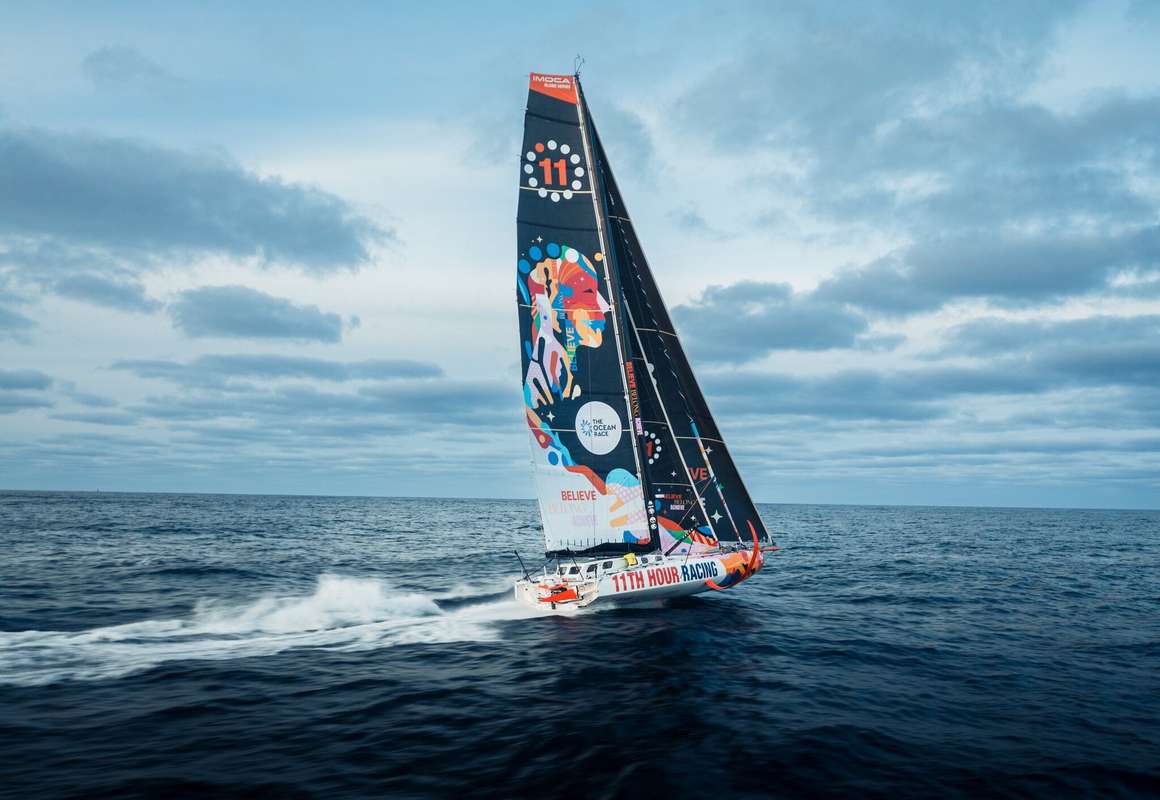
I'll give you my personal answer and then I'll give you my commentary answer, if you like. So my personal answer will be exactly the same answer that it has always been, which is 11th Hour Racing, the old Malizia, because it is a boat that was designed by Boris Herrmann, basically turning around to the designers and saying, ‘It's great that you can make these boats go really fast, but I can't get a good night's sleep. I can't eat anything. I can't rest. I can't recover. So I'm fast for the first week, and then I'm hanging on for grim death for the rest of the race.’ And that one still remains the boat that you can stand up, you can stretch. The whole thing has been geared to be Livable with a capital L.
The boat that I would pick in order to perform is a really hard one. Let's just assume that if one of the sailors were crazy enough to give me the boat, they would give me the most important piece of the entire puzzle, which is the book – or more likely the data file on a USB stick – which told me exactly what sails to put up, how to tune the autopilot, the settings that are so well guarded. If I had that for every single boat, I would say that obviously 11th Hour Racing has been proving their worth, but I think some of that was tactical.
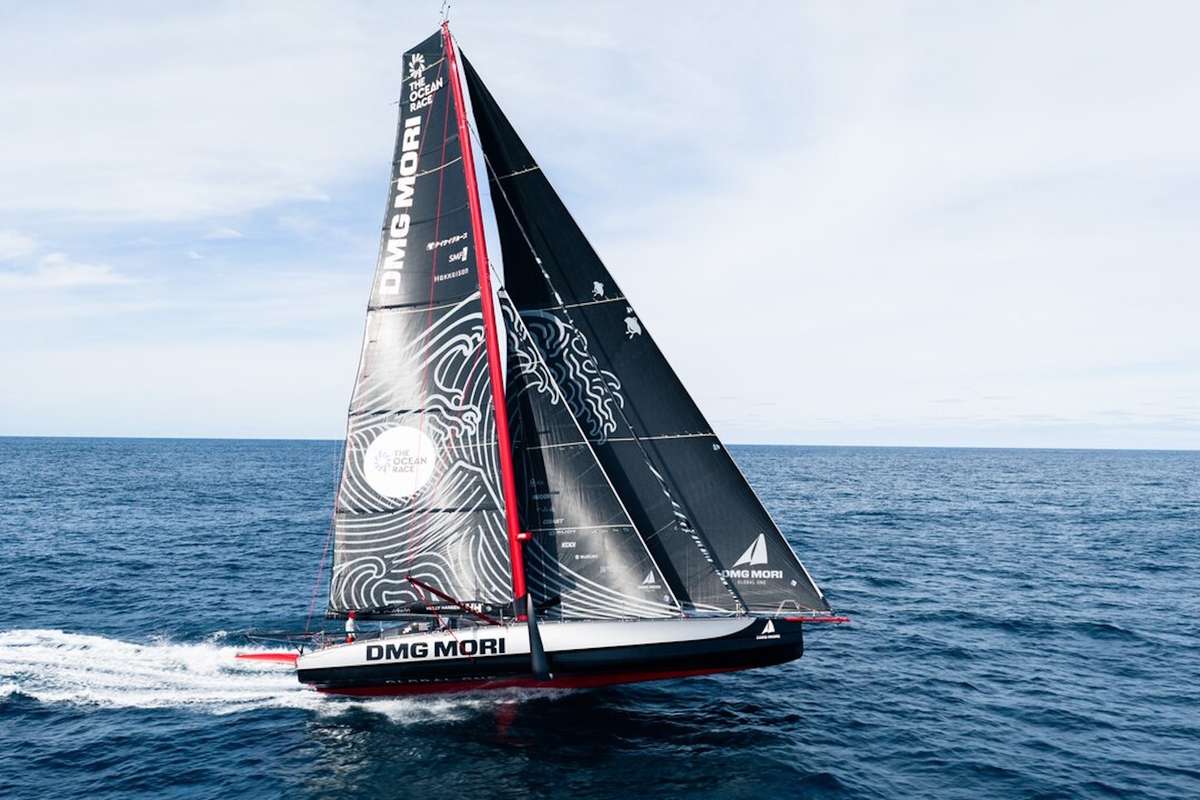
I think that the new Malizia boat is clearly really fast, but at the moment we haven't seen anywhere near its full potential with those foil damages. They struck something under the water, now they can't tune their foils, so they're still in it, which is really impressive considering they are unable to tune their foil rake. But I would still go for DMG MORI Global One. They are slowly, steadily working their way through; they're in the lead at the moment. Whether that holds is going to be weather and strategic. But I just think that that boat has got the biggest room to grow. But then, hey, what do I know?
Top speed isn't everything
Horses for courses, that's what it's always about with the IMOCAs. Where broadly would you put those three boats that you've talked about just then?
I think that 11th Hour Racing, Francesca Clapcich's boat, was always built to excel at the average speed. Whenever you go and watch any of the videos of the IMOCAs, they're always up on their foils flying along. And then the video has lots of cuts in it. No shot is longer than eight seconds. That's curious. Well, it's because they just keep nosediving. So you get these incredible speeds and then these incredible decelerations, and then incredibly up and incredibly down.
11th Hour Racing, the old Malizia, was always saying, ‘We're not going to be as fast as you on the peaks, but we'll be better than you on average.’ So I still think that that boat has proven that you can take a big hit on peak speed, but you win it all back in terms of crew freshness and steady, average, reliable stuff. If we had had a good, solid, downwind, lumpy sea state, I think that boat would have really been able to stretch ahead.
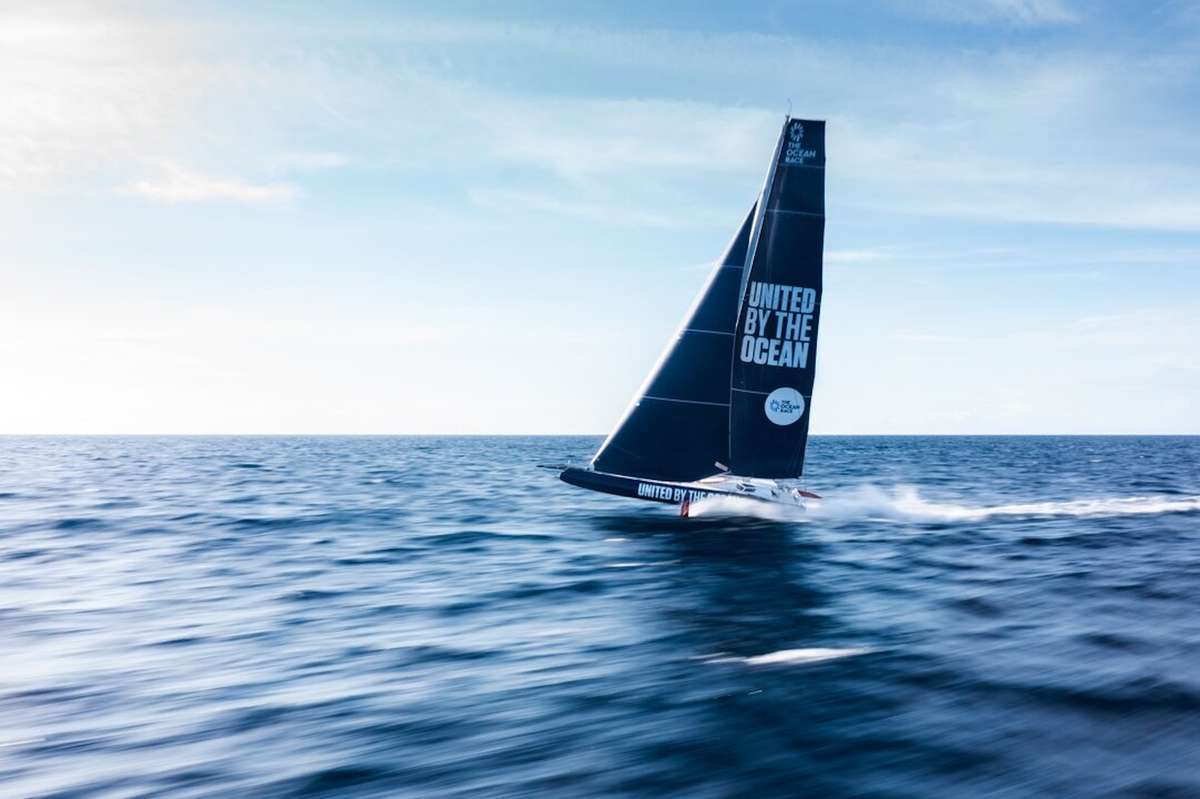
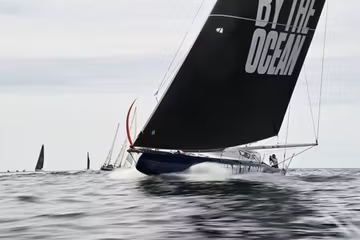
There's no doubt about it that United By The Ocean is really happy in the flat water, wind behind, and we had a glimpse of it. They sent back some incredible drone footage of them foiling fully on the keel, and then it must have been the last 20-centimetre-squared strip of the leeward side of the stern just kissing the water and gliding perfectly.
I think that the new Malizia and DMG MORI are a little bit more rounded. Particularly, I'd say DMG MORI Global One. It's got a double chine on the hull, it's got a decent bit of volume at the front to recover from those nosedives, or at least bounce out before it gets a bit too savage. I think the new Malizia hull and DMG MORI Global One would be boats that would handle a variety of conditions a little bit better, with United By The Ocean coming through in the flat and 11th Hour Racing coming through when it's lumpy and you just need something to smash your way through.
Light airs, big percentages
I think I've heard people talk about the bustle as being great as long as the boat is moving, but going through a doldrums, is that where potentially the bustle might be the biggest point of drag?
Yeah, I think that's absolutely true. The only thing that I would say is that when you get the boat perfectly balanced, perfectly ripping along, all those balance points that you've come in with – getting the weight in a particular point and the foils in a particular point, being able to use that – which I imagine is a really enjoyable state for a yacht designer to imagine and to work in, I think that's when the yacht design really comes through.
But there's always that thing in the doldrums that you might have one hull that's a bit more sticky, and I think DMG MORI Global One is possibly that boat. Realistically, I think when you get down to that light wind and you come down to the doldrums, it is going to be about being able to trim, concentrate, and adjust on the smallest of puffs of wind. If you're out there in 25 knots and suddenly there's a gust and it hits 26 knots, you don't really need to do anything. But if you're out there in the doldrums and it's blowing three knots and then suddenly it goes to four knots, in terms of percentage, that's a massive rise. Suddenly everything needs to be adjusted.
So I think that when it gets to those really light conditions, it's all about the sailors and it's all about the sail choice. We saw that because the old Team Malizia hull, what is now 11th Hour Racing, before the last round-the-world, the team was saying, ‘Let's get rid of some weight and let's change this and let's change that.’ And they have done that. I think they took 100+ kilos out of the keel after the race. They're constantly trying to make it lighter, but it's not as if the boat completely wallowed when it was in that light wind stuff, because the biggest thing that makes a difference when you're down there is the sailor's concentration. That's my opinion anyway.
Comfort as a design decision
Taking a boat round the world, you mentioned the old Malizia, now 11th Hour Racing, would be the one that would keep you freshest and most comfortable. Do you get any sense of regret from Boris Herrmann and his team, how much comfort have they given up on the new Malizia 4 compared with the old Malizia 3?
It's a really interesting question. And I can guarantee you that there will have been some time in the last couple of days where Boris Herrmann would have been sitting there going, ‘I wonder what the ride's like on my old boat, and is it any better than this?’ Only because the ride was so horrendous for everybody.
But it's not the same as trading in your car or making a snap decision on what clothes you're going to wear that night. This was a design process that has taken a huge amount of time: mock-ups, cockpits, hulls. You're living, whether it's either on the drawing board virtually or in some on-land mock-up, you're living all those ergonomics and those corners and everything, and you've done so long in your old boat that you know all the bits of it that didn't work, all the bits that you compromised, so I think it was a fully formed opinion.
That being said, the biggest thing for me – and I'm not just going to level this at Boris Herrmann, but I think the biggest thing for me, which still strikes me as quite strange – is that we do not have any backward-facing seats as standard. I remember Yoann Richomme on Paprec Arkéa had a seat that could fully swivel around, and it often was fully swivelled around facing to the back, because with the slamming and the nosediving, you get chucked forward. In exactly the same way in a lot of planes where essentially we might need to protect you from turbulence or the worst, we see that quite a bit in the IMOCAs. The worst one for me is when you see people perched on a little seat that folds down from the side and they're sat there, and if anything were to happen, they were essentially to fly forward.
That's what they have on 11th Hour Racing, they don't have a big seat. It's a very open working cockpit. It's interesting to see on the new Malizia, there are some very nice padded seats. I wonder whether that was something where you say, ‘Standing up is great. Really nice living quarters, all of that. But actually, now that the speeds we're reaching have got even more extreme than last time, I need to be packed in, nestled in. I need to be able to turn around. Essentially, if we go from 35 knots to two knots, my cushioning seat is just going to hold me. I'm not going to fly into a bulkhead.’ And we have seen that. We have seen people fly into bulkheads, breaking arms and coming out much the worse.
So there's comfort for sure that I think Boris has probably given up, but maybe what he's realised is that, ‘It's lovely to stretch, it's lovely to stand, it's lovely to move, but I need to also think about having a lower, wide enough cockpit so I can put a nice big chair in and then I can be sleeping and safe when I'm by myself.’ So there are so many different ways to look at that.
No cherry-picking
Anyone who would know the importance of that, I imagine it would be Francesca Clapcich, because she would have been on board 11th Hour Racing during the transatlantic leg of the last race when the boat did hit a submerged object. I'm trying to remember if it was a whale or something else, but do you remember that? There were a couple of really bad injuries on board.
There was. That wasn't Francesca Clapcich. She was part of that team, but she wasn't on board for that one. It was Marie Riou, Simon Fisher, the late Charlie Dalin, and Charlie Enright who were on board. And that one was nasty. That's the one that always comes to my mind when we talk about the extreme of coming in, crashing in, and going from fast to a stop.
What happened to the onboard reporter, Amory Ross, who's an incredibly experienced sailor and reporter: he was sitting downstairs just casually sitting there, and when the boat crashed, he flew metres through the air, head first into a bulkhead. It's amazing that he just broke his arm and damaged his ribs, that he didn't come off a lot worse.
In order to square that circle on the design front, there are so many things that you can't just cobble together from different boats. You can't say, ‘I really like the cockpit of this boat, I really like the living quarters of this boat, we'll put them all together.’ Because the rule in the IMOCAs is essentially you have to design a hull that when you enclose it, if that hull were to flip upside down, the buoyancy that would be coming from this superstructure that is now submerged in the water would counteract the weight of the boat sitting in the water with the keel where it is. And essentially, the buoyancy would push and right itself. You have to do all sorts of calculations. In the old days, they basically used to flip the boats over and prove that it could pass this test, that it would right itself. Nowadays, they just do it on the computer, which is probably more accurate, but much more boring.
I agree, we're missing out there!
Yeah, completely. I remember seeing those videos and those photos of boats flipping over and being a young sailor thinking, ‘What are you doing?’ But now I understand.
But what it means is you can't just say, ‘I'm going to put more weight on the bottom without also doing something to the superstructure.’ And likewise, you can't say, ‘I'll just put some superstructure on the top, but now I'm not going to touch anything on the bottom.’ One thing goes hand in hand with the other. And there are all sorts of ways that the rules, like any good yacht design rule, weave in and out of themselves.
The reason that some of the boats are so different and some of them have the opportunities to be very comfort-focused, safety-focused, speed-focused, or windage-focused, might be because that's the way they went, but it might also be because they made a decision with the weight and the keel and the foil positions, and the knock-on effect is you've got to have your coachroof this high; you can't have it lower.
Some of the boats do interesting things to try and get around this. Team Malizia, with their old boat that is now 11th Hour Racing, wanted to take some weight out of the keel, like I said, over 100 kilos. Well, if you do that, and the boat inverts, you've got 100 kilos less at that leverage point to right the boat back up. So what do you do? Basically what they did was they referred to it affectionately as the Oppy, but they made a big white GRP box that mounted onto the deck just forward of the mast so that they had more volume there. Then when they inverted, God forbid, there would be enough buoyancy from that volume to counteract the loss of the 100 kilos.
You see these things on the deck and you think, ‘Wow, what's that?’ They've taken lead out of their bulb. You can't just design the perfect IMOCA. No one knows where that is. All of it is compromise, and so much of it is based on a decision that you made two years ago about how much weight you wanted or the size of one thing or the position of one winch. It knocks all the way through the design.
Playing the long game
Now I've asked you things I want to know about – what haven't I asked you about that you're dying to tell me?
I think the interesting thing for me, having followed this race, is the different ways that the sailors are attacking things a little bit. Obviously they're all amazing racers. Some of them are Olympians, some of them have won the race before. But what's interesting to me is just those little bits of personality. We've obviously given – well, I have anyway – given DMG MORI Global One quite a lot of love. But I think it's really interesting how unassuming their overtake has been in this race. They were fourth, fifth, ‘All right, we'll do it, we'll push, no stress,’ and they just keep ploughing on.
I think that people like Sam Davies, Kojiro Shiraishi, their real heart is the long stuff, the Vendée Globe, and there are people that will do well on this, and then there are people that will do well when we get to the round the world, and they are slightly different skills, slightly different paces. So I think it's interesting just to see those little ways that those people have pushed, pushed, pushed, or whether they've just silently waited and chipped away. I think that the boat's only ever as good as the sailor who's in control of it.
So you're giving them extra points on DMG MORI for patience.
Yeah, they’re playing the long game. Look, I'm doing this from thousands of miles away and I'm probably simplifying things, but hey, that's my job, right? I think that they always seem to be just steadily getting on with the task. They don't seem to have had that much in terms of breakages, which is unbelievable. And I probably just jinxed it, right? It's unbelievable for a brand new boat. We’re talking two months old.
All those little things where you design a boat, you build the boat, you put it on the water and you realise actually there's a chafe point on that sheet or that bit's a bit loose or we needed a bit more reinforcement there – all these things that Team Malizia are going through doesn't seem to be happening at the moment for DMG MORI Global One. So that's an interesting one. I like the way that that team is just ploughing away.
The other thing that's interesting as well, and this is probably holding out a little bit too much hope, but there's just an interesting thing happening at the moment with the weather, where the four leading boats, leading by a long way, over 250 miles or so, happen to go a long way north. They are 200-plus miles off the rhumb line. They're really going a long way north to get around a high-pressure system, and a high-pressure system is moving southeast. But the two boats at the back, by the forecast anyway, by the time they get to that same point, the high-pressure system will have moved through and they'll just be able to keep on going. So I think it's a long shot to be talking about Embrace The Challenge and MSIG Europe catching up and being in contention, but I think there might be a nice bit of compression in the fleet where the two boats at the back have been given a shortcut, just luck of the gods.
So much more I want to ask you, Niall, but we're going to save that for next time. So for the time being, that has been a great update with some really good insights. Thanks so much.
Topics
Articles You Might Be Interested in
United By The Ocean edge out 11th Hour Racing to win the first Ocean Race Atlantic

Podcast: Valencia SailGP review, and does the ACP break its own rules?
The week in racing - 7 Sep ‘26
LIVE: The Ocean Race Atlantic fleet departs New York
The week in racing - 31 August ‘26
The week in racing - 17 August ‘26
How Pace took line honours in the 2026 Round Britain and Ireland Race, one chapter at a time



Member Discussion