
LIVE: SSL Gold Cup 1/16 Finals Day 1

It’s day one of the SSL Gold Cup 1/16 Finals. Eight nations come through from the 1/32 Finals, eight higher-ranked teams join them on Guanabara Bay today – defending champions Hungary among them – and only half of the 16 will still be in the competition after Golden Sunday.
Scroll down for our team-by-team guide, and stream all the racing either below or on The Foil YouTube channel. The matchboard below has every matchup and the full schedule, and results and standings can be found here.
Today’s Race 1 schedule (Rio local time / GMT / CET):
- 12:00 / 15:00 / 16:00 – Group A: Hungary, Ecuador, Estonia, Tahiti
- 13:10 / 16:10 / 17:10 – Group B: Chile, South Africa, Portugal, Malaysia
- 14:30 / 17:30 / 18:30 – Group C: Myanmar, Lithuania, Thailand, Japan
- 16:00 / 19:00 / 20:00 – Group D: Ukraine, Uruguay, Peru, Czechia
Survivors from last round
The qualifiers arrive with four days of racing on the bay. Portugal won three of their four races to top Group A, with Ukraine second. Lithuania shrugged off a black flag to win on Golden Sunday and finish level with Tahiti on 14 points in Group B, as long-time leaders Greece dropped to last. Estonia edged Malaysia by a single point in Group C, Uruguay never finished outside the top two in Group D, and Myanmar took the final spot with a last-leg win on Sunday that left them level with Oman on points and through to this round.
The new challengers
Group A
Hungary arrive as the team everyone wants to beat. Zsombor Berecz’s Shamans won the inaugural SSL Gold Cup in Gran Canaria three years ago, beating Italy, the Netherlands and Spain in the Grand Final after the Olympic silver medallist gambled on going left on the run while the rest of the fleet went right. They’re ranked only 17th in the SSL Nations Ranking, but nobody in Group A will be reading much into that.
Ecuador have about the toughest introduction going. Led by Julio Velez and ranked 38th in the world, they share Group A with the reigning champions, and the Estonian Icebreakers – who won their first two races of the last round with real authority – and a lightning-quick Tahiti crew who will want fewer mistakes this time. Ecuador trained at the SSL Training Center in Switzerland in the summer of 2025, but unlike Estonia and Tahiti, they come in without four days of racing on Guanabara Bay behind them.
Group B
Chile, led by captain Pablo Lorca, go straight into a Group B where both qualifiers have momentum. Portugal won three of their four races last week with an afterguard of Afonso Domingos and seven-time Olympian João Rodrigues, and Malaysia’s Monsoon team won their last two races to finish only a point behind Estonia.
Ian Ainslie’s South Africa complete Group B. The three-time Olympic Finn sailor has spent much of his career developing the sport at home, and his squad blends experience with a new generation of sailors, sharpened by a training camp on Lake Neuchâtel in August with David Rae on the helm.
Group C
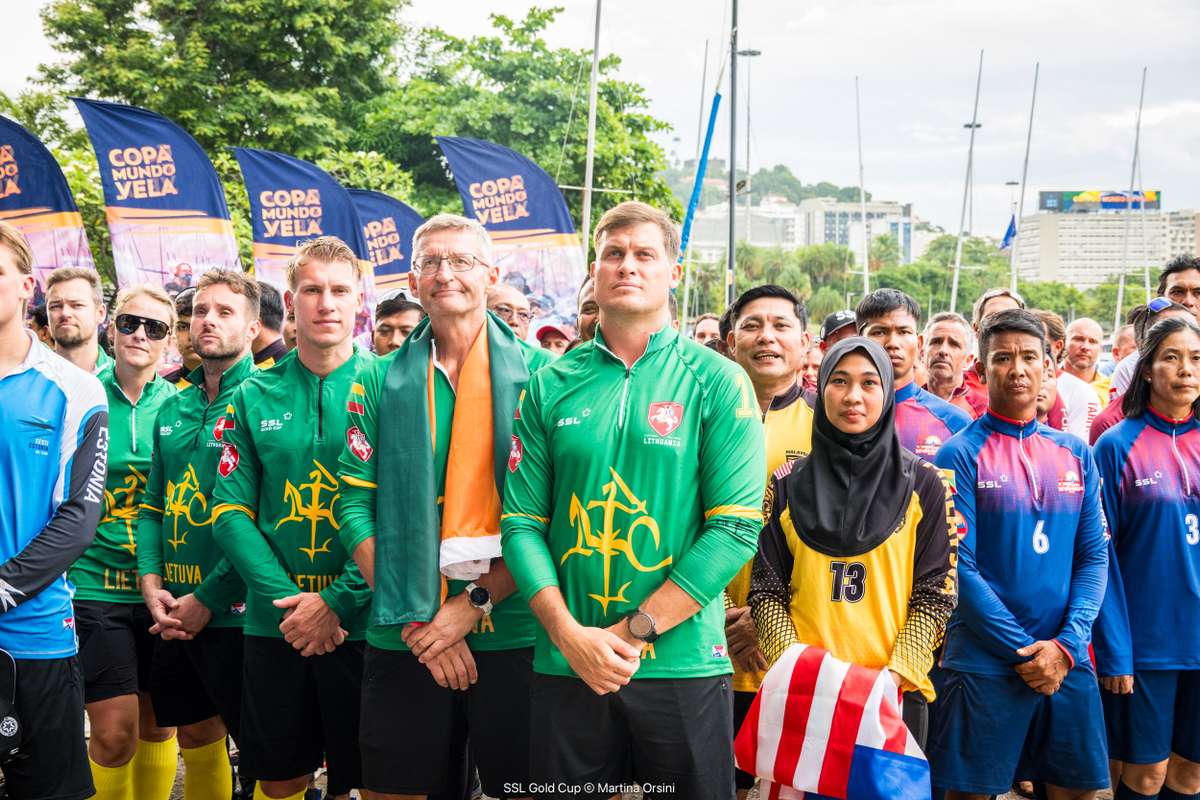
Thailand, captained by Noppakao Poonpat, hosted the Asian qualifier on the road to Rio and come into Group C as one of six Asian nations to qualify on ranking. Their rivals include Rokas Milevičius’s Lithuania, who stuttered through the opening days of the 1/32 Finals before pulling it all together on Golden Sunday.
Eiichiro Hamazaki’s Japan are the other newcomers in Group C, and they’ll be wary of Myanmar. Inya were the story of the last round, leading at the first mark twice with nothing to show for it before snatching their place on the final leg of the final race.
Group D
Peru’s Paracas Warriors face a Group D where the newcomers can’t afford a slow start. Rodion Luka’s Ukraine finished second in three races and won the other last week, and Uruguay, captained by 49er sailor Hernán Umpierre, never finished outside the top two.
The Czech Lakers, captained by Ondřej Teplý, complete the line-up. Like Peru, they’ll have to find their feet on Guanabara Bay quickly – this is not a group in which anyone will want to be staging a comeback on Sunday.
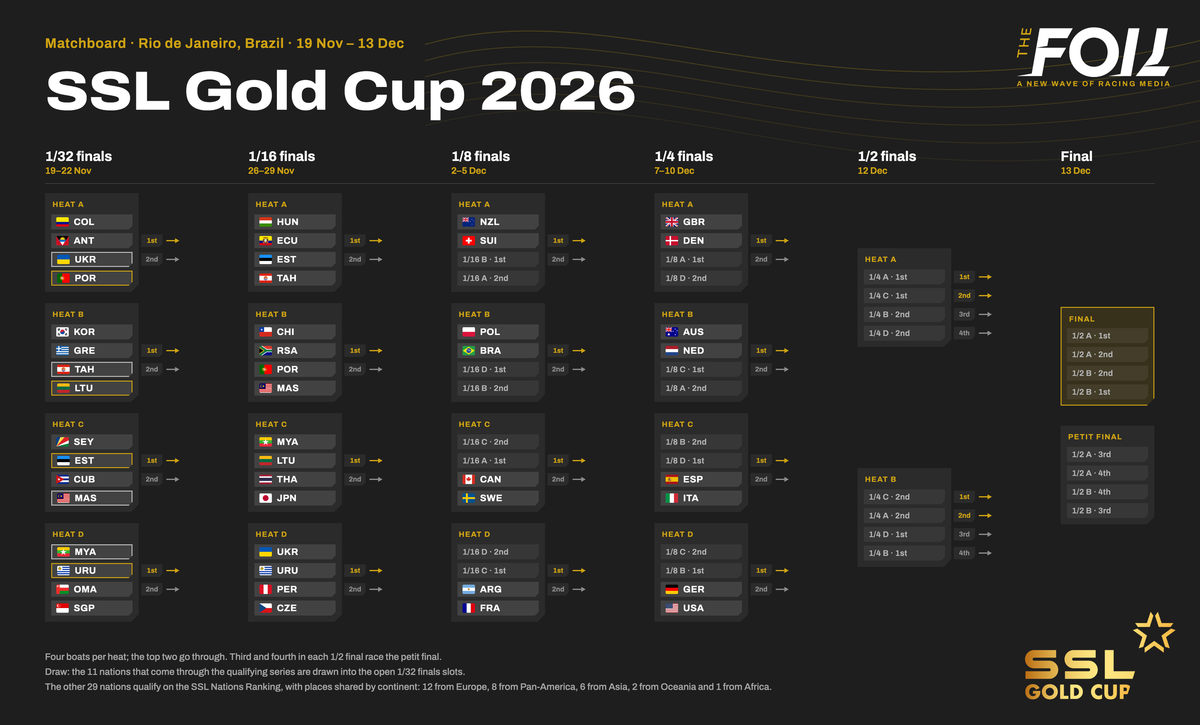
Sixteen nations are drawn into four groups of four for the 1/16 Finals: the eight qualifiers from the 1/32 Finals and eight new arrivals. Each group sails four races, one a day, and the four groups take turns on the water from midday to late afternoon. Sunday’s final race counts double, and the top two in each group go through to the 1/8 Finals, where hosts Brazil enter the competition.
SSL Gold Cup FAQ
What is the SSL Gold Cup?
It’s billed as the football World Cup of sailing. Countries race each other instead of clubs or private teams, and the winner is crowned Nations World Champion. It’s a World Sailing Special Event and this is only the second edition, after Hungary won the first in Gran Canaria in 2023. Forty nations are taking part on Guanabara Bay in Rio, 32 of them still in contention, with the Grand Final on 13 December.
Why are some nations already racing while others haven’t started?
It comes down to the SSL Nations Ranking, which scores each country on the world ranking positions of its top five skippers and top two crews. The higher a nation is ranked, the later it joins, a bit like seeding in a tennis tournament. The 16 nations in the 1/16 Finals are the eight that came through the 1/32 Finals plus eight higher-ranked nations joining for this round.
How does a team progress?
Every round is raced in groups of four boats, and the top two in each group go through. The eight nations that got through the 1/32 Finals (19–22 November) have joined eight new nations in the 1/16 Finals (26–29 November). The same happens again in the 1/8 Finals (2–5 December). The quarter-finals run from 7 to 10 December, followed by the semi-finals on 12 December and the Grand Final on 13 December. See the matchboard above.
What boats are they racing?
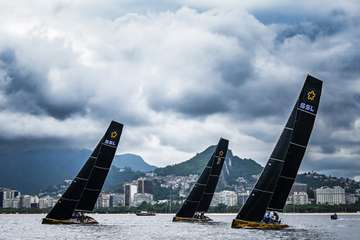
Every team races the SSL47, a 14-metre one-design keelboat adapted from the RC44. The organisers supply the boats, which are identical and stripped back with no electronics. That means results come down to crew work, tactics and boatspeed, not budget.
Who’s sailing?
Each nation has a ten-strong crew of its own sailors. The idea is to bring a country’s best sailors from across the sport onto one boat: Olympians, offshore sailors, match racers and America’s Cup sailors alongside young talent coming through.
How can I watch?
Every race is streaming live on The Foil YouTube channel. You can also watch in the player at the top of each of our live race-day articles.
Topics
Articles You Might Be Interested in
LIVE: SSL Gold Cup 1/16 Finals Day 2
The week in racing - 23 Nov ’26
How the SSL Gold Cup 1/32 Finals played out
LIVE: SSL Gold Cup 1/32 Finals Day 4
The SSL story: from Star boats to the Gold Cup
The week in racing - 16 Nov ’26
The best sailing photos of 2026: See the Pantaenius Yacht Racing Image Award shortlist



Member Discussion