
Freddie Carr: winging it at half-time in SailGP

As we reach the halfway point of SailGP season six, I thought it was the right time to dive into the form guide and put some facts behind people’s opinions on who’s good, who’s struggling, and which teams excel in different conditions and boat configurations.
I spent the past two days reviewing all seven Grands Prix so far, covering 13 days of racing, with New York day one counting as a non-racing day.
It’s safe to say my head is a little fried. It hasn’t been easy to draw any rock-solid conclusions, but there are definitely some themes that stand out.
Across the 13 race days so far, the 27.5m wing has been used five times, as has the all-purpose 24m wing, while the 18m wing has appeared on three of the windier race days.
In terms of the foils, the high-speed package has been used seven times, the light-air setup five times, and on day two in Rio we saw a hybrid configuration featuring the light-air daggerboards with the high-speed rudders.
Looking at component combinations, the joint most frequently used setup has been the high-speed foils with the 24m wing, appearing four times so far. Tied with that is the light-air boards paired with the 27.5m wing, which has also been used four times this season.
The third most common configuration is the high-speed foils with the 18m wing, which has featured three times. Surprisingly, the light-air boards with the 24m wing have only been used once this year, on the opening day in Sydney, while the hybrid foil package with the 27.5m wing in Rio on day two has also had just a single outing.
Of the six events this season that have featured two race days, leaving New York to one side, the configuration changed overnight at four of them. Only Bermuda and Auckland kept the same setup from Saturday through to Sunday.
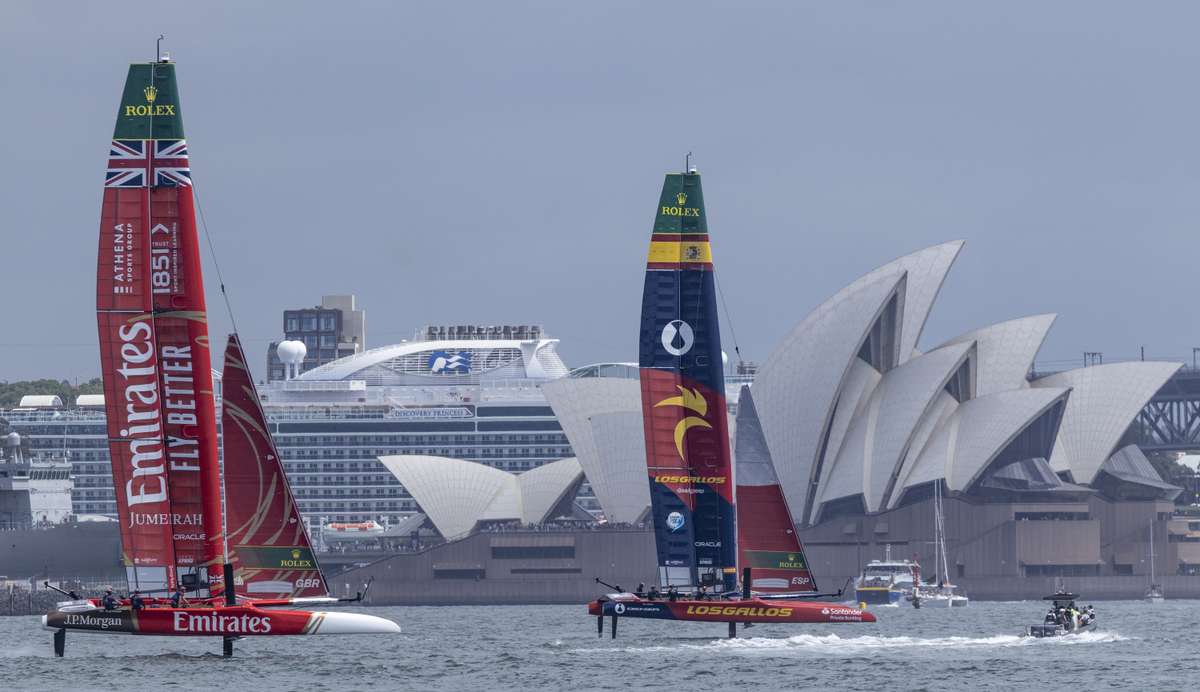
In Perth, Sydney and Rio, where the fleet switched configurations overnight, Great Britain and Germany improved on their Saturday positions in two of the three events. That suggests these teams may have a particular strength in adapting quickly to new hardware setups over the course of a race weekend.
The opposite trend appears to be true for Artemis Sweden and the USA. Both teams dropped down the leaderboard following an overnight configuration change in two of those three events. It's only a small sample size, but it does hint that adapting to new setups may not yet be one of their strongest attributes.
I then took all of this information and tried to identify teams with strengths or weaknesses in specific configurations. To say there weren't many clear patterns would be an understatement. I really don’t want to make it sound as simple as the good teams are good in every setup while the teams lower down the leaderboard struggle in all of them, but honestly that’s not far from the truth. I’m glad I spent six hours watching most of the racing back!
There are, however, a few trends I'd happily discuss in the pub, even if I wouldn't state them as fact on a live TV broadcast. When the breeze is up and we’re on the high-speed foils with the 18m wing, as we were in Perth on day two and both days in Auckland, Great Britain and Australia do an excellent job of collecting points. Across the eight races sailed in those conditions, only once did either team finish outside the top four.
Staying at the windy end of the range with the high-speed foils and the 24m wing, unsurprisingly Australia features again. To be honest, that’s just the season they’re having – you could probably include them among the top performers in every configuration.
The other team that stands out in this setup is Artemis. They had a stellar first day in Perth, winning the final two races. After missing the opening day in Bermuda, they were right at the front of the fleet on day two in the same configuration. The most recent outing for this setup came in Halifax day two, where they arguably enjoyed their best SailGP day yet, narrowly missing out to Spain in the Final. The 24m wing and high-speed foils seem to be a real sweet spot for Artemis.
Moving one step down the wind range, it's surprising that we've only seen the light-air boards with the 24m wing once, on Sydney day one. The top three that day were Spain, the Bonds Flying Roos and Artemis. I think that tells us two things. Firstly, Artemis really does love a 24m wing. Secondly, the Bonds Flying Roos simply get the job done whatever configuration race management hands them. But it was also the first sign of my theory that Spain are genuine light-board specialists.
Across the five race days where the light-air boards have been used with either the 27.5m or 24m wing, Spain have consistently been in the mix. In Sydney they dominated the qualifying races to top the fleet racing leaderboard. In Rio, where the lighter daggerboards were used all weekend, they finished second behind Tom Slingsby and Australia. Put New York to one side, where they didn’t race because of the boat misbehaving, and they bounced back to win in Halifax.
The fact is, whenever Joel Rodriguez has the light-air boards underneath him, Spain are one of the strongest teams in the fleet.
So who controls the huge 27.5m wing best? That's actually much harder to answer. The dirty air created by these enormous wings makes the racing far less predictable, so clear trends are more difficult to find. We’ve had three Super Sundays sailed on the 27.5m wing and they’ve been won by the USA in Sydney, Australia in Rio and Spain in Halifax.
Reviewing all of this racing has been fascinating. The race day I probably enjoyed watching most was Rio day two, when the fleet raced with the hybrid setup of the 27.5m wing, light-air daggerboards and high-speed rudders. It was a genuine test of every team because they’d never raced this configuration before. Australia completely dominated the day, winning all three qualifying races before taking the Final.
Every team has a playbook for the different configurations, but it’s highly unlikely anyone had meaningful data or settings for this specific setup before arriving in Rio. Listening to the onboard communications as crews learned the configuration in real time, lap by lap, was exceptional. To me, that's exactly why Australia are dominating season six of SailGP.
Articles You Might Be Interested in
From partners to opponents: inside the North Sails–Team New Zealand patent battle

Three legs and an electronic brain: how Ferrari Hypersail will fly (Pt. 2/7)
Freddie Carr: Why Pensacola could change SailGP for good
Emirates GBR and Team 14 claim first slots on SailGP’s Pensacola training F50
Inside the Batmobile: a first look at Ferrari Hypersail

SailGP’s year-round training base is about to open for business
Batteries, foils and LiDAR: where does the sailor’s job end?
American Express secures title rights to SailGP's Hong Kong opener




Member Discussion