
From partners to opponents: inside the North Sails–Team New Zealand patent battle

North Sails last week went public in its patent fight with Emirates Team New Zealand. It accused the Cup Defender of building a patent on the sailmaker’s own technology, then turning it on the rest of the fleet.
In a statement dated 12 October, which it said was prompted by “inaccurate statements” from the Kiwis, North said it had been “forced to initiate” legal proceedings in response to the Defender’s “repeated and unjustified threats of patent infringement proceedings”. Team New Zealand, it says, “misappropriated North Sails’ intellectual property to obtain a patent over sail technology that it is now threatening to enforce against its America’s Cup competitors”.
“North Sails is deeply disappointed that Emirates Team New Zealand has undermined the longstanding relationship of trust that has allowed North Sails to share its technology and expertise for the benefit of the sport,” the statement reads.
North says it firmly believes the patent is invalid. It adds that the Kiwis have so far leaned on “procedural and jurisdictional arguments” rather than the substance. “We look forward to our challenges being addressed on their merits,” it says.
Team New Zealand, for its part, has said it “absolutely disputes the claims”. Three days before North’s statement, it asked the US court to throw the case out or put it on hold, arguing that the dispute belongs in arbitration in New Zealand. In a statement on 10 October, the team said it was “disappointed to be forced to defend such fabricated claims”. The US lawsuit, it added, is “a simple and baseless attempt to distract from the real issues of breach” – a breach of contract it lays at North’s door.
To understand how a sailmaker and its most successful Cup customer ended up in court, let’s start with the patent itself.
A sail that flattens itself
The patent at the centre of all this is US 12,110,089, titled simply “Sail structure”. First filed in December 2020 and granted in October 2024, it names Team New Zealand’s Stephen Collie as sole inventor and the team as owner.
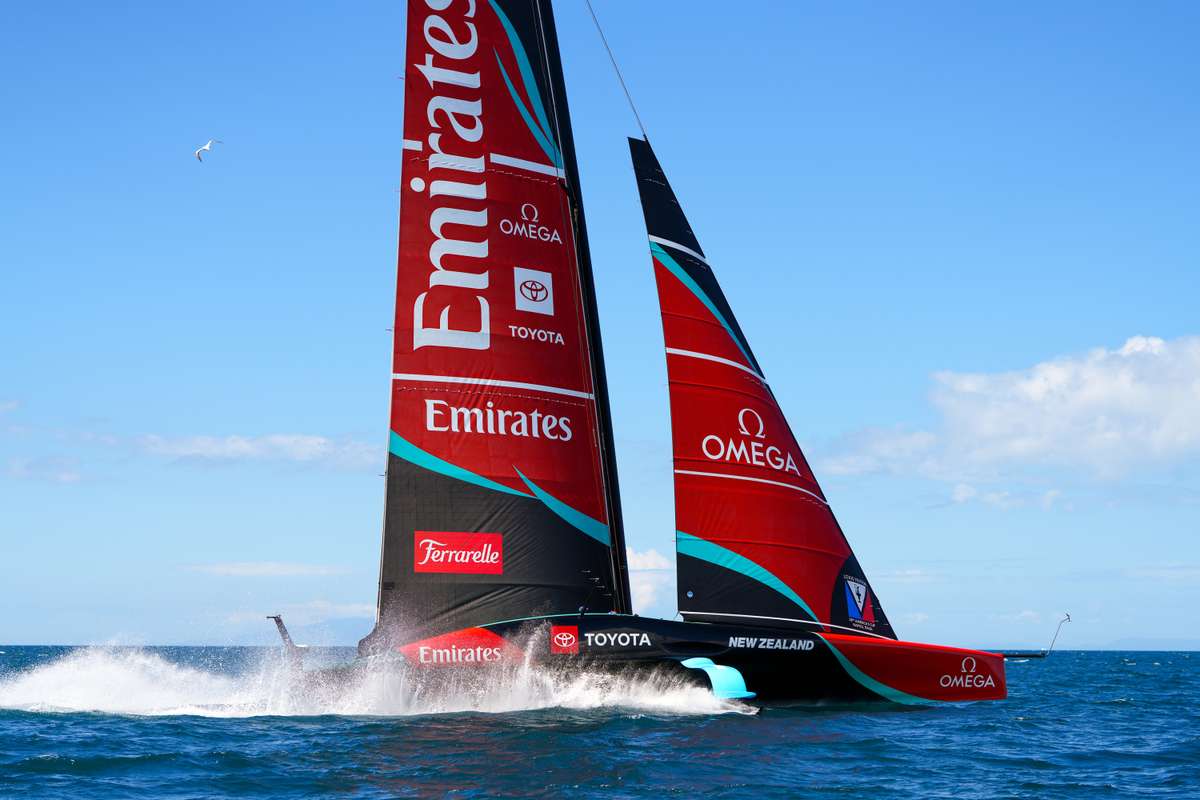
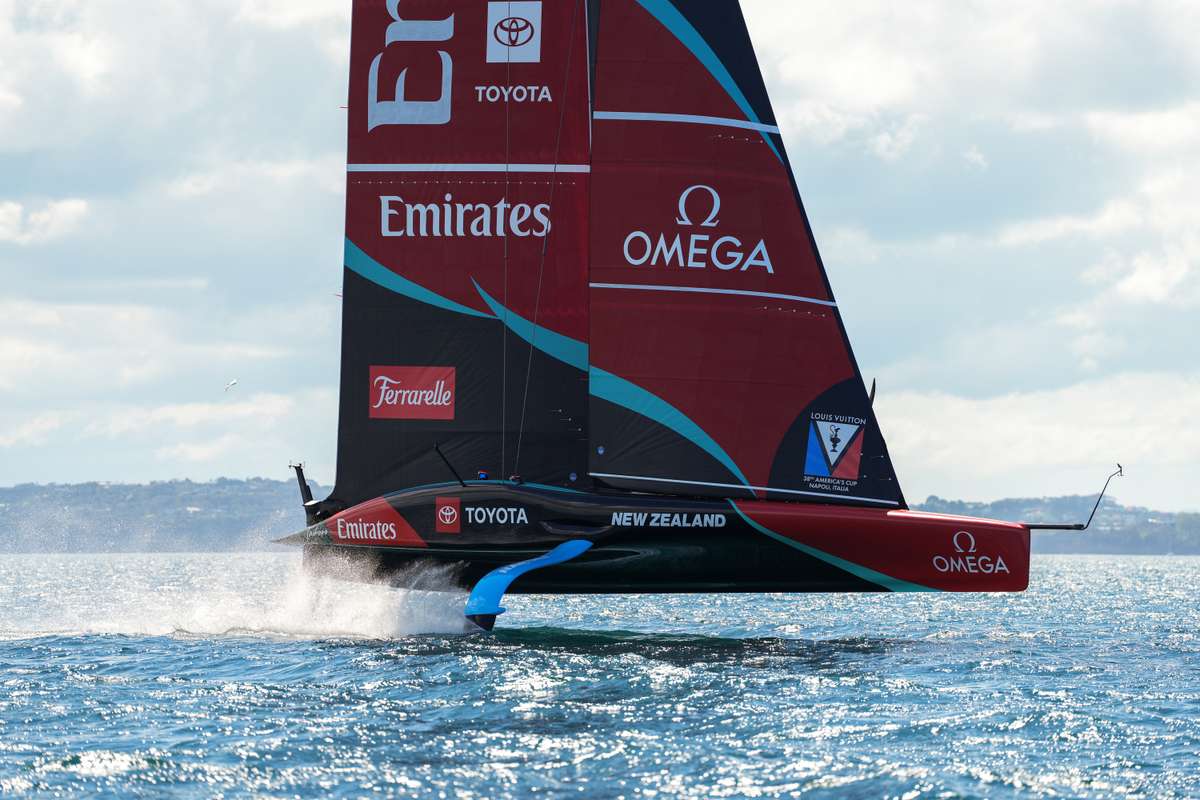
Its core idea is a sail built from two very different materials. In a conventional sail, the luff is roughly as stiff as the rest. Collie’s design makes the luff region deliberately stretchier – the patent suggests polyester-based tapes – while the body uses much stiffer material such as carbon. Under the main US claim, the body must be between two and 20 times stiffer than the luff.
That mismatch changes what the cunningham does. On a normal sail, pulling the tack down mostly just tensions the luff. With a stretchy luff, the tack comes down further and the load is pushed back into the stiff band running from head to tack through the body of the sail. As that band straightens, it drags the sail flatter and pulls the point of maximum depth forward. Some versions add a third, stiffer strip along the seam between the two zones to steer the load.
The result is more depowering from a single control line. The patent’s own computer modelling shows mid-camber dropping to about 6.2 per cent at full cunningham load, against about 8.3 per cent for an equivalent sail with a stiff luff. And it explicitly covers twin-skin mainsails – the type the AC75 uses.
North’s version of events
North filed its case in the US District Court for the Eastern District of Virginia on 15 September, naming both Team New Zealand and Collie as defendants. It rests on how Team New Zealand’s designer came to know what he knew.
North says Collie signed a confidentiality agreement in 2017 to use its NS Design Suite software. It says he then attended a North workshop in Bend, Oregon, in January 2018 as the only non-employee in the room. There, North alleges, he learned about hybrid polyester–aramid and polyester–UHMWPE tapes developed by North materials engineer Matt Savage. North argues those are the tapes that make a soft luff possible.
Collie denies this. In a sworn declaration filed with Team New Zealand’s motion, he states that he has never been to Bend, Oregon, has never attended a North workshop and was not in the US at all in January 2018. He also says he has never used NS Design Suite to design sails or develop structural layouts. The team’s filing does not deny that he signed the 2017 confidentiality agreement – it argues instead that the agreement alone is not enough to bring him under the Virginia court’s jurisdiction.
Then come the sails themselves. North says it sold Team New Zealand sails embodying the design in 2019. That was more than a year before the first patent filing in December 2020, which under US law should have stopped the patent being granted. North also accuses the team of keeping those sales from the patent office.
North wants Savage named as co-inventor and the patent family handed over. Failing that, it wants the US patent struck down. If it wins ownership, it promises a royalty-free licence for every Cup team. Team New Zealand says North had earlier sought to license the patent itself.
None of this has been tested in court. Several key points are pleaded “on information and belief”, including the claim that Team New Zealand encouraged Collie to file.
The Kiwis see it differently
Team New Zealand rejects the lot. In a statement on 18 September, chief executive Grant Dalton called the lawsuit “a spurious attempt by North Sails to intimidate and pressure” a team with valid patents. North, he argued, had known about the patent for more than five years and had built the team’s sails using the technology across several campaigns. He suggests the US case is “presumably a response to arbitral legal proceedings taken against Norths in NZ over the misuse and breach of the patent”.
The team also accuses North of breach of contract, including “a breach of confidentiality and our IP with other America’s Cup competitors”. It had served North with a notice of dispute – the first step towards arbitration in New Zealand – but says North delayed the required talks and sued in Virginia the day after they finally took place, “with full knowledge of ETNZ’s impending arbitration”. That arbitration is now under way, Dalton says.
The arbitration clause is the crux of the motion. The supply agreement sends disputes to arbitration in New Zealand under New Zealand law, so “this is a foreign dispute”, the lawyers argue. They add that the Virginia court has no jurisdiction over Collie, as North’s case for it rests mainly on the Bend workshop he denies attending.
The patents have been granted in the US and Europe, the lawyers note, and North’s challenge at the US Patent Trial and Appeal Board was turned away in January, although that was a refusal to hold a full review rather than a final verdict. And as Dalton points out, that challenge “never raised ownership”.
Most pointedly, the team says North acknowledged in its AC37 and AC38 supply agreements that the IP in Team New Zealand’s sails – patents included – is the team’s “exclusive property”. Yet its own filing shows North did push back once. When the team added that clause in the AC37 talks – covering, it says, the elastic-luff technology – North objected that it would award the team “full ownership of sail design IP” that North considered “jointly owned”. North signed anyway in September 2022, and the clause went into the AC38 deal in May 2025, seven months after the US patent was granted. That, the team argues, underpins both its motion and the arbitration.
A model built on trust
The wider story is about how Cup sailmaking works. North supplies every team. Each gets access to its design software and dedicated designers walled off from the other teams. Sail concepts stay secret until the end of the cycle. North says the supply agreements then require teams to pool what they have learned in a “collective design debrief”.
According to North, Team New Zealand refused to join that debrief after AC36, at the same time the patent application was being filed. North claims it was the first team ever to refuse.
The Kiwis’ legal team has its own trust argument. In February, they note, North told teams it was simply manufacturing sails in Sri Lanka, leaving design – and patent risk – to the teams. Then, when Team New Zealand asked North to confirm whether the sails it is supplying for AC38 use the patented design, North declined, citing the confidentiality it owes its customers.
Team New Zealand’s lawyers don’t buy it. North’s own designers are embedded in every team and can already see the designs, they say, so North could check without revealing anything. And if North is bound to keep those designs secret, it is more involved in them than a mere manufacturer would be – which, the lawyers suggest, means it may be infringing with its eyes open.
What it means for Naples
This would be a niche IP squabble if it weren’t for AC38.
In July, Team New Zealand put North and all six challengers on notice, warning that using such sails in Italy without a licence would infringe its European patent, and adding that at least one team may already have done so. The same letter pointed to a failed bid in June to amend the AC38 Protocol so that no one could rely on patents. Team New Zealand says that move was aimed squarely at its own patents. Dalton goes further, singling out GB1. North, he notes, is owned by Oakley Capital, “who in turn is the majority owner of Team GB1”, and GB1 “has sought to use the patent through a protocol change and was unsuccessful”.
It’s those warnings North objects to in particular. In its statement, it accuses Team New Zealand of enforcing the patent against its rivals “to the detriment of fair competition”, and says its legal challenges aim to stop the Defender using “the invalid patent to disrupt fair competition in the America’s Cup”. As exclusive sail supplier to those rivals, North says it is being targeted “as a means to achieve its objectives” – and that, having “long sought to resolve the dispute amicably”, it was left with no choice but to act. Its lawsuit goes further, accusing the Kiwis of seeking an edge “not through sailing skill, but through use of these misbegotten patents”.
Team New Zealand’s lawyers say the team is not trying to disrupt AC38 at all – any disruption, they argue, would come from North and the challengers choosing to infringe. The team says it has a clear legal and moral right to enforce its patent.
Whatever the case, this is now a legal battle on three continents:
- the US court in Virginia
- the European Patent Office
- a court in Milan, where North filed a challenge in August to the Italian part of Team New Zealand’s European patent
- a confidential arbitration in New Zealand
None of these tends to move quickly, and racing in Naples starts next May.
The one-loft model was meant to take sailcloth out of the Cup equation. For now, the most important design debate of AC38 is taking place in courtrooms rather than sail lofts.
Articles You Might Be Interested in
Three legs and an electronic brain: how Ferrari Hypersail will fly (Pt. 2/7)
Team Australia finish Te Rehutai rebuild and set February target for Naples
The week in racing - 19 Oct ’26
GB2 and Alinghi Women & Youth name their squads for Naples 2027
La Roche-Posay Racing Team the first to launch their AC75 in Naples
Inside the Batmobile: a first look at Ferrari Hypersail
Batteries, foils and LiDAR: where does the sailor’s job end?


Member Discussion