
Batteries, foils and LiDAR: where does the sailor’s job end?

Is technology ruining sailing? That was the question on episode 42 of The Foil Podcast, and the answer turns out to depend on which job the machine is doing – supplying the power, telling the crew what’s going on, or making the call. Freddie Carr, Andy Rice and our viewers don’t agree on where to draw the line.
In 2007 Freddie Carr was a grinder on an America’s Cup boat, a job he reckons made him the best sailor he’s ever been, juggling boat handling, trim and match racing all at once. By 2024 he was a cyclor on the British boat that lost the 37th match, and the job had shrunk to something rather more one-dimensional.
“In my last America’s Cup, I had to shut my eyes and sit at max heart rate for 20 minutes,” Freddie says on this week’s Podcast. “And that was the only test that I had, with a bit of to-ing and fro-ing with a few trim bits and bobs.”
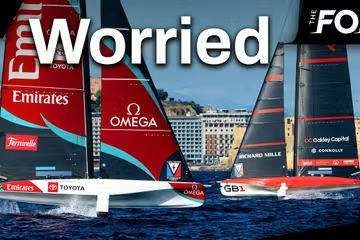
That contrast set the tone for the episode’s debate. And when the AC75s line up in Naples in 2027, the cyclors Freddie sat alongside will be gone, replaced by a battery. But as the conversation went on – and as viewers piled into the comments afterwards – it became clear that “technology” covers three quite different jobs on a boat. It can supply the power, it can tell the sailor what’s happening, or it can make the decision for them. Each one sparks a different argument.
Legs out, battery in
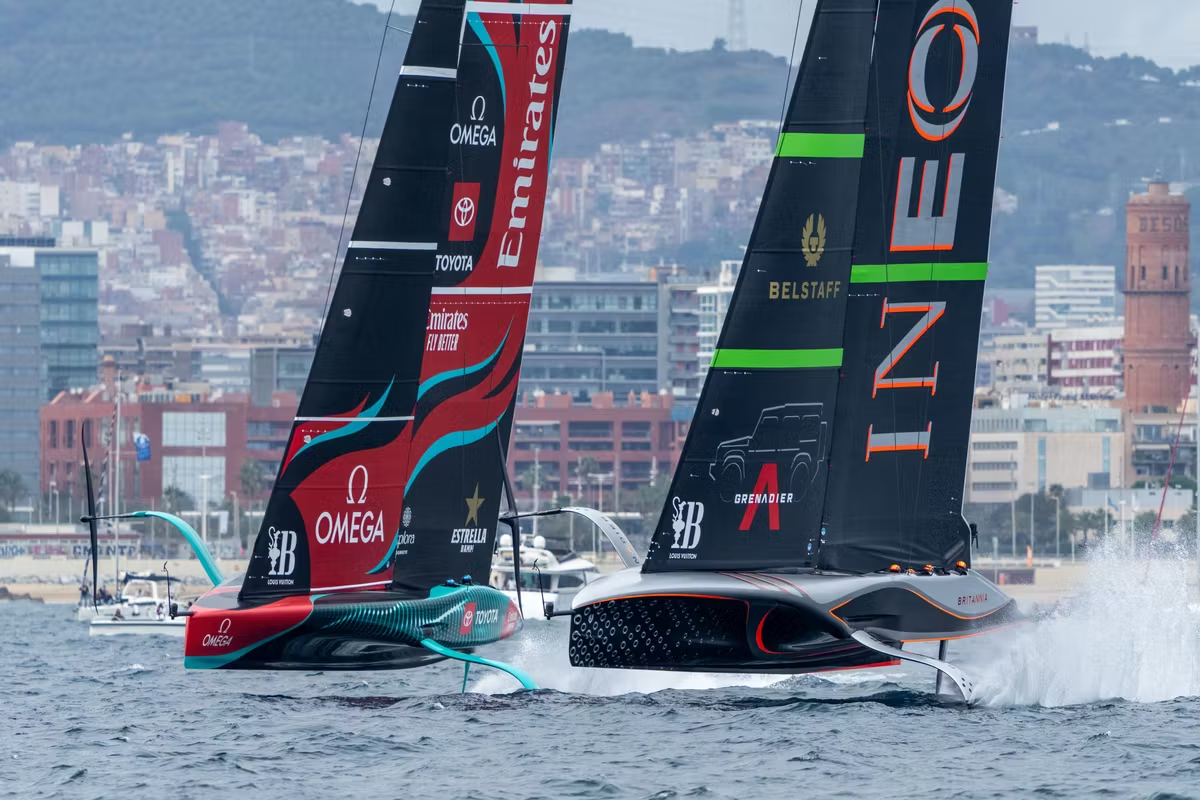
The AC38 Protocol cuts the crew to five and fits a supplied battery system meant to mimic the average output, peaks and fatigue of four cyclors. No manual power input is allowed apart from steering.
Freddie says he is “truly gutted” by the change, because it removes “that amazing physical element that you needed to get an America’s Cup boat around the course”. As he sees it, “the America’s Cup needs human endurance and athleticism in it to make it the credible sport it always has been.”
Technically, the battery only replaces the muscle – the trimmers are still making the decisions. But for some viewers, that’s a distinction without a difference. “If there’s a battery you may as well just add a motor, what are we doing,” one wrote under the episode. Others had never warmed to the cyclors in the first place. “Bicycles and batteries have no place in yacht racing, every crew member must have pure racing and sailing skills, not just watts in their legs,” said another.
One comment came down to what viewers could actually see. “I didn’t care one bit for the hidden cyclors,” the viewer wrote. “There’s hardly anything lost for me going from occasional glimpses of dudes in a dungeon to batteries.” It’s a fair point. Physical effort can matter hugely to the crew and still barely register for anyone watching at home.
Andy has a similar gripe about how the racing comes across on screen. He marvels at the AC75 as a piece of design, but admits that watching it or an AC40, “I can’t really tell whether I’m watching real life or watching an AI resolution of a race.”
Joining the dots
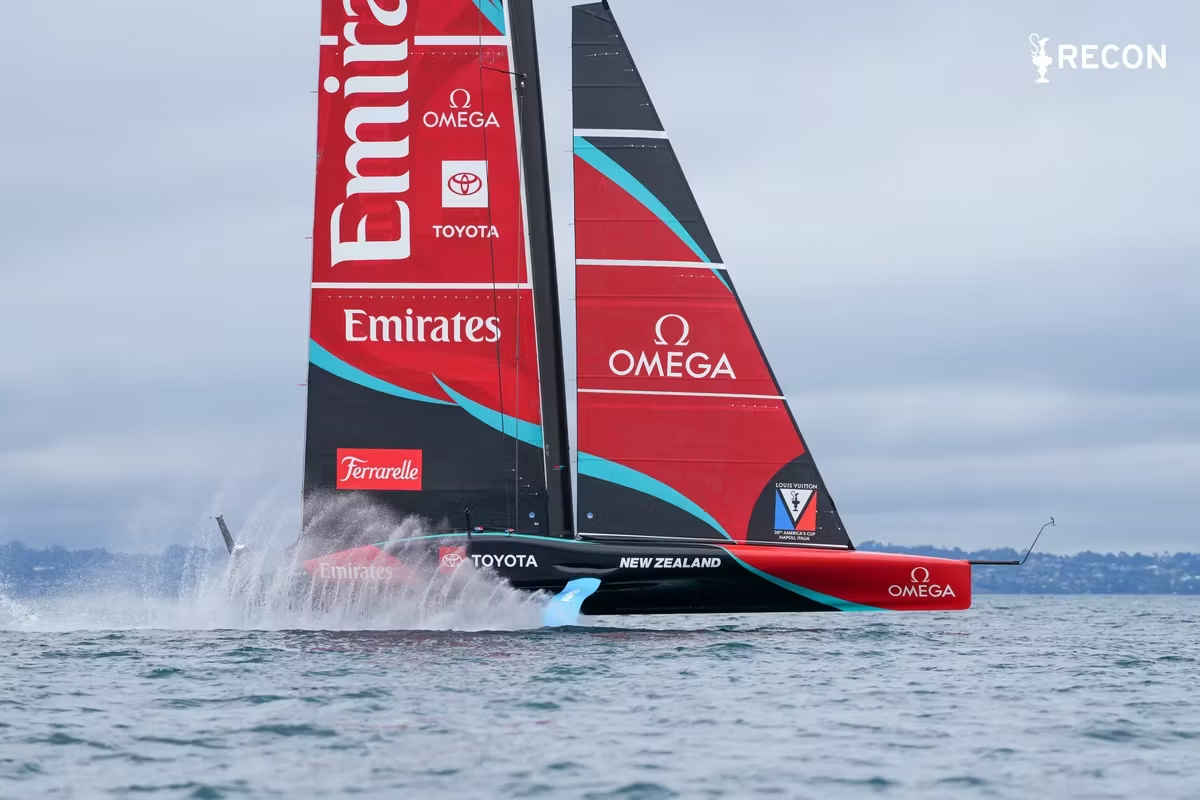
For all that, it’s the sails rather than the battery that really bother Freddie and Andy. Freddie reckons that the biggest change between the 2021 and 2024 Cups was positional feedback on the sails, with the computer knowing where they sit in space. He calls it “probably one of the saddest things that’s happened in the Cup” and argues that AC75 crews are “not trimming the sails” in the way the sport’s name implies.
Andy goes further. He calls the system “such a clever piece of technology that it’s an obviously stupid idea that should never have been allowed to creep into the Cup”, and likens it to joining the dots in a children’s drawing book. But, as he sees it, it could be undone: the AC40 and AC75 “could be detuned” to put “proper old school trimmers looking up at sails” back on board.
Even viewers who have no time for the pair’s wider scepticism draw the line at automated trim. “I fundamentally disagree with Freddie and Andy’s comments – they are both luddites,” one viewer wrote, pointing to the AC40 regatta in Naples as evidence that the best sailors still win in foiling boats. “Most sailing is not about endurance as Freddie believes – it’s about making the boat go fast in the right direction.” But the same commenter added: “The one point I agree with is that auto adjusting the sails should not be allowed. Auto foil control of foils has not stopped AC40s proving the top sailors.” Andy, for what it’s worth, is happy to wear the “luddite” badge, as he says in the episode.
Others would happily hand over even more to the computers. One commenter argued the sport is “on the doorstep of supercavitation and real speed”, and likened manual trim to asking a driver to control the cam angle in an engine, “a job no human should be doing. I say let the physics lead the way.”
And one viewer raised a point we hadn’t considered: “Regarding manual trimming, is there a safety element to consider with the speed these boats are hitting?”
Sailing in three dimensions
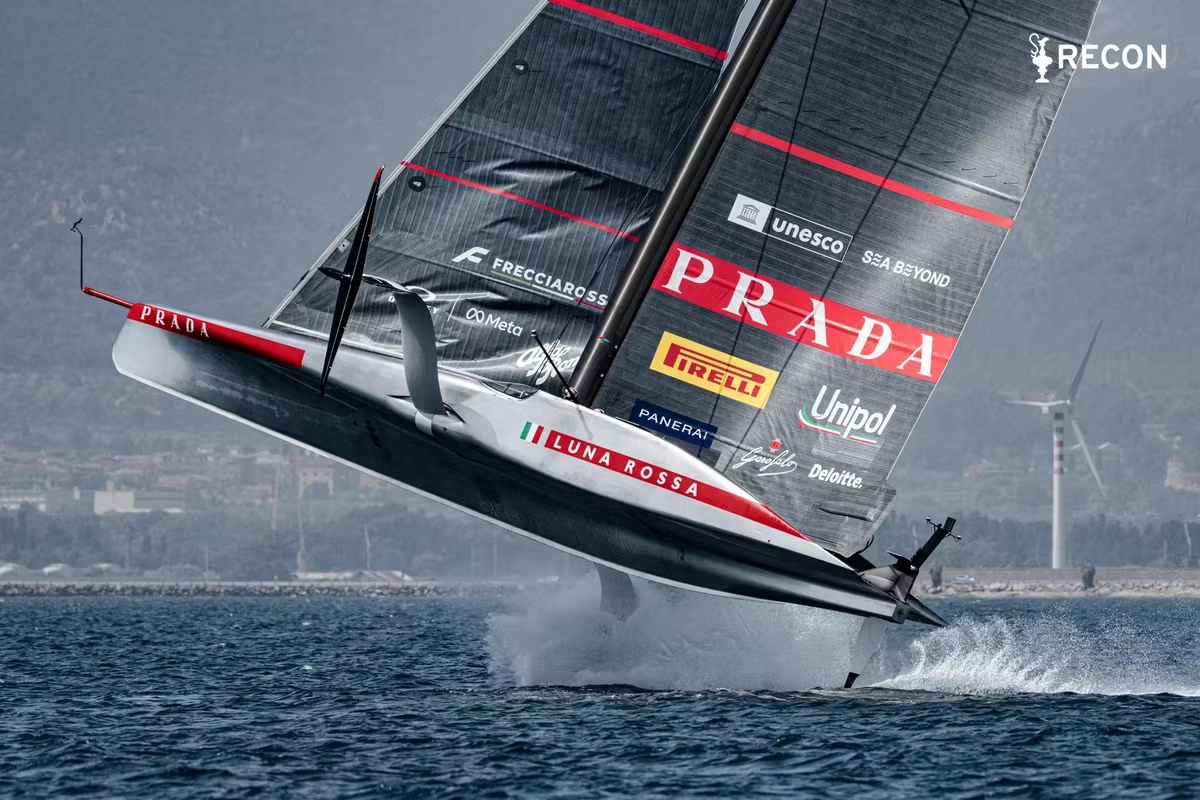
None of this means Freddie and Andy have a problem with foiling itself – quite the opposite. Andy’s best argument was that foils hand the sailors new jobs as well as taking old ones away. “I love the fact that you have to fly these boats and not just sail them in 2D,” he says. He points to SailGP’s choice between sailing in H1 mode, with one hull lifted, and bearing away to get fully foiling, and to the recent race in Valencia where the US went for H1 while Australia went for full foiling. In the AC40s, he likes the jeopardy of a boat dropping off its foils and another sweeping past.
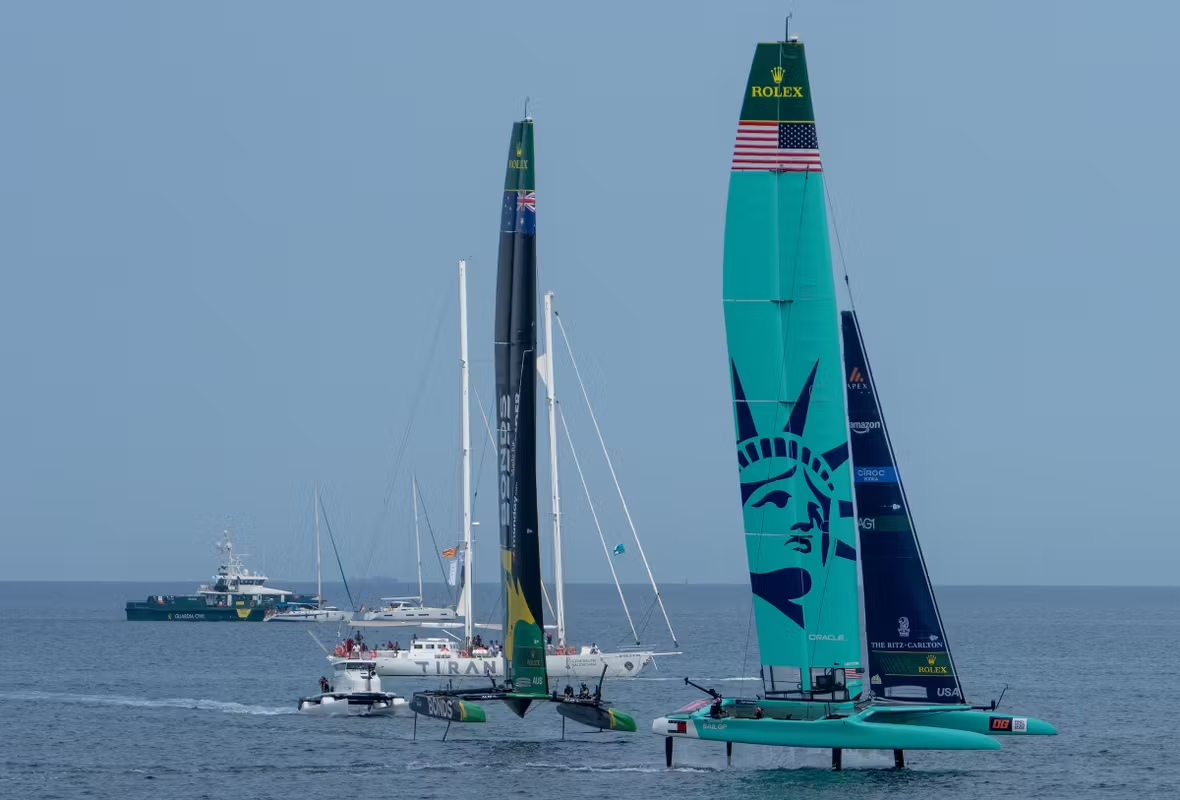
He was picking up on a comment from one fan who has sailed dinghies since the age of five and only recently started foiling: “Opening up the Z vertical axis adds a new dimension literally to the sport. The boat gets more twitchy and quicker off weight positioning that would go unnoticed in most boats gets punished while foiling.”
For Freddie, the real gain is in the thinking. Coming into a windward mark with four boats on port and four on starboard, crews have to decide which side they want and how to get there while another team owns the layline. “The conversation there is like nothing we’ve ever seen in the sport,” he says. On SailGP he can pick out individual athletes sprinting across the boat and getting on the handles, and drivers trimming the wing sheet as they steer. He calls it “a beautiful dynamic”.
Is LiDAR coming to the 52s?
The next round of this argument could well be fought out in grand prix monohull racing. On The Foil’s boat tour of North Star III, mainsail trimmer Paul “Pom” Green explained how he uses LiDAR to scan the sail shape and compare it with a target shape. “I originally thought you’d be looking at it just to get your eye in but we actually run it the whole time now,” he said.
For now, LiDAR only supplies the numbers – what Pom does with them is still down to Pom. The boat’s powered hydraulics go further, changing how the crew deliver power and get through manoeuvres. As the team put it on the tour: “You press a button and the winch spins, you press another button and another winch spins, you press another button and the cylinder moves. You don’t have to choreograph the amazing grinders who are super skilled at the choreography.” Northstar won the Maxi GP world championship at its first regatta in Porto Cervo, opening with four straight wins and finishing on 14 points to Balthasar’s 25 in second.
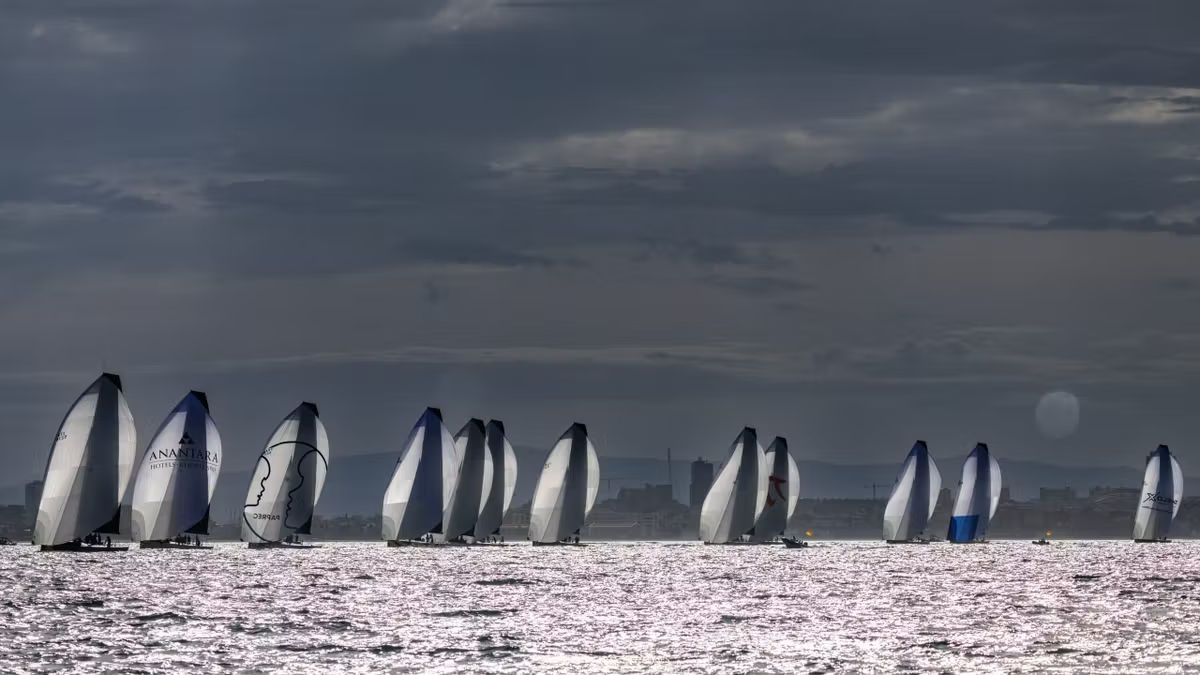
Freddie, who described Cup trimmers as working off a database of settings to hit their target, predicts the 52 Super Series will also soon have to decide whether to allow LiDAR on board. Nothing has been announced yet, but he sees it as the next piece of America’s Cup tech trickling down through the sport. With 12 or 13 crew racing boat-for-boat without handicap, the 52s run on what Freddie describes as a constant trim loop: “Every single Cunningham movement, outhaul movement, jib sheet burp, runner adjustment changes your mode for better and for worse. And you have to evaluate live with your eyes, reading your numbers about whether that has made you go better in a high mode against your opposition that you’re trying to pinch off.”
On a short start line with 16 boats, he says, even a grinder has to be thinking about a double tack to get under a rival and setting up the buttons for it. “Every person on that boat has to think like a world class tactician.” Plug a live comparison against the perfect sail shape into that loop and you have to ask: would it sharpen those judgements, or start making them?
Andy’s gut feeling is that LiDAR has no place on the racecourse. He would rather keep it to training, but wonders whether that could ever be policed – and if you can’t enforce a rule, he argues, there’s no point writing it. Then there’s the cost. He admits he has no idea what LiDAR costs, but “it just sounds expensive” – and the Cup has already shown how quickly cost can thin out a fleet.
As Freddie says: “It will be a BIG call for that class about what they do...”
Articles You Might Be Interested in
Inside the Batmobile: a first look at Ferrari Hypersail
Two days, two headaches for Luna Rossa in Cagliari
Why a Formula One insider is betting on the America’s Cup
The Tabarly Effect: how one quiet sailor built a nation of ocean racers
Why Les Voiles de Saint-Tropez is so special
The RC44: how Russell Coutts hit a winning formula

The Foil Debrief: What America's Cup warm-up events could count for



Member Discussion
Ok I really have a bone to pick regarding what you call 2D vs 3D sailing. I'm 75 years old and grew up with dinghy sailing. I was in the US Navy for 20 years and had the pleasure of sailing/racing is San Francisco including several Big Boat series. I've even sailing at Diego Garcia in the middle of the Indian ocean - and also killed the commanding officer - but that's for another day.
I understand the issue with using batteries not bodies on the AC boats - fair point. But SailGp is definitely a physically demanding g ame with lines and all. And as you noted the speed at which decisions are made is unbelievable.
I've owned and raced a Tornado, Prindle 18-2 and Hobie 17. Since 2019 I've owned three different foilers UFO, Flo1 and soon a Birdyfish S. Yes 3D sailing is different and demands additional skills than those used on our Lasers, Flying Scots, Ynglings, Catalina 22 and 25s that we have in our Duluth Superior Sailing Association here in Duluth Minnesota. I just don't understand why you seem to be dissing 3D sailing. My guess is the same points you make were those used by the sailing groups when Nathanael Herreshoff launched Amaryllis in 1876. It's not a real sailboat and should be banned from racing - which they did.