
From the archives: the 2002 Route du Rhum, as it happened

I’ve dusted down an article about the Route du Rhum that I wrote in November 2002 for a British news sheet called ‘All At Sea’. As I started researching the Route du Rhum again, for the latest edition of the race which started on 1 November, I was reminded about the article I’d written 24 years earlier.
This tells the story a few days after the start, and already the storylines were madder than fiction. The 2002 edition of this four-yearly transat only became even more crazy, something we're seeing play out again this week.
I never wrote the follow-up to this article because ‘All At Sea’ went bankrupt. Financially, they were... all at sea, you might say. Although like an ORMA 60 trimaran they were salvaged a few weeks later and brought back to life again. But I never got paid for this, not that I’m bitter or anything.
So, here’s the article from November 2002. If you know nothing about the Route du Rhum, I think this will whet your appetite to find out more. It’s a race that doesn’t have the right to exist, yet thanks to the French and their lack of respect for the rules or health-and-safety, the Route du Rhum is a race that is celebrated across the nation.
–Andy Rice
Route du Rhum, November 2002
If the bureaucrats in Brussels had their way, the Route du Rhum would have been banned a long time ago, and after you've read this you might be inclined to think it was a sensible idea. The stories behind this singlehanded race from St Malo to Guadeloupe are amazing, and the 2002 edition is shaping up to be as mad and crazy as any of the previous races in this event's 24-year history.
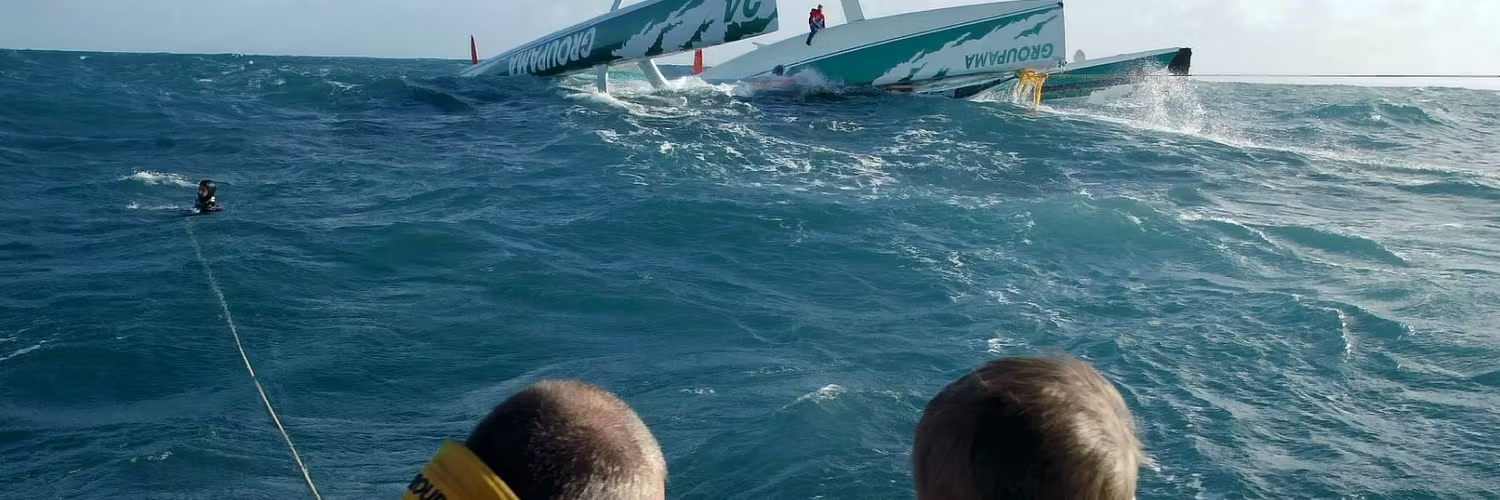
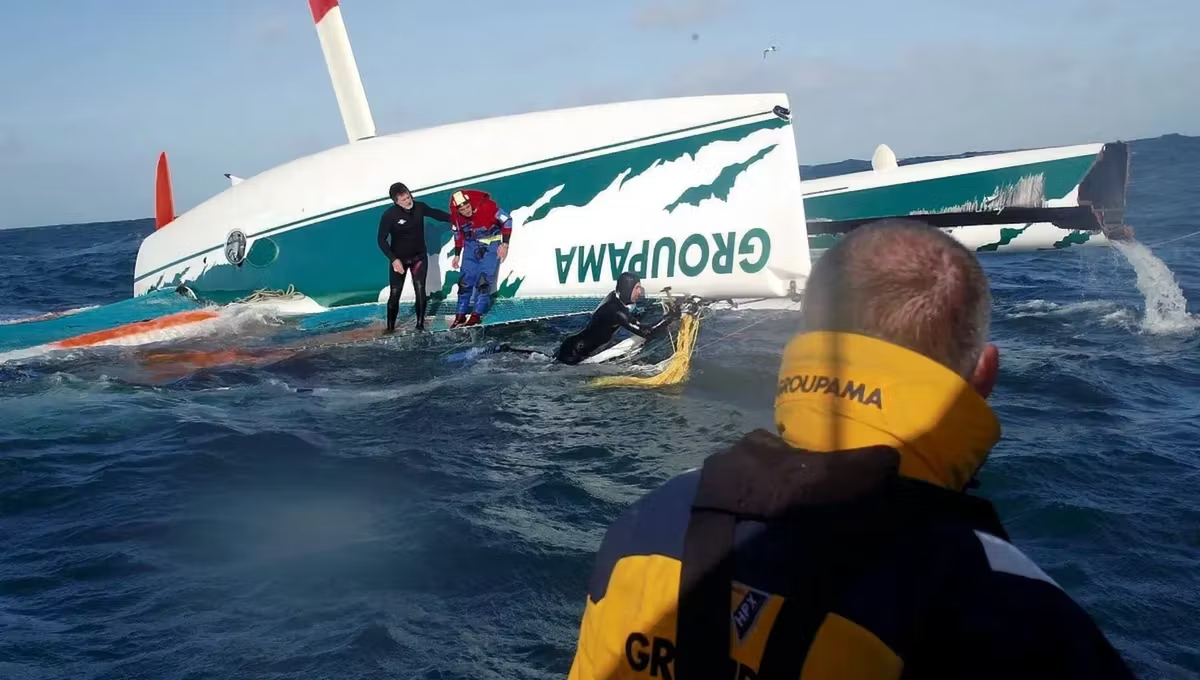
Barely a day out of the start, and the casualty list was already piling up. Biggest shock was the capsize of Franck Cammas's 60-foot trimaran Groupama, sailing upwind in a moderate to fresh breeze. The 29-year-old escaped unhurt from the incident, although worse was to come, as Jean Le Cam's trimaran Bonduelle ploughed into Groupama's upturned hull in the Atlantic darkness.
Fortunately for Le Cam, there was surprisingly little damage to his green and yellow machine, and he was able to heave to, waiting near Groupama until a French coast guard vessel came to Cammas's rescue. But while Groupama was being towed upside down to the French port Roscoff, Le Cam made his way to Camaret to inspect his damaged float and make a decision about whether to carry on across the Atlantic. Apparently, the crash box did a good job of minimising the amount of damage to the float, but there was delamination and more than a metre of the cloth was soaked. Undeterred, Jean Le Cam was back in action two days later after an incredibly quick patch-up job.
Spooked out of the sport
Cammas's pitchpole was doubly surprising in that he was one of the favourites in the highly competitive multihull fleet. If it could happen to him, it could happen to anyone, a conclusion that must have occurred to Bertrand de Broc who, on hearing news of Cammas's fate, decided to retire for safety reasons. De Broc had been sending his 60-foot tri Banque Covefi at full tilt in the pitch darkness when he was forced to luff up to avoid an object in the dark. He was later to discover that 'that object' was in fact Groupama, and that he had only narrowly avoided a similar pile-up to the one suffered by Bonduelle.
His reaction the following morning, on hearing exactly what had happened the night before, was to retire from the race and the sport. He made no secret of how the incident had unnerved him, and said on his radio: "I was frightened during the night and I have taken the decision to stop racing solo in general. You have to be 200 per cent out there, and I realised that I had some doubts and could not get rid of them." De Broc has suffered his own fair share of scares in this dangerous sport, with a dismasting in the 1990 Route du Rhum and a capsize in the 1996 Vendee Globe. He concluded his radio message by saying: "Solo racing is finished for me."
De Broc’s decision looked all the more sensible when little more than a day later, and Francis Joyon had also capsized upwind. The trimaran Eure et Loir was vying for the lead from Thomas Coville at the time, sailing close-hauled in a very rough sea. He was on a manoeuvre at the foot of the mast when he was hit by a squall. Speaking on the radio from his upturned tri, the skipper commented: "The boat was immediately lifted on one float and I rushed to the cockpit, but I did not have time to ease the sheets. The boat capsized in two seconds. At the moment I am hiding in the cockpit and I am trying to empty the boat with water. I will ask assistance from a tow boat. We will arrange all that today. Anyway I will not set off the distress beacon. I will stay on my boat, and I am not in distress and I do not need any further assistance."
More disaster was to come, with the top of Gitana's mast breaking off, forcing Lionel Lemonchois to divert his trimaran to La Trinité. Italian competitor Giovanni Soldini was forced out of the race when he discovered large cracks appearing between the cockpit and the rear cross beam of his 60-foot tri TIM. He nursed the boat to Lorient to see if he could make sufficient repairs to continue. And winner of the last Vendee Globe race Michel Desjoyeaux gave away 80 miles to the leaders in the multihull division, when broken battens and electrical problems forced him to make a pitstop in a small port near Brest before beginning his game of catch-up.
Jean-Luc Nélias thought he might have to pitstop too, after breaking Belgacom's mainsheet traveller. But the Frenchman was valiantly attempting to effect the necessary repairs at sea and avoid further delay by returning to the French coast.
Freighters and falling masts
Heard enough yet? Well that's just the multihulls we've talked about so far. The monohulls have also suffered a war of attrition. Nicolas Peitrequin was struggling to make the start line, citing forestay problems as the reason, although one wag suggested he was too busy still painting the boat's name on the transom, the succinctly titled Un Autre Regard pour l'UNHCR. Sebastien Josse made it across the startline, only for the mast to fall over the side of his boat VMI. He is waiting for a replacement mast to arrive in St Malo and still plans to complete the course.
Briton Conrad Humphreys set out into the Ocean after pulling into Roscoff to make emergency repairs to Hellomoto, which was involved in a pre-start collision with Jean-Francois Durand's Défi Vendéen. The Frenchman had got stuck on a race mark and Humphreys didn't have time to take avoiding action, as a result of which he is planning on protesting Défi Vendéen. Meanwhile, Durand was forced to turn back to Sable d'Olonne as his 50-foot monohull was taking on water.
The following day, Monday 11 November, two competitors crashed into commercial ships. Loick Pochet on the Open 60, La Rage de Vivre, hit a freighter but was able to limp back to Brest with a damaged bow where he decided to abandon the race. Christophe Huchet, sailing the Open 50 Apic A3S, was in the shipping lanes off Ushant when she was hit by a freighter. Huchet was picked up by a merchant vessel which took him to Brest, where Huchet could get some much-needed treatment for a dislocated shoulder and torn knee ligaments.
Coville takes charge
So is anyone left sailing? Well there were a few at the time of writing although things might have changed by the time you read this. Just three days into the race, and only 10 multihulls out of the original 18 were still on their way across the Atlantic, with four having abandoned so far. In the multihulls, Vendee Globe veteran and last time's Route du Rhum monohull champion Thomas Coville was leading aboard Sodebo, and was no doubt easing up from his breakneck pace across the Atlantic, when he heard what had happened to his closest rival for the lead, Francis Joyon. Yvan Bourgnon is sailing Rexona Man, the former Primagaz trimaran with which his brother Laurent won the 1994 and 1998 editions of this race. In light of what has happened to some of the newer tris, Bourgnon was probably grateful for sailing on board such a proven performer, even if his boat is getting a little long in the tooth.
Monohull race favourite Roland Jourdain sailed Sill out to an early lead in Division 1, closely followed by Mike Golding's Ecover. Ellen MacArthur has indicated this could well be her last solo outing on board Kingfisher, the boat that made her famous. She was lying in fourth place, close on the heels of Jean Pierre Dick's Virbac. MacArthur, like the other front runners, was pushing hard from the very beginning, grabbing only 1 hour 10 minutes of sleep in the first 24 hours. In fact, Ellen is probably spending more time sending her daily video feeds to the Discovery Channel, which is covering the race with five-minute updates during evening prime time for the duration of the race.
Ellen's friend and colleague from the race management stable Offshore Challenges, the Aussie Nick Moloney, was leading the class 2 monohull division in his newly sponsored Open 50 Ashfield Healthcare. But Mini Transat champion Yannick Bestaven chomped past Moloney aboard Republique Dominican, having repaired his brand new mainsail which split just an hour before the start. Having recouped the five hours lost to the leaders, Bestaven was beset by a second and more serious problem when he heard a number of cracking sounds and feared for the structure around the keel. Reluctantly, but sensibly, he diverted to Lorient before assessing whether it was safe to continue.
Where it all began
So by now you might think that this was shaping up to be the most extraordinary race ever, in the 24-year history of this event, which takes place every four years. But it has a lot to live up to. In the very first Route du Rhum back in 1978, 98 seconds was the distance by which Canadian Mike Birch won the race into Guadeloupe ahead of Michel Malinovsky. Granted, we have seen closer finishes in some of the recent Volvo Ocean Race legs, but for its time this was an unbelievably close finish and one that might never be bettered. Since that first victory, Birch's name has become synonymous with this race, and guess which 71-year-old is currently competing in the 2002 edition? Mike Birch.
Birch, a one-time real-life cowboy, has borrowed Philippe Monnet's UUNET and renamed her Tir Groupé - Montres Yéma, following a last-minute sponsorship deal. Questioned about his age, Birch said it could be an advantage: "I don't need much sleep." And he reckoned it could be good for the health too. Hmmmm...
Birch, who has competed in every Route du Rhum since its inception, reckons the boats are probably easier to sail now than they were in the mid-eighties. For the 1986 race, Birch was at the helm of a monster 80-foot cat called Tag Heuer, with considerably less technology at his disposal than the modern 60-footers enjoy now. The problem for the modern 60-foot tris, however, is that they must serve a dual purpose. They spend most of their time as fully-crewed all-out speed machines for the round-the-cans racing on the French ORMA circuit. And then they are expected to get one lone lunatic safely across from one side of the ocean to the other. With the skippers and designers pushing to gain those last ounces of speed for the short-course racing, it is small wonder that these boats are so prone to self-destruct on a transatlantic passage.
A race with a dark side
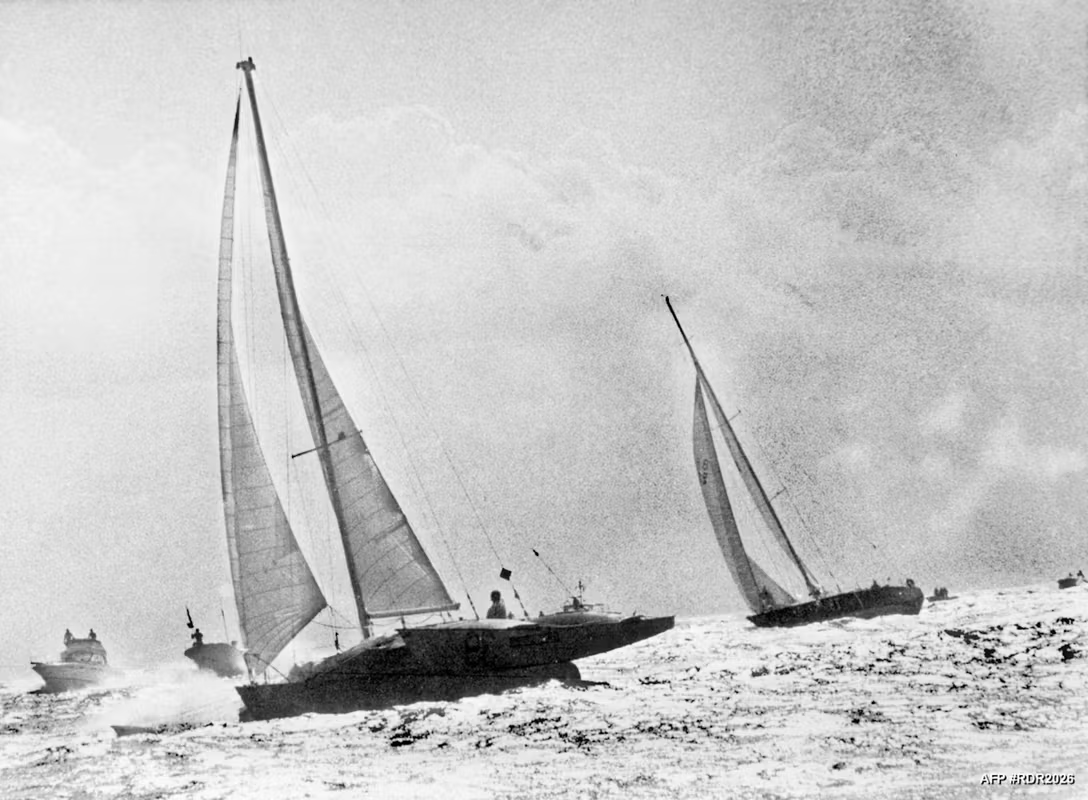
Not that that is anything new for the Route du Rhum either. It was just a few hours into the start of the 1986 race when organisers began to fear the worst for Loic Caradec and his awesome, wingmasted 85-foot cat called Royale. The ARGOS tracking system revealed an erratic course that made people in St Malo fear the worst, and those fears were confirmed when the boat was discovered capsized with no sign of Caradec. His body was never found.
Tony Bullimore, the man most famous for surviving that upturned hull ordeal in the wastes of the Southern Ocean during the 1996/97 Vendee Globe, was lucky to escape with his life from that fateful 1986 race. His Nigel Irens-designed trimaran, which had helped Bullimore smash a few records, ended up smashed on the rocks off Brest. Bullimore escaped to safety, but not before he had climbed a steep cliff above the raging sea.
Against all odds
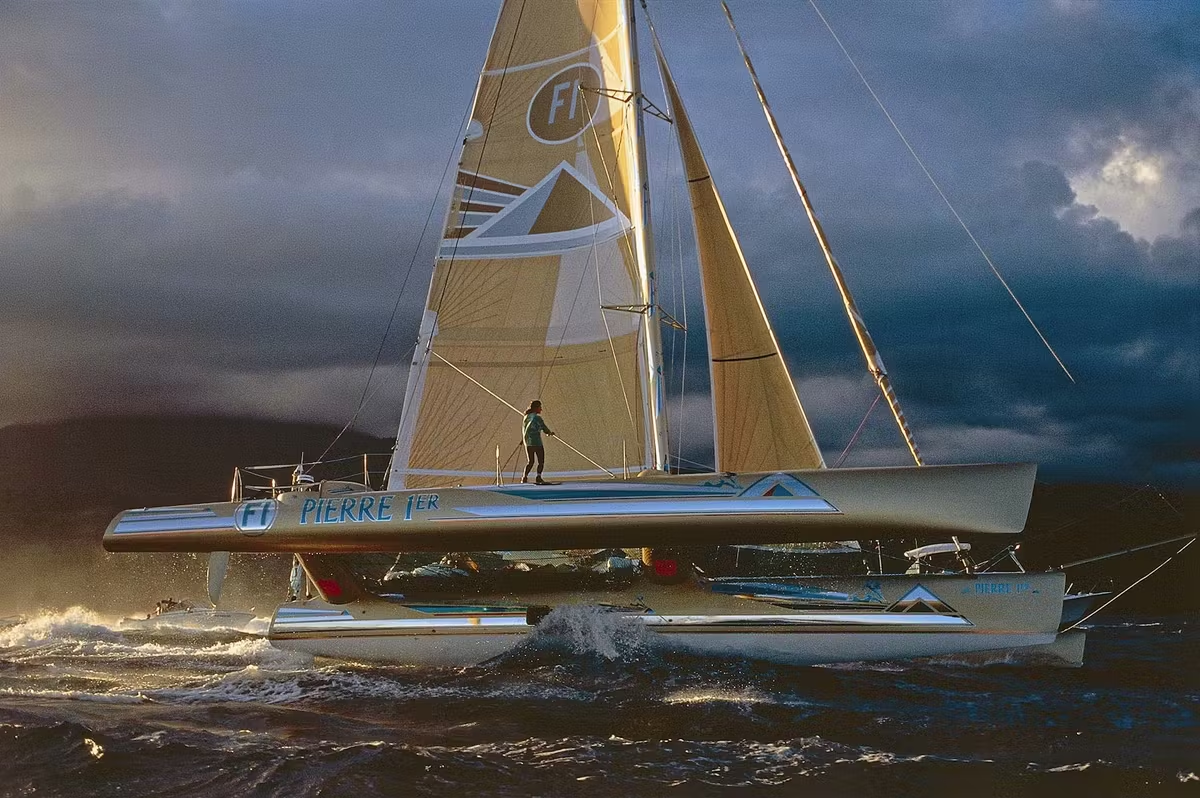
But of course, there have been the fairy-tales-come-true in the course of this event's epic history. In 1990 Florence Arthaud became the first - and so far only - woman to win the Route du Rhum aboard her trimaran Pierre 1er. She faced problems early in the race when her Nagrafax machine failed, which meant her only source of weather information was via telex from her weather router. Then her autopilot went down. Arthaud lashed herself to helm for two whole days, while a huge depression engulfed the fleet. Next, her electrical system gave up the ghost, meaning she had no communication with the outside world, nor any weather information.
A severe haemorrhage almost convinced Arthaud to set off her distress beacon and abandon the race, but somehow she found the will to carry on, navigating by the seat of her pants. She eventually crossed the line in a time of 14 days, 10 hours and 8 minutes, ahead of the 30 other boats in that race. Unbelievable.
Laurent Bourgnon set the current record for the 3,540-mile race in 1998, sailing Primagaz to a time of 12 days, 8 hours and 41 minutes. Perhaps his brother might be the one to break that record this time around. But considering the worst was yet to come - with a forecast of 60-70 knot winds expected to hit the fleet about five or six days after the start - breaking records is the last thing on anybody's mind right now. Breaking boats have been the sorry theme of this race so far. Whilst 59 boats in St Malo marked a record entry for the Route du Rhum, how many will make it to Guadeloupe? Place your bets.
Topics
Articles You Might Be Interested in
How do you pick World Sailor of the Year in a sport this diverse?
Match race to the line as Bourgnon and Horeau take Route du Rhum wins

Freddie Carr: The SSL Gold Cup could be the shake-up Olympic sailing needs
The week in racing - 9 Nov ’26
Laperche takes six hours off the Route du Rhum record at his first attempt
F1's special projects crackdown, and what it means for sailing
Route du Rhum 2026 – Race Blog



Member Discussion