
Grigio and Giallo: Up close with the finished Ferrari Hypersail hull (Pt. 1/7)

The 100-foot flying monohull is painted, the livery is on and the appendages are in the building. Andy Rice puts on his hard hat and high-vis and goes inside.
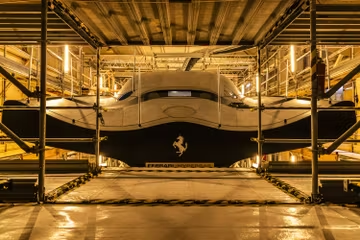
There is a moment when a boat stops being a project and becomes a thing. For Ferrari Hypersail, that moment came this week. When I was at the construction yard in Pisa, the hull was sitting there whole for the first time – painted, lettered and looking very Ferrari indeed.
I was not the only one struck by it. Matteo Lanzavecchia, the project's Chief Technical Officer, admitted that until now he had only ever seen the boat in pieces. "We had a part here, a part in the other," he told me. "It was the first time that I saw it all together."
Getting in to see it was an event in itself. Blue overalls, safety boots, helmets with the chin strap done up, shoe covers before the stairs, and a firm word about cameras. Ferrari runs a tight shop. Fair enough – this is a 100-foot foiling monohull designed to chase the biggest record in offshore sailing, the Jules Verne Trophy, and nobody has built anything quite like it.
READ MORE: Inside the Batmobile: a first look at Ferrari Hypersail
The numbers, Ferrari-style
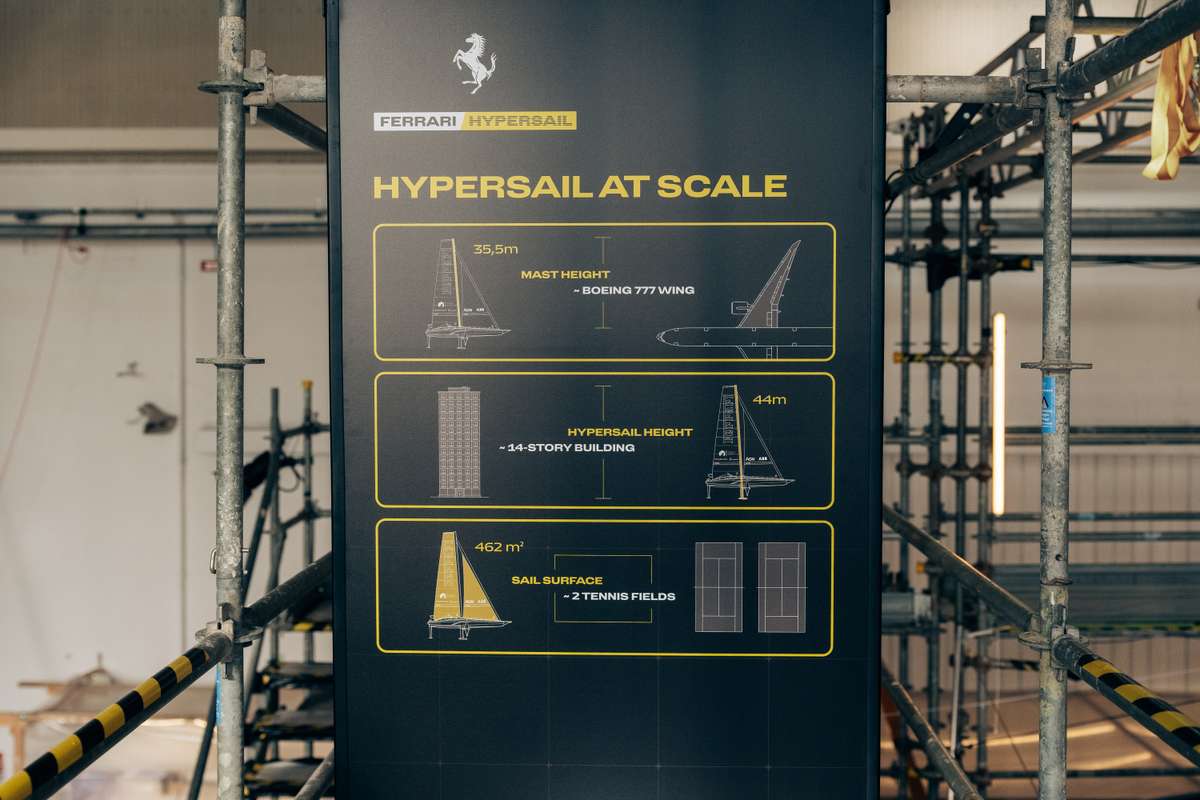
Ferrari likes to explain scale in terms you can picture. Stand the boat up with its foils deployed and it is 44 metres tall – a 14-storey building. The 462 square metres of sail is about two tennis courts. Each foil wing is 8.7 metres long, which Ferrari helpfully notes is two F80 hypercars parked nose to tail. The maximum load on a foil is equivalent to six double-decker buses. Everything about this boat is a fight between strength and weight, and you can see the fight in every detail.
A hull shaped to leave the water early
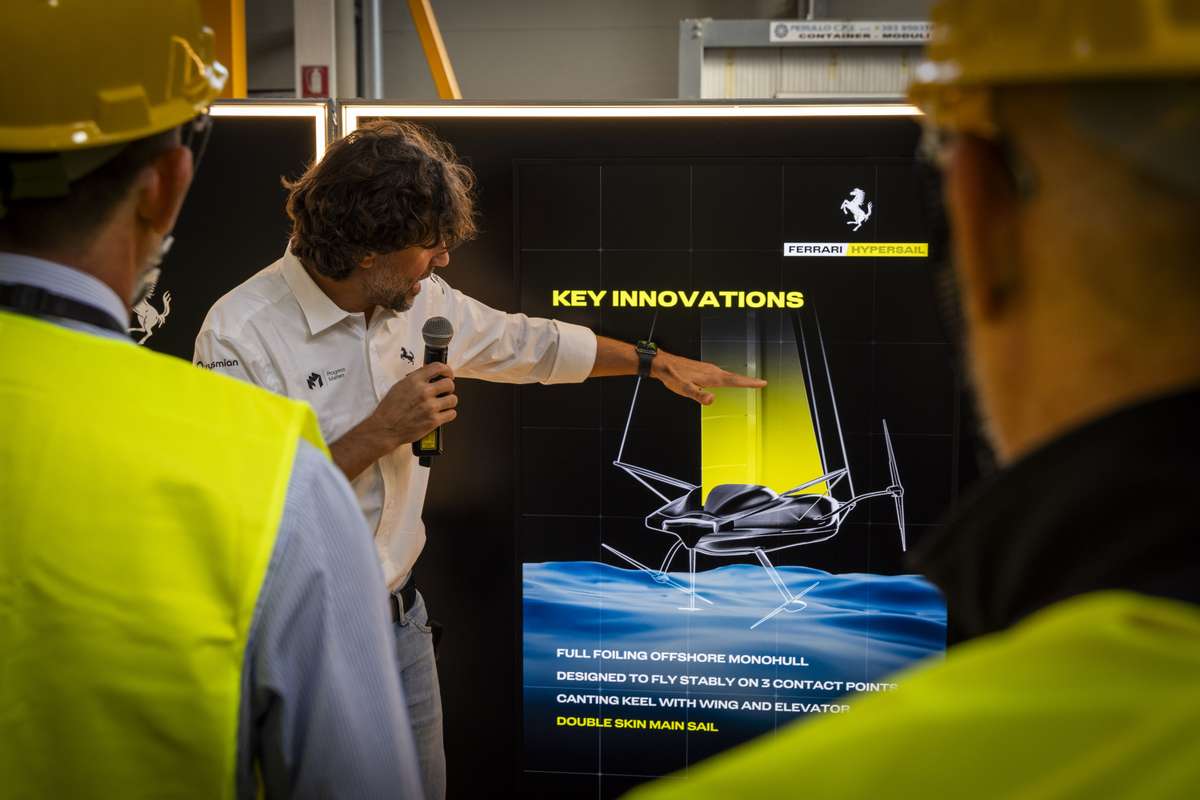
Marco Ribigini, Technical Team Leader of Ferrari Hypersail, walked us down the length of the hull. The shape, he said, went through more than 20 aerodynamic iterations. The brief that drove it was simple to state and hard to achieve: the lowest possible take-off speed.
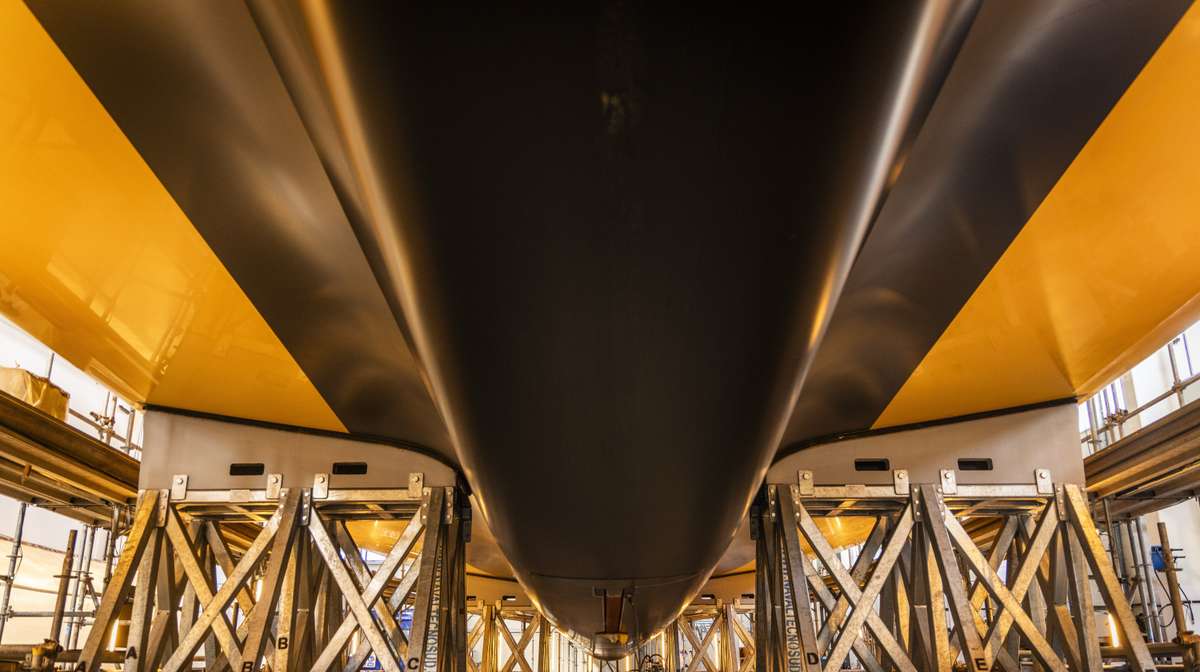
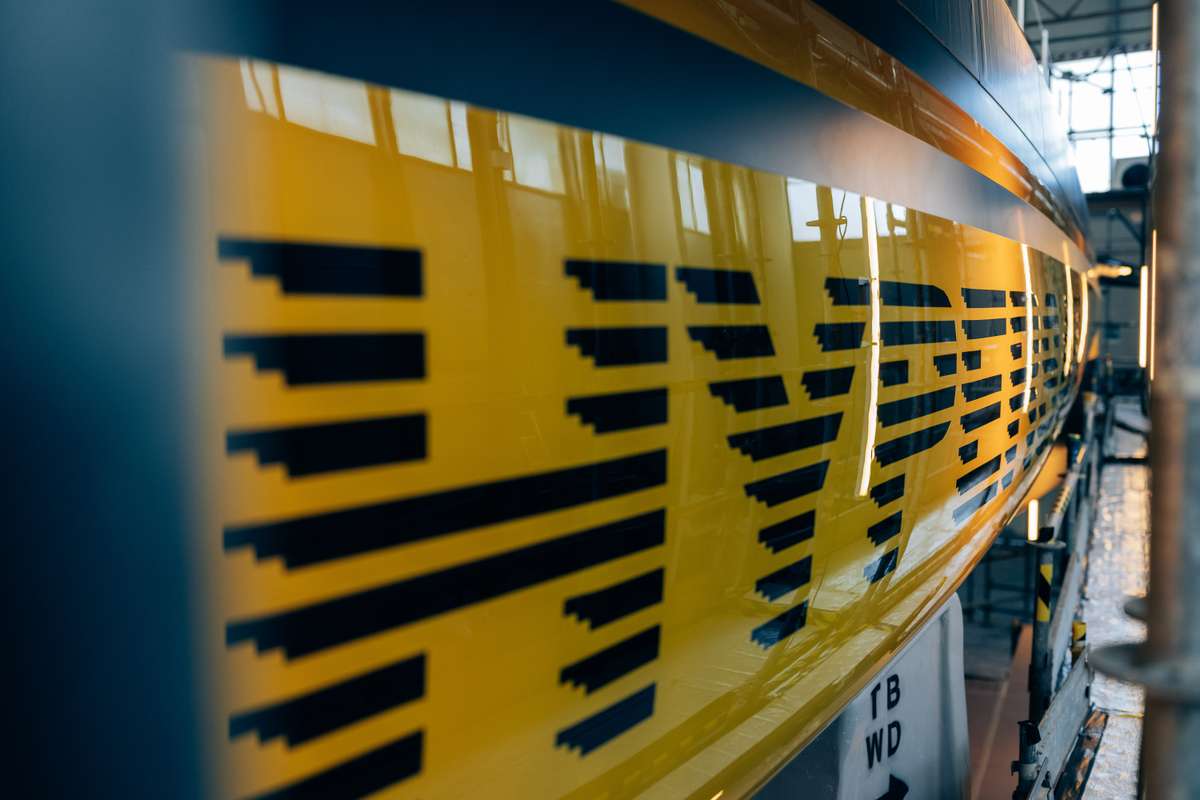
You can see the result in a series of crisp lines running along the topsides. Their job is to help the boat move through three phases – displacement, skimming and finally foiling. As speed builds, those lines break the water's grip on the upper hull and cut drag just when the boat needs to accelerate out of the water.
The boat is not designed to sit level. At rest it leans at around eight degrees. "It's not very elegant," Ribigini conceded. As it gains speed, it comes upright. Once the foils start lifting, the wetted area shrinks and the speed climbs again.
Walk underneath and the bottom is not flat either. It has a gentle curve. When the boat is flying low, or not quite flying at all, that curve helps with pitch stability and lets the hull follow the waves rather than slam into them.
Paint by the gram
You would expect a Ferrari to be painted well. You might not expect the paint to be weighed so obsessively.
Working with technical partner Boero, the team developed a process to keep the coating as thin as possible. The grey – a new colour called Grigio Hypersail – is two coats plus two coats of clear. The yellow, Giallo Fly, is three coats plus two of clear. The total weight of paint across the boat averages around 197 grams per square metre. To be clear, that is very light for a coating that has to survive salt, heat and sun for months on end.
There is one more enemy: things that want to live on the hull. The black underwater surfaces use a special ceramic coating to keep barnacles away. Ribigini even gave us the Italian word for them – cirripedi.
Built like a car, in carbon
Under the paint, the hull is built from multiple layers of carbon fibre. The goal is stiffness. If the hull flexes under ocean loads, the foils and flaps cannot respond precisely to their commands, and a flying boat that cannot control its flight is a dangerous thing.
Inside, Davide Sabatini, responsible for the 3D model, showed us how every single part is modelled – from the smallest screw up to the mast. The internal structure is a grid of transverse bulkheads and longitudinal stringers, threaded with an electrical system that runs from stern to bow at four different voltages. More on that later in this series.
The last look in Pisa
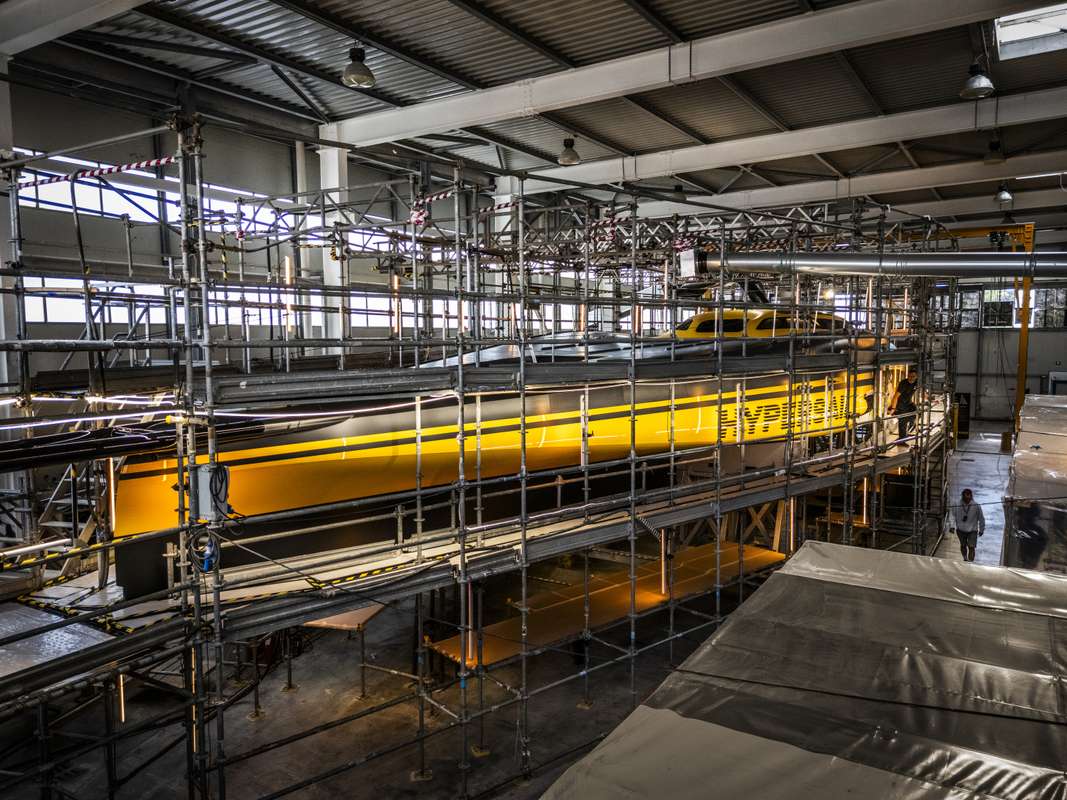
This was, Ferrari told us, the last time the boat would be seen at this yard. Next stop is a new base in Livorno, Tuscany. The mast is coming from Southern Spars in Auckland and the sails from Gosport, both due in Italy by the end of November.
So the shape is done. The paint is dry. The next question is the big one: how does a 100-foot monohull actually get up on its foils and stay there? In Part 2, I go next door to the building where the appendages are waiting.
Topics
Articles You Might Be Interested in
Three legs and an electronic brain: how Ferrari Hypersail will fly (Pt. 2/7)
Django 7X edges out Balthasar for Rolex Middle Sea Race overall win
Inside the Batmobile: a first look at Ferrari Hypersail
Why pro sailors dread the Middle Sea Race - Course Preview
The week in racing - 12 Oct ’26
The Tabarly Effect: how one quiet sailor built a nation of ocean racers
The week in racing - 5 Oct ’26



Member Discussion