
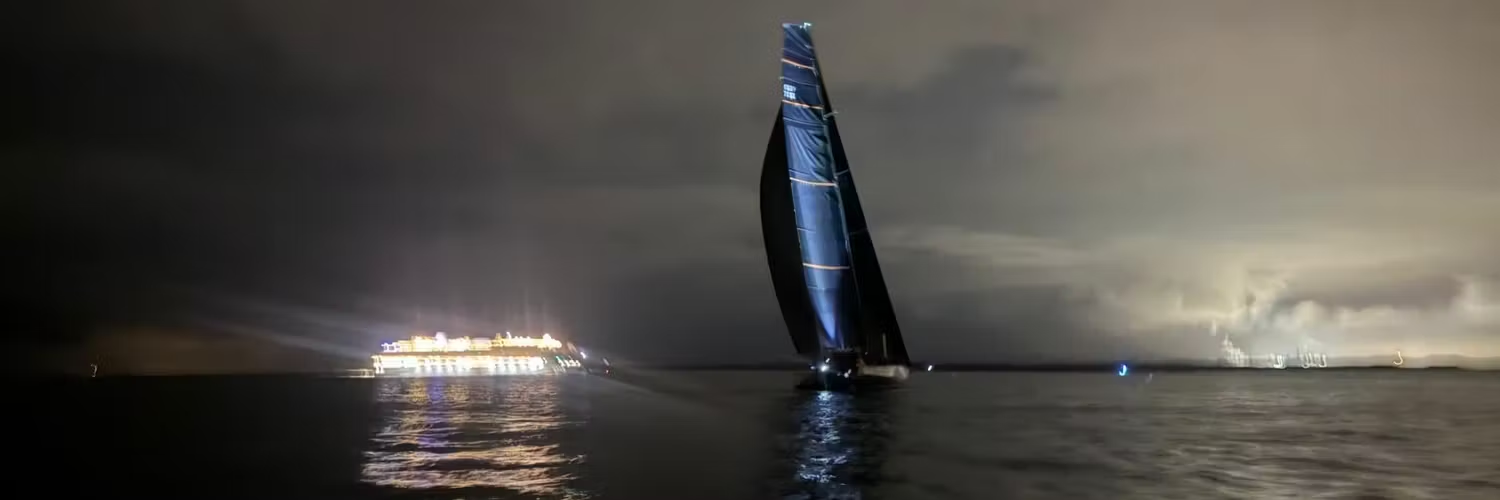
How Pace took line honours in the 2026 Round Britain and Ireland Race, one chapter at a time

Johnny Vincent's Volvo 70 Pace crossed the Royal Yacht Squadron line off Cowes at 04:17:31 BST on Sunday 16 August, taking monohull line honours in the 2026 RORC Round Britain and Ireland Race.
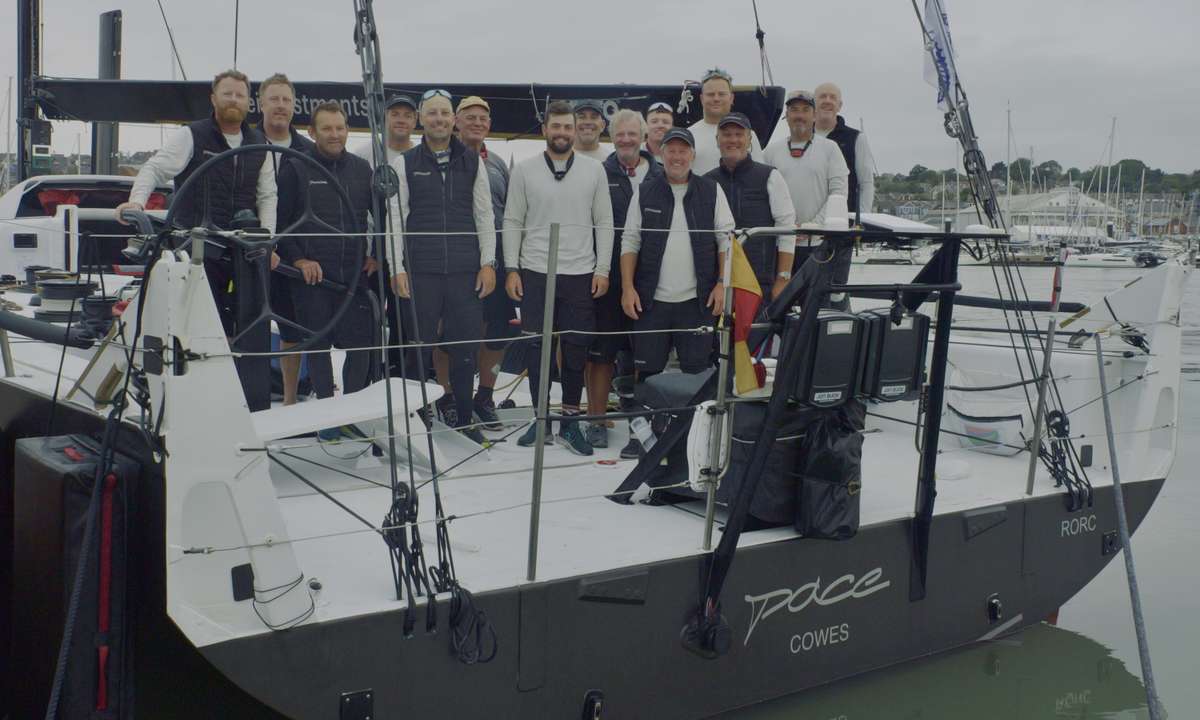
Six days, 14 hours, 47 minutes and 31 seconds after the cannon fired, Vincent – an owner rather than a professional sailor – had sailed the 1,805 nautical miles around Britain and Ireland and come home first, in the 50th anniversary edition of one of offshore racing's most unrelenting challenges. Pace carried a crew stacked with offshore pedigree, among them 2008-09 Volvo Ocean Race-winning navigator Jules Salter and fellow round-the-world veterans Neal McDonald and Stu Bannatyne.
"The Round Britain and Ireland Race is not one yacht race," Vincent reflected after. "It is a series of four races joined together. You do it chapter by chapter and then reach the end of the book when you come back to Cowes. That makes it totally unique. The first chapter takes you through familiar Fastnet waters. Chapter two runs from south-west Ireland to Muckle Flugga in a completely different ocean environment. Chapter three begins when you turn at Muckle Flugga. There is this extraordinary emotion that you are going home, but you are further north than Cape Horn is south. Then comes the North Sea, with oil platforms and gas rigs. The final chapter is probably the most challenging navigationally, with obstructions, separation zones, depth, sand and a very narrow passage through Dover. It arrives when everybody is beaten up and tired, but there is still a lot more to do."
From Cowes back to Cowes, here's how each chapter was won.
First blood at Land's End
Sunday 9 August began with cannon fire and clear skies over Cowes, as 32 boats and 182 sailors from five continents beat cleanly out of the Solent. By the two-hour mark, Pace had already moved to the front, clearing Bembridge Ledge at over ten knots with Jens Kellinghusen's Ker 56 Varuna 6 barely a mile back.
The first real fork came at Land's End and the Isles of Scilly. Pace held the water lead on an inshore line, committing to thread the traffic separation scheme around the Scillies, while Varuna 6 and Antoine Magre's Mach 50 Palanad 4 went further offshore looking to gain. For Palanad, the opening night had been a punishing introduction before the wind finally offered a way out.
"The first six hours of VMG upwind and short tacking in short choppy sea state was not ideal for the 'big spoon' we call home," reported Joss Creswell aboard Palanad. "As darkness fell the wind veered and we were able to ease sheets and put up a Code Zero. Suddenly we were doing 13 knots in 14 knots of windspeed. A big morale boost having done a wobbly six or seven knots for hours."
For Pace, staying at the front through that tricky opening was less about one clever move than a habit of squeezing every mile. "There were opportunities to push hard when it was easy to push hard and to gain from a wind shift, a wind bend or something in the forecast," Salter said. "We tried to do that all the way around the course." That approach was about to be handsomely rewarded.
The low-pressure express
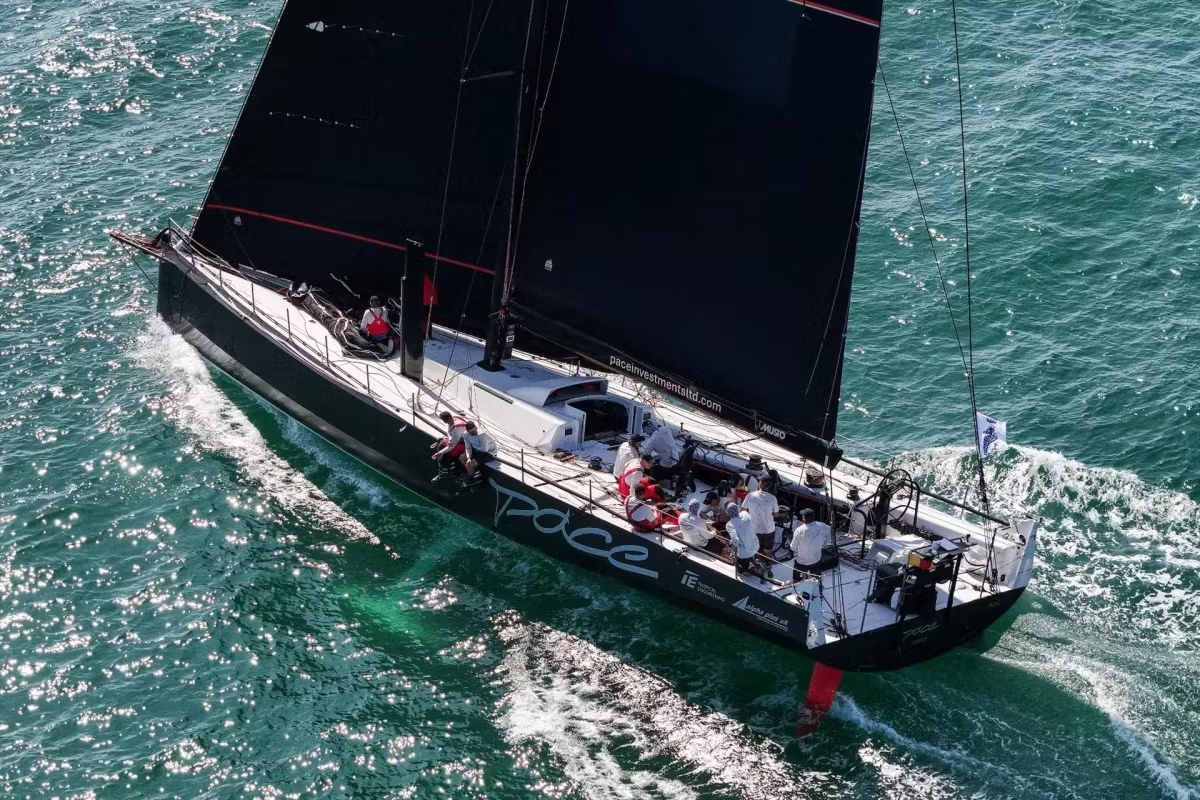
South-west of Ireland, the race changed character entirely. A big Atlantic low, sitting around 999 hPa, took control of the weather and pointed Pace's bow due north, feeding her a fast lane of southerly breeze up the Irish and Scottish coasts. By Wednesday, she had reeled off 428 nautical miles in a single 24-hour run, averaging close to 18 knots. By the time she was off the Hebrides, the team's lead over Varuna 6 had become a commanding one, with Palanad 4 holding third.
From the deck, boat captain Anthony Haines described what that kind of speed actually feels like: "Out here off the Hebrides, Pace is thundering along in a solid 25 knots of breeze from the south. We spent the night in 20-25 knots downwind, the boat averaging 17 to 25 knots, with plenty of water sweeping the deck and keeping everyone honest. It's wet, it's noisy, and it's physical, but the crew is settling into life at sea – finding their own ways to stay comfortable, grabbing rest when they can, and even starting to enjoy the freeze-dried meals. The frantic sail changes of the opening days have eased into a more settled rhythm, and with that comes a quiet confidence on board."
None of that speed comes for free on a Volvo 70. "The crew were incredibly sharp at getting the right sails up and down, then making the small angle changes needed to keep the boat fully on pace," Salter explained. "You are looking at the sea state, wave angles and which little shifts to take. If you keep doing that, suddenly the boat covers hundreds of miles relatively easily."
Behind, Palanad 4 had worked clear of the light stuff and Magre was weighing up what came next. “Pace and Varuna have taken advantage of their larger size and sail area to get away,” he said. “But we are doing all we can to keep up and stay within reach for when the breeze comes in.”
The turn for home
Pace's charge carried her past Bull Rock still holding an hour and 34 minutes over Varuna 6 and five and a half hours over Palanad 4, then stretched further still on the run to St Kilda, where the gap over Varuna 6 grew to seven hours 40 minutes. Palanad was quietly finding another gear of her own – faster than Varuna 6 on the same stretch, clawing back the best part of ninety minutes to close to within three hours 36 minutes of the Ker 56 by the time Pace rounded Muckle Flugga.
Meanwhile, Pace had covered the section from St Kilda in just over 18 hours, pushing her advantage over Varuna 6 to almost 18 hours. For Salter – completing his first full lap of Britain and Ireland despite four round-the-world races – it came down to reading the coastline as much as the weather.
"When you are racing around Britain, you are effectively turning right at every corner. You combine that with the weather and keep the boat at its fastest and most efficient angle. If you minimise the distance and sail faster for a shorter distance, you will do better."
That approach was reflected by the numbers. By the finish, Pace's tracker had logged 2,113 nautical miles against a course of 1,805 – strikingly close to the theoretical shortest route, with only two deliberate deviations, after Black Rock and again in the northern North Sea.
Gybing through the minefield
The run home is the chapter Vincent rates as the toughest, and it's easy to see why. The southern North Sea is a maze of gas and oil fields, shipping separation zones, wind farms and sandbanks, all with hard, invisible edges.
"There were a lot of gybes, sometimes waking people 30 minutes into what was supposed to be a four-hour off-watch because we had to gybe again," said Salter. "That trust between the navigator and the crew is incredibly important."
Pace ran VMG downwind past Norfolk, Suffolk, Kent, Sussex and Hampshire, gybing through the dark until a favourable tide finally carried her back through the Solent. Pushing this hard, this late in the race, was only possible because of the groundwork laid before. "Preparation gives you the confidence to push the boat really hard," Vincent said. "Not recklessly hard, because there is always a margin, but really hard. My understanding of what this boat can cope with has moved up massively. She is part of the team." Stepping ashore just after four in the morning, it took a moment before anything like celebration set in.
"A big sense of completion is how I would describe it. It has been a long journey and a tremendous adventure. What an amazing race and what an amazing event. We had all sorts of conditions: no wind, lots of wind, flat sea, big waves and some great scenery."
The races still being written
Pace has her line honours, but she's only one story in a fleet still racing across half a dozen classes.
Over the weekend, Palanad 4 was leading the projected standings for IRC Overall, with Pata Negra out front in IRC One, GameOn edging Bellino by minutes in IRC Two, Mzungu! holding IRC Two-Handed from Kestrel, and Jetpack under pressure from Zanzibar in IRC Three. Further back, Penfret, Gambit and Swift were locked in their own Class40 battle. Two retirements aside – the Class40 Tjoba and the maxi Venomous, both crews safe and well – the rest of the fleet is still on their way back home.
Pace's four chapters are done, but the overall result is still open. Track the fleet via the RORC tracker with live rankings.
Topics
Articles You Might Be Interested in
Three legs and an electronic brain: how Ferrari Hypersail will fly (Pt. 2/7)
Django 7X edges out Balthasar for Rolex Middle Sea Race overall win
Grigio and Giallo: Up close with the finished Ferrari Hypersail hull (Pt. 1/7)
Inside the Batmobile: a first look at Ferrari Hypersail
Why pro sailors dread the Middle Sea Race - Course Preview
The week in racing - 12 Oct ’26
The Tabarly Effect: how one quiet sailor built a nation of ocean racers
The week in racing - 5 Oct ’26



Member Discussion