
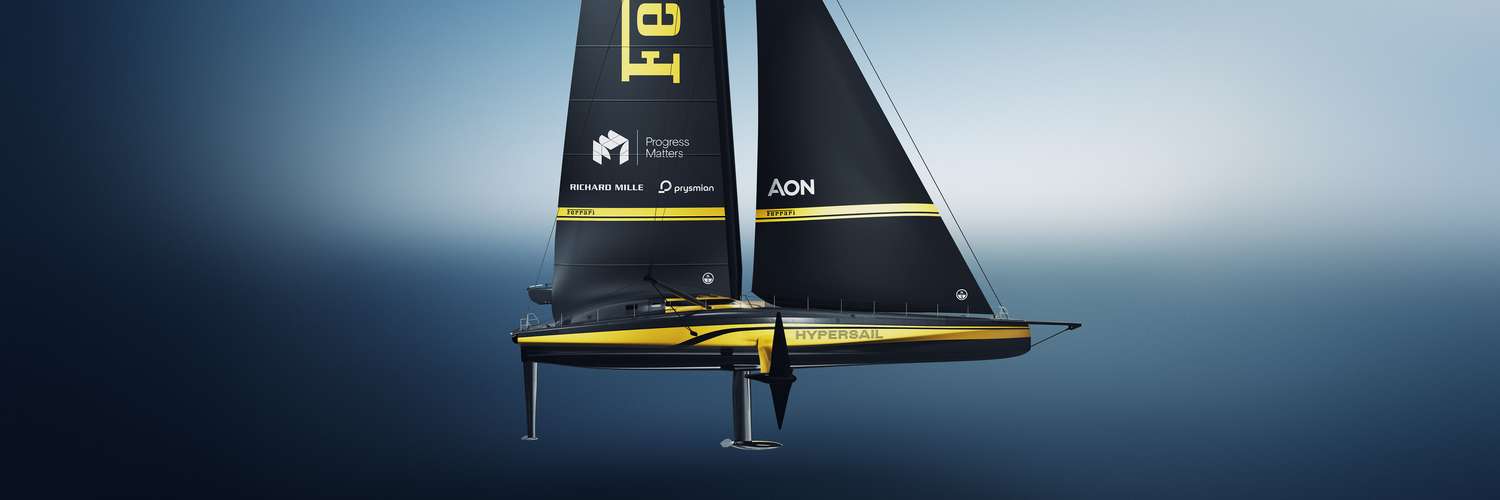
Everything we know about Ferrari Hypersail

Ferrari has never built a boat. So when the most famous name in motorsport finally decided to make one, it was never going to be a weekend cruiser tied up in Portofino.
Hypersail is a roughly 30-metre flying monohull built with a single purpose in mind: to be the fastest offshore boat the planet has ever seen, and to go after records that have only ever fallen to multihulls.
On paper, the boat reads a little like science fiction: solar panels you can walk on, a mainsail with two skins, foils heavier than anything yet built, and a flight-control system borrowed straight from Formula 1.
Due in the water late this year, it’s easily one of the most ambitious things happening in offshore sailing right now. Here’s everything we know about it so far…
Ferrari Hypersail at a glance
- What it is: a roughly 30-metre (100-foot) fully foiling offshore monohull, built to break crewed round-the-world and ocean records
- Who’s behind it: Ferrari’s first sailing project, instigated by chairman John Elkann
- Project leader: Enrico Voltolini, after Giovanni Soldini’s departure in April 2026
- Naval architect: Guillaume Verdier, with a team of around 16
- Ferrari tech leads: Matteo Lanzavecchia (CTO, and Head of Vehicle Engineering) and Marco Ribigini (technical team leader)
- Design: Flavio Manzoni and the Ferrari Design Studio
- Rig and sails: Glenn Ashby, with North Sails Technology Group and Southern Spars
- Size: around 30 metres long, a 40-metre mast, and a 20-metre beam with the foils deployed
- Crew: 10 to 12
- Where it’s built: Pisa, Tuscany – hull lifted from the mould in May 2026
- Power: fully electric, with no combustion engine on board; around 100 square metres of solar, plus wind, hydro and kinetic harvesting
- Headline tech: the first twin-skin mainsail built for offshore, and an automated, F1-derived flight-control system
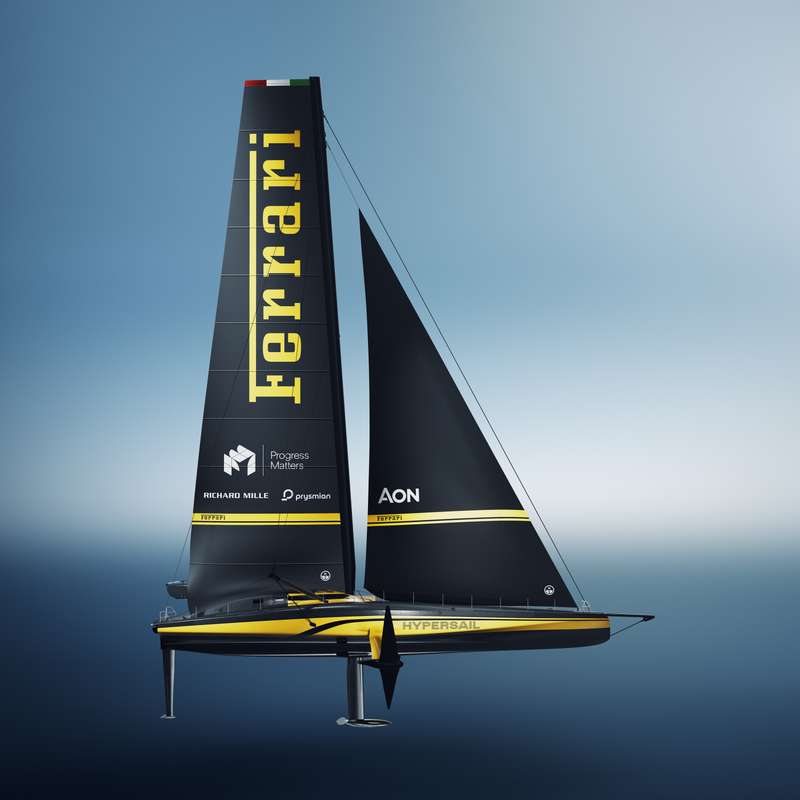
- Livery: Giallo Fly yellow over Grigio Hypersail grey carbon – emphatically not red
- Performance targets: take-off in 10-12 knots, averages in the high 30s and 40s, a top-end somewhere near 50 knots, and 1,000 nautical miles in a day
- Launch: late 2026, followed by a long commissioning and sea-trial phase
What exactly is Ferrari Hypersail?
At its core, Hypersail is a fully foiling monohull built for the open ocean. The design team, led by world-renowned naval architect Guillaume Verdier, think of it as an offshore version of an America’s Cup AC75 – a boat that lifts clear of the water on foils, only one built to do it for weeks at a time rather than a 20-minute inshore sprint.
The obvious question: why a monohull, when every round-the-world record going belongs to a multihull? The short answer is that nobody on the project was ever really tempted otherwise. A trimaran would have meant muscling in on the territory of the Ultim fleet, and in any case the notion of a big foiling offshore monohull – effectively an ocean-going AC75 – had been rattling around in Verdier’s head for years. The recent leaps in the IMOCA fleet pointed the same way: watching the speeds the latest 60-footers were pulling despite their class restrictions, the designers reasoned that a boat with the rulebook thrown out could go a great deal further.
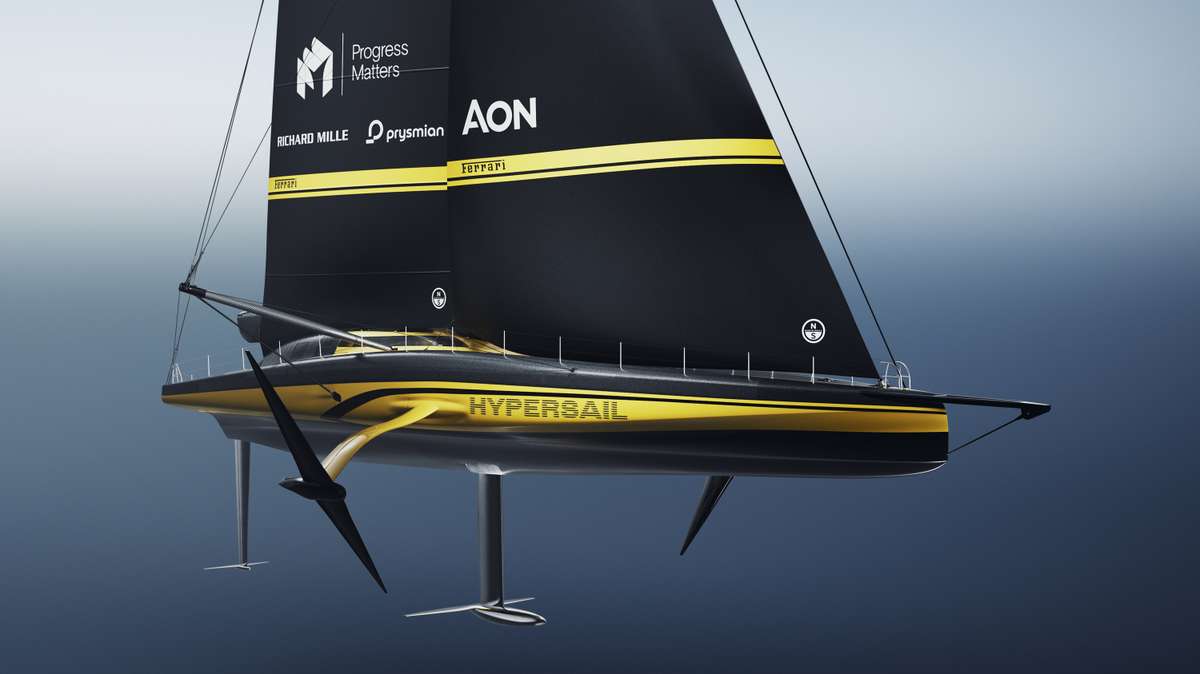
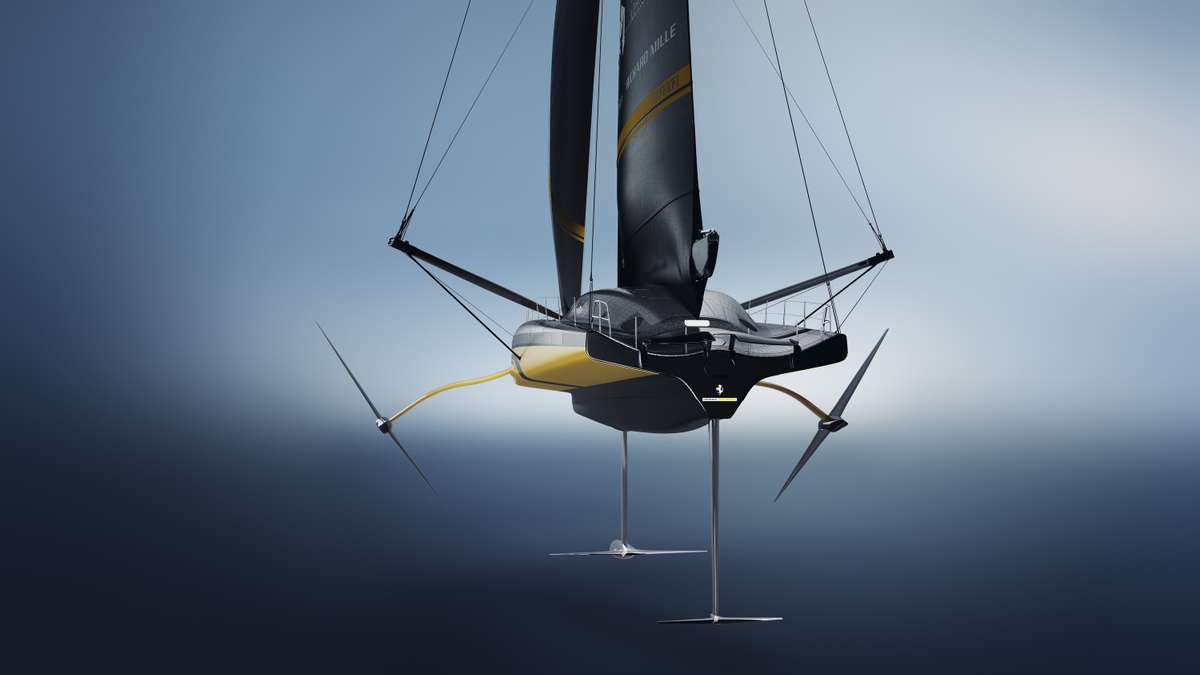
The trick that makes it work sits underneath. Where an AC75 hangs its weight on a single leeward foil and balances on its rudder, Hypersail flies on three points of contact: a main foil, a wing slung under the keel, and the rudder. Roll the boat and the submerged foil bites harder while the airborne one eases off, nudging everything back to where it should be. That’s the theory, anyway, for keeping a 30-metre machine stable in six-metre waves.
Why Ferrari built a boat
The project was instigated by Ferrari chairman John Elkann, who approached Verdier in around 2022 about a collaboration. For Ferrari, the rationale runs through endurance racing: the company has returned to the top of that world with its Hypercar, winning the 24 Hours of Le Mans, and a round-the-world record is endurance competition of the most extreme kind.
Beyond the racing, the team frames the project around what it calls “contamination” – its term for two-way technology transfer. The expectation is not only that Ferrari’s expertise feeds into the boat, but that lessons learned at sea feed back into its cars. The project also reflects the company's wider shift towards electrification – it has recently unveiled its controversial all-electric Luce road car – with a manufacturer best known for combustion engines learning to generate and manage power from renewable sources.
The team behind the project
Hypersail has involved hundreds of people, and the team is emphatic that it’s a collective effort. The naval architecture is led by Guillaume Verdier, one of the most sought-after designers in the sport, whose recent work includes the latest America’s Cup winners, a series of IMOCAs and the new Gitana 18 Ultim. He worked with a core team of around 16.
On the Ferrari side, roughly 20 engineers drawn from aerodynamics, hydrodynamics, control systems and high-voltage electrics are led by chief technology officer Matteo Lanzavecchia and technical team leader Marco Ribigini. The Ferrari Design Studio, under Flavio Manzoni, handled the styling, while the rig and sail package – and the layout of the cockpit – were developed by Australian sailor Glenn Ashby, drawing on his America’s Cup background. North Sails Technology Group and Southern Spars built the rig.
Giovanni Soldini’s departure
The project was originally led by Giovanni Soldini, one of Italy’s most celebrated offshore sailors, whose career includes a renowned mid-ocean rescue of Isabelle Autissier during the 1998 Around Alone race. Soldini was central to Hypersail from the outset, which made his departure in early April 2026 come as a shock to those following along.
Ferrari’s position is that Soldini considered the design-and-construction phase complete and stepped away as the project moved into testing. He declined to give his own reasons.
Into the seat steps 39-year-old Enrico Voltolini, a Lombardy nautical engineer and sailor with a CV that spans the Finn and Star Olympic classes, the America’s Cup and SailGP – and a grinder’s physique that had him do time on Luna Rossa and now the Italian SailGP boat. Elkann has publicly backed the appointment, casting it as the natural step into the boat’s next phase and one taken with Soldini’s experience and advice behind it.
The boat: foils, a canting keel and three points of contact
Get up close and Hypersail starts to look less like a yacht and more like a collision of several different boats.
The hull borrows the AC75’s bustle – a slim lower section that cuts drag whether the boat is flying or just skimming the surface – bolted beneath a more conventional shape above. The designers describe it as a trimaran’s central hull grafted underneath a regular monohull: the bustle keeps drag down both in flight and in that in-between skimming mode, while the fuller hull above helps build speed and generate righting moment when the foils aren’t yet doing their job, or when the boat stops dead.
The appendages are where it gets more radical. Retractable T-foils sit on curved arms, chosen over the IMOCA-style L-foil for the way they spread their loads. A single, enormous 5.5-metre rudder sits behind the keel, deep enough to keep its grip however high the boat is flying. And the real novelty is the keel itself: a canting keel carrying a horizontal wing, with a lead bulb required for safety – a combination never attempted on a full-foiler this size.
None of it came cheap in engineering terms. These are, by the design team’s own account, the heaviest and most heavily loaded foils anyone has yet built for a sailing boat, and finding materials that could survive the punishment of the open ocean was a vast challenge in itself.
Then there is the small matter of parking it. With the foils out, Hypersail spans a little over 20 metres. The team flirted with something easier to slot into a harbour, then let performance win out – and resigned themselves to berthing the thing slightly sideways.
The rig and the twin-skin mainsail
If the foils are Verdier’s territory, the rig is Glenn Ashby’s. Hypersail carries a 40-metre mast with outriggers, a trick lifted from the IMOCA world, and a mainsail unlike anything offshore racing has used before: a twin-skin main, the same concept that powers the America’s Cup boats, scaled up and toughened for weeks at sea. It was tested at small scale on, of all things, a Tornado catamaran before anyone committed to it.
The point of two skins, Ashby explains, is partly raw efficiency and partly stability – the separation of the high and low-pressure sides “really locks the boat in and makes the boat much easier to sail,” which matters enormously when you are loading and unloading through heavy seas rather than a gentle inshore chop.
Inside, the crew of 10 to 12 will be sealed into a fully enclosed cockpit, riding out apparent winds north of 50 knots tucked away inside, emerging onto the deck only for manoeuvres and sail changes. Five grinding pedestals generate the power, the loads being far higher than an Ultim’s. And the whole thing is, in Ashby’s words, “very race car-esque” – there will be no great steering wheel, and stepping inside, he says, is “like sitting in a space shuttle”.
Energy: a boat with no engine
This, for our money, is the part that should really make people sit up. Hypersail has no combustion engine. Every watt the boat needs to fly itself, to drive its hydraulics, to run its computers and to make the crew’s drinking water has to be generated under sail, from the elements it is sailing through.
The reasoning was practical before it was ever environmental. “Since this boat had to spend several weeks on the ocean, if you want to propel this boat using fuel, you would have to fill the boat with petrol,” technical team leader Marco Ribigini tells The Foil.
So instead the team built a harvesting suite. Around 100 square metres of walkable solar panels are spread across the deck and hull sides, their positions worked out by modelling exactly where the sun will fall on a given passage – to the point where, the engineers found, a kilo of panels at the stern was worth two on the deck. Patented wind turbines that thrive at 40-odd knots of apparent wind do the heavy lifting. Hydro generation and a kinetic system – energy pulled from the boat’s own movement, like a self-winding watch – are in development, both already patented.
The approach reflects a broader idea that Verdier has been pushing for years and sees Hypersail as a kind of proof of concept for.
“I think it would be quite fun if you start a race with absolutely zero energy on board. Empty batteries. You go off the dock and you’re allowed to do whatever you want… It would be really clean, and not very different from the fundamentals of sailing. People are so used to this incredibly efficient return that you get from petrol.”
It is, he reckons, the purest version of the sport you could build – grab your energy from the sun, the wind and the water, and forget about regulating who's using how much fuel.
Underpinning it all is a power architecture closer to a hybrid hypercar than a yacht: 800 volts for the large keel and foil cants, 48 volts for the fast-moving flaps, and lower voltages for the electronics.
F1 brains on the water
Hypersail’s flight control is where Ferrari’s motorsport expertise is most directly applied. Keeping a flying monohull stable across a moving ocean for 40 days is a job no crew could do by hand – in the America’s Cup, sailors trim the foils constantly across a 20-minute race, but nobody is doing that for six weeks straight in eight-metre waves. Ferrari’s solution is an automated system that allows the boat to fly itself.
The flight-control system essentially reads the sea ahead like a road. Sensors map the wave pattern coming at the boat and a predictive model trims the flaps to match before the wave even arrives, much as a car’s ABS manages a wheel the instant before it locks.
The architecture controls six things: course, ride height, pitch, leeway, roll, and righting moment. Two groups of actuators do the work – the flaps, which are small, fast and low-energy, and the cants, which are large, slow and high-energy. Sitting behind it all is a Model Predictive Controller (MPC) that uses a sensor system the team calls a "sea carpet" to anticipate wave inputs before they arrive. Activating active flight control, by their own simulator estimates, can boost performance by 10 to 20 per cent. In rough seas, that's three or four knots of average speed, which, over the distance of the globe, is everything.
The expertise behind it runs deep. Hypersail’s head of aerodynamics previously held the same role with Ferrari’s Formula 1 team, and the boat leans on technology threads running straight from the F80 supercar through to Ferrari’s Luce, launched just last month. The "Boost Optimisation" algorithm Ferrari uses on the F80 – which decides where on a track it's worth deploying battery energy, and where it isn't – saved 35 kilos of battery weight without hurting lap times. That same logic is being applied to Hypersail's foil controllers, deciding which wave it's worth flying over and which it makes more sense to surf.
It does raise the inevitable question: does this much automation hollow out what sailing is meant to be? Ferrari’s answer, when the point was put to the team at a recent seminar in Milan, was that today’s cars are nothing like those of 30 years ago, and nobody thinks the joy has been engineered out of driving. The sailor still steers, still hunts the wind, still calls the shots. The boat just handles the flying.
The livery
Hypersail’s livery is built around Giallo Fly, a shade of yellow that Ferrari regards as its “second soul”. It traces back to the helmet worn by 1950s driver Luigi Musso; after his death, his partner Fiamma Breschi suggested the colour to Enzo Ferrari, and it first appeared on the 275 GTB. That it happens to be called Fly, on a boat designed to do exactly that, is a fitting coincidence.
The design borrows visual cues from across Ferrari’s history – the proportions of the Monza SP1/SP2, a coachroof echoing the Le Mans-winning 499P, and a colour split drawn from the 512 BB. The livery was revealed during Milan Design Week in April 2026, accompanied by a dedicated exhibition and a lighthouse installation overlooking Piazza del Duomo.
How fast – and fast enough?
So what is this thing actually capable of? The team is careful with numbers, but the shape of it is clear enough. Hypersail should lift off in 10 to 12 knots of breeze and settle into its happy place in 15 to 20, even 25 – averaging, Ashby reckons, “high 30s, well into the 40s,” with a long-term top end around the 50-knot (57.5mph) mark. It is designed to fly higher than an Ultim, with markedly cleaner aerodynamics.
Crucially, Ashby is at pains to point out that none of this is really about a single headline speed. “It’s not so much about the top speed with any of these big offshore boats,” he tells The Foil. “It’s about your average speed.” Sustaining those averages through a big sea is the whole game. There is a ceiling, though – somewhere around 50 to 52 knots the foils hit cavitation, a hard physical wall the engineers compare to the sound barrier, where the water effectively boils off the surface of the wing.
The boat’s main weakness is light air – in 5 to 10 knots the larger Ultim trimarans hold an advantage – so it’s not designed to perform in very light conditions. The headline target is 1,000 nautical miles in 24 hours, which would surpass the outright 24-hour distance record of 908 miles set by Banque Populaire V in 2009.
Can a monohull really beat the trimarans?
And that brings us to what the whole project is chasing. The benchmark is the Jules Verne Trophy, the outright record for sailing non-stop around the world, and the bar is high. In January, Thomas Coville and his crew aboard the maxi-trimaran Sodebo Ultim 3 went round in 40 days, 10 hours and 45 minutes, covering more than 28,000 miles at an average of 27 knots and finally toppling a mark that had stood since 2017.
Here’s the fact that makes the task so daunting: every Jules Verne record in the trophy’s history has been set on a catamaran or trimaran. No monohull has ever held it, and Ferrari wants to be the first.
And here's the twist: Hypersail’s closest rival comes from the same design office. Verdier’s team also designed Gitana 18, the new 32-metre Maxi Edmond de Rothschild Ultim that launched in February 2026 and was already foiling in around 10 knots of wind off Belle Île by late May, with Charles Caudrelier as skipper and a Route du Rhum debut scheduled for November.
Having designed both boats, Verdier is reluctant to predict which is quicker, framing the comparison in terms of physics: both are limited by cavitation and by similar lift-to-drag ratios, so “the difference is the weight”. That weight is the monohull’s cross to bear: safety rules force it to carry a lead bulb the trimarans don’t need. The trade-off is the cleaner aerodynamics that should let it fly higher and hold its averages better once it’s up and going.
Will we ever see Hypersail and the Ultims line up alongside each other? Almost certainly not – this is a project about records and the clock, not fleet racing. As for the headline number, the design team have set themselves a target of 1000 miles in a single day. No mean feat, given the outright 24-hour distance record stands at 908 nautical miles, set by Banque Populaire V back in 2009.
Where it’s at, and what happens next
It might be tempting to write off Hypersail as a Ferrari vanity project – a brand looking for a new way to put its logo on something fast. But that undersells it. The technical brief is genuinely radical: an offshore monohull faster than anything before it, fully self-powered, with road-car-derived active flight control taking on the open ocean.
It's also a challenge to French dominance of the outlandish offshore programme, which has been fairly absolute for 30 years. While the Verdier team is largely French, Ferrari is Italian. The yard is in Tuscany. The sailmakers are global. The result is an international project of a kind offshore sailing has rarely seen at this scale – and one that, for once, isn't being run out of Lorient.
And for all the talk and the renders, this is now very much a real boat. Around 20 hull shapes were run through Verdier’s simulator before one was settled on – the team worked their way through most of the alphabet naming them, by their own reckoning – and the chosen design was poured into four moulds at a yard in Pisa. Twenty-two bulkheads went in, the deck was married to the hull, and in May the whole thing was lifted clear of the mould for the first time, after more than a year of curing and lamination.
The boat now has its mechanical, hydraulic and electrical systems to install before it touches the water late this year, and then comes the long commissioning and debugging phase that Ashby flags as the real key to the whole programme. Hypersail is built as a platform meant to run for the next five or six years, which is to say nobody expects records overnight.
But the slow burn is part of what makes it worth following. Whether or not a monohull can finally out-run the trimarans, it’s hard not to appreciate the sheer nerve of it – a project this outlandish, and this far outside the French scene that has long dominated offshore records. We'll see it on the water in a matter of months, and we can't wait to see whether it lives up to the billing.
The next update isn't far off, either. Ferrari will reveal the latest on the Hypersail programme in Maranello, the company’s spiritual home, on 23 June. The Foil will be there to bring you everything.
Articles You Might Be Interested in
The Tabarly Effect: how one quiet sailor built a nation of ocean racers
The week in racing - 5 Oct ’26
The week in racing - 28 Sep ‘26
The week in racing - 21 Sep ‘26
The week in racing - 14 Sep ‘26
United By The Ocean edge out 11th Hour Racing to win the first Ocean Race Atlantic

Podcast: Valencia SailGP review, and does the ACP break its own rules?
One week in: Q&A with The Ocean Race Atlantic’s Niall Myant-Best



Member Discussion