
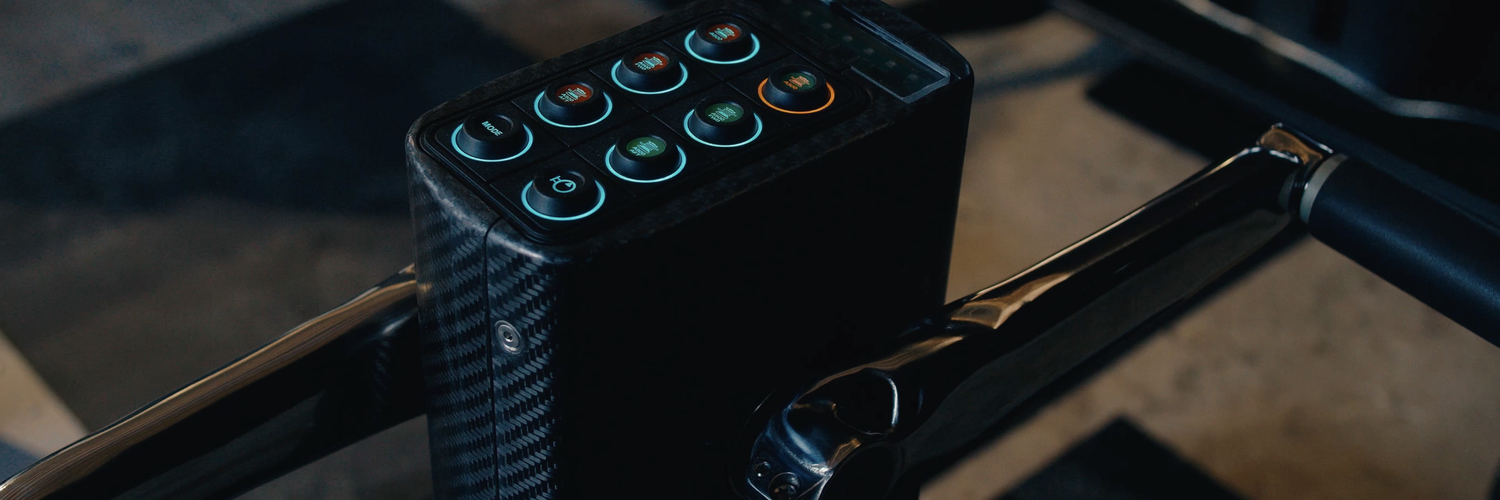
Ferrari Hypersail’s blank-sheet answer to grinding (Pt. 4/7)

Ferrari’s engineers threw out the gearbox and turned Hypersail’s grinders into generators. Andy Rice put the winch-by-wire system to the test.
When I was offered the chance to try Hypersail's innovative winch-by-wire system, I didn't exactly leap at the opportunity. There's no quicker way to humiliate yourself in front of an audience than getting hot and sweaty trying to turn winch handles. But I gave it a go anyway, and compared with conventional grinding it was far easier. Not easy, just easier.
The idea came from one of Ferrari's automotive engineers, Matteo Lanzavecchia, Chief Technology Officer for Ferrari Hypersail. On my recent visit to Pisa to see the almost-completed 100ft foiling monohull, Lanzavecchia explained what was wrong with the old way of doing things, and he reached for a cycling analogy to do it.
"A traditional winch system is like using pedals and a gearbox on a bike," he said. "The problem with the conventional system is that you need to align the pedals, the winches and all the elements of the transmission."
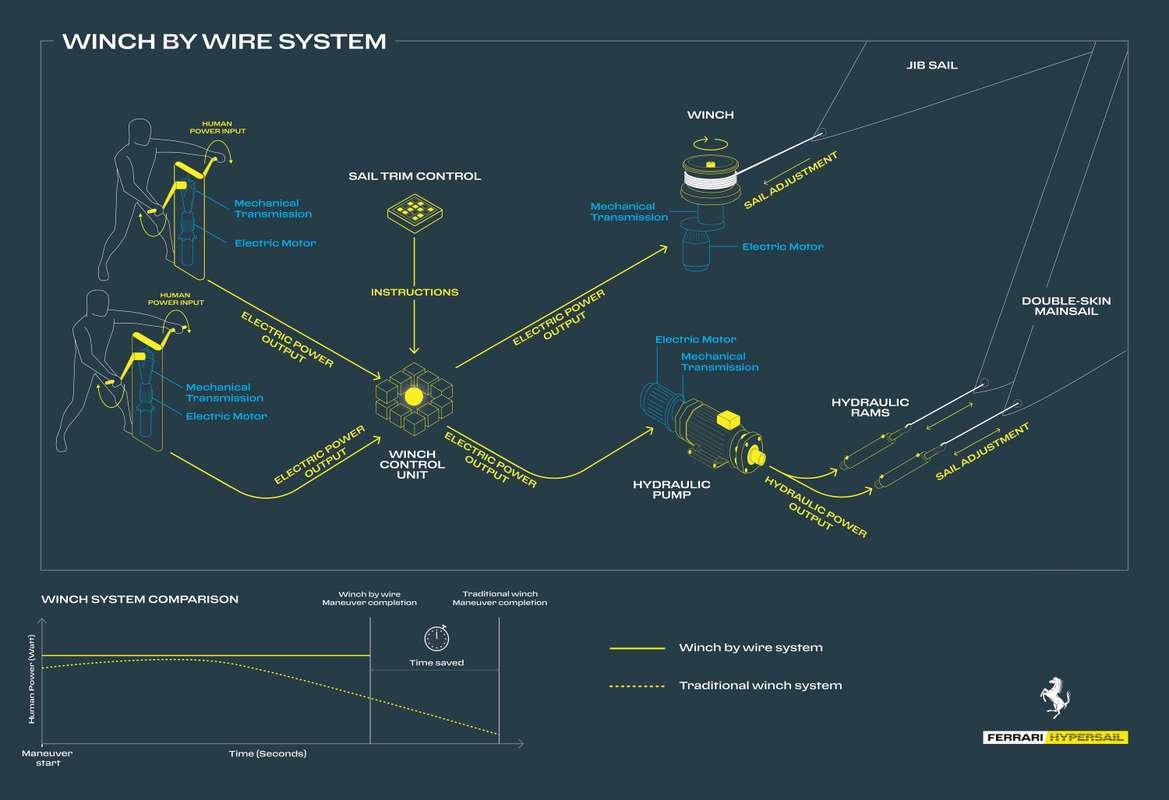
That mechanical linkage comes at a cost. According to Lanzavecchia, coordination losses between the pedestals can wipe out up to 25% of the total power when four of them are working together. Then there is the business of switching from one pedestal to another, "which means stopping, disconnecting, reconnecting and then starting again."
The real pain arrives at the end of a manoeuvre, when the load on the sails is at its maximum. "It's like riding uphill on a bike with a fixed gear ratio," he said. "You end up making very slow movements at very high torque."
From grinder to generator
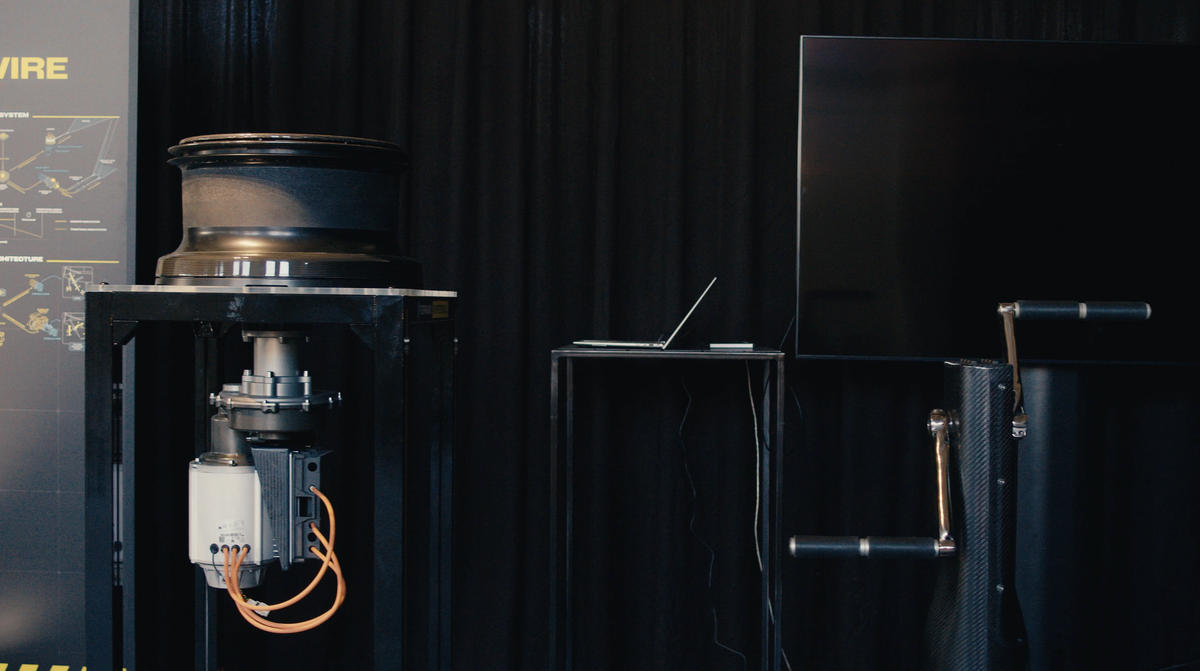
Ferrari's answer was to start again from scratch. "Our system is a blank-sheet approach to sail trimming," said Lanzavecchia. The conventional pedestal has been replaced with an e-pedestal, effectively a generator that converts the grinder's mechanical effort into electrical power. That power is distributed on a 48-volt bus to a winch control unit and then sent on to the actuators.
Freed from the constraints of a gearbox, the grinders can work at a fixed point and at a very high speed, which is where the human body performs best. Ferrari put some of the grinders through tests in a medical environment and found that their metabolic efficiency peaks at around 80 to 120 rpm.
"From the start, the goal has been to keep the grinders working in that zone of maximum power and maximum efficiency, so they're less tired at the end of a manoeuvre," he said.
No gearbox, no dead time
The electrical approach brings practical benefits too. Because nothing needs to be mechanically connected, the pedestals and actuators can be installed wherever suits the boat, with no alignment requirements. And power can be switched from one actuator to another instantly. "There's no dead time spent stopping and starting again," said Lanzavecchia.
He is candid that electric motors offer no great efficiency gain in themselves. "In terms of efficiency, there's not much difference from one motor to another," he said. "The big advantage is that you can grind at a constant speed, which means you burn a lot less energy yourself."
It also changes how a boat's systems are sized. "Normally, if you need the power of three winches, you fit four, because one is effectively lost, like on a tandem bicycle," he explained. "With our system, every single input is converted into useful energy, so you don't have to oversize it."
Keeping the feel
Lanzavecchia says the idea met with little resistance inside the project. The one complaint concerned feel, because a mechanical system gives the grinder direct feedback. Here, the boat and the road cars have been learning from each other. Ferrari has used the technology to develop the by-wire gearbox controls for the upcoming Ferrari 12Cilindri Manuale, in which the traditional cable-operated clutch is replaced by electronics while preserving the sensation of the real thing.
"It gives you exactly the same feeling and experience," he said. "You still feel the clutch through a spring, but behind it there are only wires. It feels good, so we think that, at the end of the day, we've got a good idea."
Beyond Hypersail
Ferrari is confident enough in that idea to have patented it. Whether it will find its way onto other boats is another question. Hypersail was designed around the rule that all the energy below deck must be human-powered, a constraint that doesn't apply to most yachts. "On boats that aren't racing, you can simply have an electric winch with a push button," Lanzavecchia acknowledged.
Even so, he sees the wider philosophy as the way forward. "In general, a self-sufficient boat that harvests energy from solar panels and wind turbines is a greener approach," he said. "We don't burn any fuel at all."
Fittingly for a system born out of a cycling analogy, the original spark came from Lanzavecchia's own e-bike. "I'm really into bikes, and an e-bike still relies on a gear shift," he said. "You have a central electric motor that assists you, and then you change gear."
His thought was to go one step further. "My idea was that if you fit two motors, one in the centre and one in the wheel, you can manage everything electronically and always choose exactly the right speed," he said. "We do a lot of thinking like that at Ferrari."
In Part 5, I look at the rig, the sails and the boom that nearly disappeared.
Topics
Articles You Might Be Interested in
Route du Rhum runners and riders: IMOCA
The boom that survived on Ferrari Hypersail: rig, sails and seeing in the dark (Pt. 5/7)
Route du Rhum runners and riders: Ocean Fifty
Route du Rhum runners and riders: Ultim

Route du Rhum 2026: the essential guide
No fuel, no engine: how Ferrari Hypersail powers itself (Pt. 3/7)
Russell Coutts calls time on SailGP’s veterans, but age is the wrong target



Member Discussion