
The questions that remain following New York SailGP


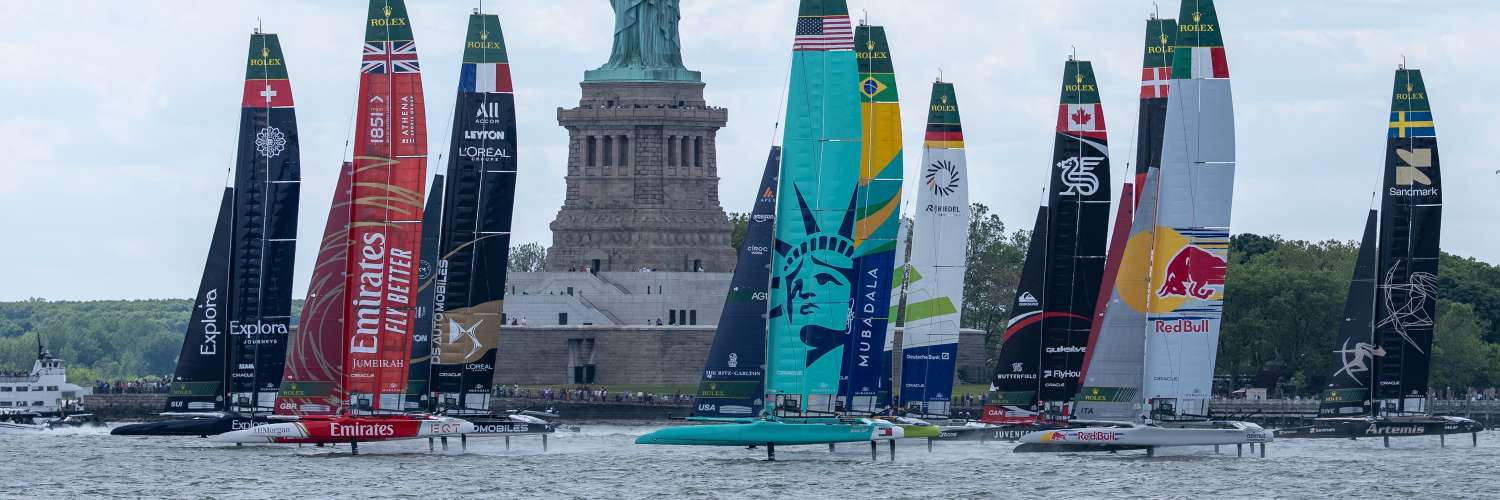
The New York SailGP left us with more questions than answers. From a dramatic three-boat collision to a grand final that divided opinion, the sixth round of the season gave the league plenty to reflect on ahead of Halifax.
1. Is it time for new starting rules?
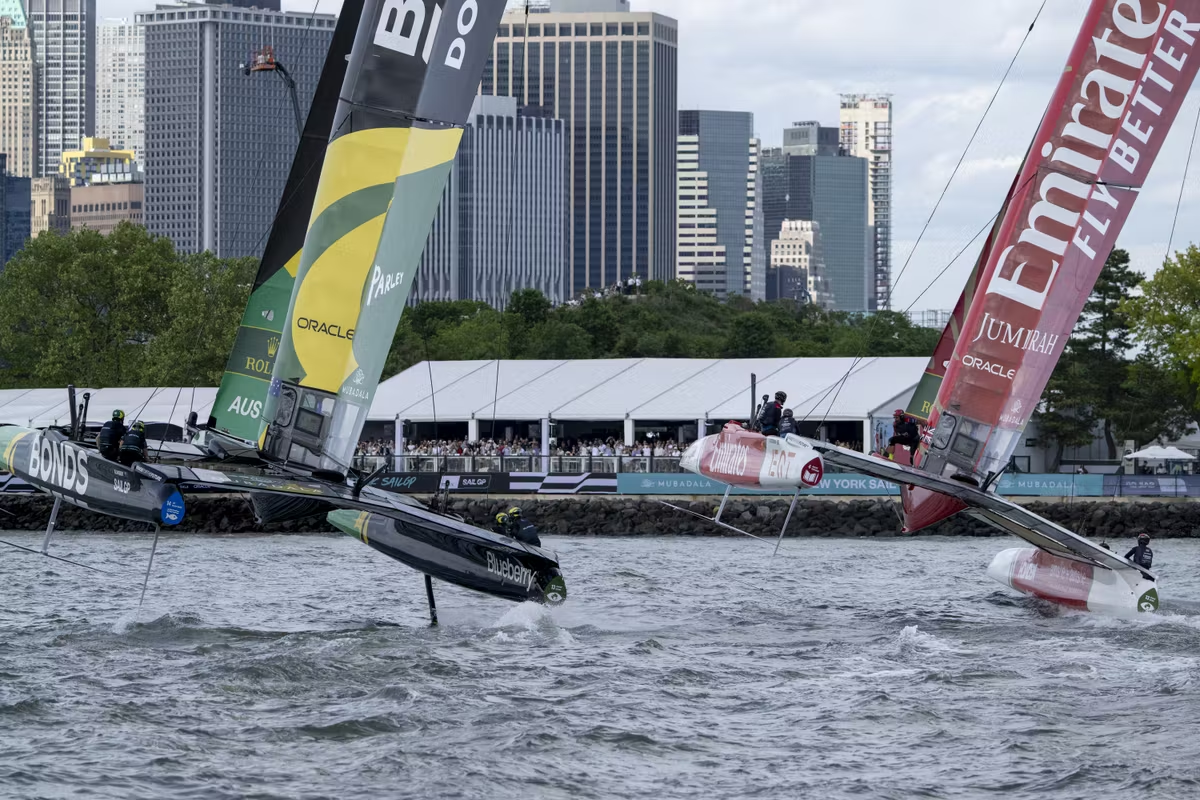
The three-boat collision in race three on Sunday was the defining moment of the weekend, and not for the right reasons. The USA received seven penalty points and Italy four, the correct decisions in accordance with the rules, in my opinion. USA failed to keep clear as a windward boat, and Italy did not do enough to avoid contact.
What I do question, however, is whether the current rules are fit for purpose in the modern context of SailGP. Italy's manoeuvre was not unsportsmanlike under the current rule set, but it was dangerous.
Italy turned almost 90 degrees to the start line, presenting their boat side-on to the oncoming fleet. As Mozzy highlighted to me, the configuration of the start line allowed Italy to sail along it to a degree we rarely see during other SailGP starts. The rules and course configuration permitted it, but should those rules allow it in the first place?
My proposal would be a change to rule 17, aligned with the approach used in Appendix B for windsurfing fleet racing, where at 30 seconds to the gun, all competitors are required to sail their shortest course towards the start line.
Appendix B Windsurfing Fleet Racing Rules
17: On the same tack before a reaching start
Rule 17 is changed to:
When, at the warning signal, the course to the first mark is approximately 90 degrees from the true wind, a board overlapped to leeward of another board on the same tack during the last 30 seconds before her starting signal shall not sail above her shortest course through the starting line to the first mark while they remain overlapped if as a result the other board would need to take action to avoid contact, unless in doing so she promptly sails astern of the other board.
In practice, you would essentially have two phases: the jostle for position before 30 seconds, and then a clean, directional run to the line. Once a team has a lane, they sail it. Any changes in course in the last 30 seconds, and it’s the duty of the boat changing course to keep clear.
Whether 30 seconds is the right threshold or whether 10 or 20 seconds might be more appropriate, I’m not certain, but the principle feels right. I think it would go a long way to prevent incidents like the one we saw in New York.
2. Will we see the USA boat sacrificed for repairs to the Italian’s?
This is not without precedent. Cast your mind back to Sassnitz in 2025, when the British and USA boats collided. The USA were deemed to be at fault, and the British boat was too damaged to race on Sunday.
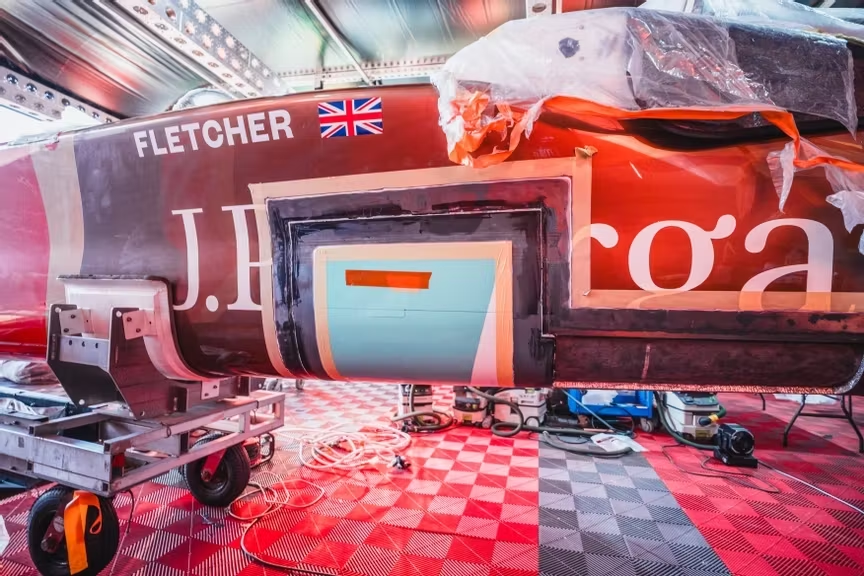
The response? A section of hull from the USA F50 was cut out and donated to Great Britain so they could take to the water. The question now is whether something similar could happen ahead of Halifax.
Italy's boat appears to need the most significant repairs from the New York collision. If there is a genuine risk that the Italian team cannot get their boat ready in time, would SailGP look to the USA to provide a solution? Could we see a sacrifice of the American platform to get Italy back on the start line?
Sources told me that the spare hull sections remaining after the repairs to the French and Kiwi platforms after the Auckland crash have already been air freighted to Halifax to help with the salvage efforts.
A slightly more left-field theory concerns brand new boat 14, which was announced in New York as being the hull that the Black Foils are set to make their return to racing on in Halifax.
As the only team left in SailGP still to source private backing, the Black Foils remain centrally controlled by SailGP. With the Italian boat having commercial interests that may outweigh the Kiwis, could we see boat 14 temporarily handed over to the Italians? Likely not, but I thought I would throw it in there.
As far as I understand, SailGP Technologies plan to have all three boats on the start line in Halifax, but repairs to the Italian boat will be the tightest to complete in time. There’s still every chance that we could see one of these solutions deployed by SailGP if the deadlines are too tight.
It is worth watching this one closely.
3. Have Spain been hard done by?
Buried within the boat logistics story is a subplot that deserves its own spotlight: the fate of boat 14 and whether Spain, and the rest of the fleet, have been left short-changed.
Los Gallos have the oldest F50 in the fleet, and it has shown. Diego Botin has always been clear that the boat is not slow, and the team’s results show that. When Spain race, they race fast.
The problem is getting to the start line in the first place. Reliability gremlins have plagued the team throughout the season, forcing them out of races through no fault of their own. New York is the most recent example with the team missing out on the point-scoring races on Sunday.
The arrival of boat 14 felt like the natural remedy. The widely held expectation was that the new platform would go to Spain, with the Spanish hull then passing to the Black Foils to get Burling's team back on the water following their devastating crash in Auckland with the French.
That felt fair. The Kiwis crashed out, destroying their boat, whereas Spain have suffered technical issues through no fault of their own. The logic of rewarding the victims of reliability over the Kiwis, who were deemed at fault for their crash, seemed sound.
Then it all changed. It was announced at the New York SailGP press conference that boat 14 would go directly to the Black Foils, with Spain continuing with their ageing hull.
Sources told me that the driving factor behind the decision was time. Repainting the Spanish hull to the Kiwi livery may have pushed the Black Foils' return beyond Halifax, and that is a delay the league is clearly not willing to accept. It seems a few tins of paint may have ultimately decided who receives the new boat.
A deeper point relates to the Pensacola training base, still without its resident F50. Along with the original expectation that Spain would receive boat 14, it was thought that the unreliable Spanish hull would find its new home in Pensacola. Crucially, allowing teams to train - something that is becoming an impossible task in the league. It is easy to underestimate just how deep the knock-on effect of the Auckland crash has had on SailGP.
Giving the Black Foils boat 14 may well be the right call commercially, given the pressure the league faces to get one of its most high-profile teams back on the water. Whether it is the right call for Spain or athletes in need of training time is a harder question to answer.

4. How many boats need to be craned in for scores to count?
Saturday in New York threw up a question that the rulebook has not yet answered cleanly.
Strong wind conditions meant only four boats were successfully craned in. The following morning, SailGP publicly made the call not to count Saturday's results in order to uphold the integrity of the competition.
“In the interest of maintaining the integrity and fairness of competition, the Race Committee has determined that racing sailed on Day 1 will not be scored.
Scoring for the Mubadala New York Sail Grand Prix will commence from Day 2, with all results counting towards the 2026 Season Rolex SailGP Championship standings.”
That decision was understandable, and one I agree with, but it sits awkwardly alongside what happened in Halifax last year, when two boats were unable to be craned in, and scores counted.
So we now have a spectrum: two boats absent and results stand; eight boats absent and they do not. Somewhere between those two points is presumably a threshold, but it has never been defined.
If a similar situation arises again, the league should not have to make an on-the-spot judgment call. A clear written threshold, determining at what point reduced fleet numbers compromise the validity of racing, would bring consistency and clarity.
5. Will we ever see VAR in sailing?
I had a great conversation with Freddie on the podcast about the two incidents in the closing 30 seconds of the grand final between Great Britain and Australia. It got me thinking about the broader question of officiating in SailGP.
There was a close rule 10 and rule 11 call in quick succession, and in my view, Great Britain were hard done by on the latter. Based on my review of the footage, I believe Australia should have received a penalty for not keeping clear as a windward boat, which likely would have flipped the result.
Now, I do not envy the umpires. Making those calls at the speed they do, with the pressure they have on them, is genuinely one of the hardest jobs in the sport. I have enormous respect for what they do, and I probably would have made the same decision given the same time frame.
But it does raise the question: would they feel more empowered to make their decisions if they had more time to do so? In a grand final situation, would there ever be a case for placing the winning moment on hold while a brief review takes place? Just like a VAR check in football?
I am not suggesting umpires are getting decisions wrong routinely, far from it. But if the tools exist to get more decisions right, the sport should at least be having the conversation.
The questions are part of the story
Not all of these questions will be answered publicly. Some may well be resolved behind closed doors, and we may never learn the full picture.
SailGP is one of the best things to happen to sailing in a generation, so these questions are worth asking for athlete safety, the integrity of the competition, and the long-term commercial health of the league.
Articles You Might Be Interested in
Los Gallos snatch Geneva from the Flying Roos
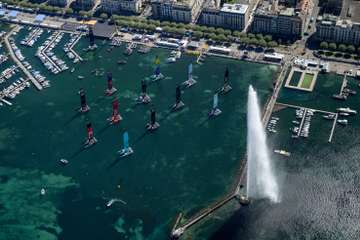
Five races, five winners on day one of SailGP's Geneva drift
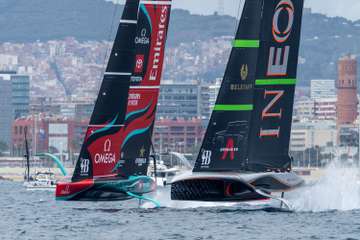
Ratcliffe isn't backing down – what the latest INEOS vs Athena court filing tells us
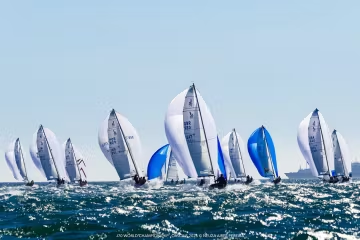
Freddie Carr: Oceanpact-Viking holds its nerve to win J/70 World Championship

Martine Grael points to ‘team dynamics’ after Brazil SailGP exit
Two drivers down: Who steers the US at Geneva SailGP?
Freddie Carr: Leopard 3 and North Star III crown a Maxi Yacht Rolex Cup for the ages
The week in racing - 14 Sep ‘26



Member Discussion