
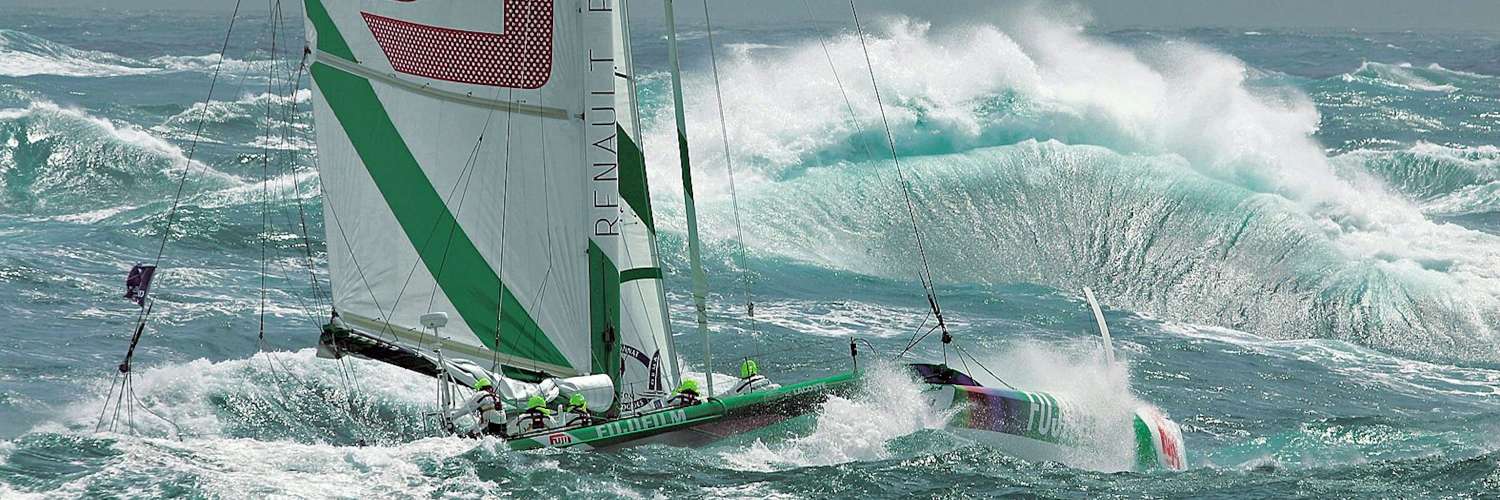
Loïck Peyron on the night Fujifilm fell apart

In 2002, a fleet of 18 multihulls started the Route du Rhum. Only three finished. Loïck Peyron recalls the storm off Cape Finisterre that tore his brand-new trimaran to pieces, the strange calm that followed, and the leap of faith that saved him.
The numbers from the 2002 Route du Rhum still sound like a misprint. Eighteen multihulls started. Three reached Guadeloupe.
“We went too far,” Loïck Peyron says simply. “To define the limit, you have to go too far.”
The boats were the ORMA 60s: 60-foot trimarans, extremely light, with towering wing masts limited in height but not in area. They had to be raced across a multiple of formats, inshore and offshore, solo, two-up, and with crews of 12. They were among the fastest and most fragile racing machines ever built.
And the autopilots, Peyron says, were “completely dumb”. You pressed a button and the boat tried to follow a compass heading or the wind. In a big sea, that was not enough. The skippers had to steer.
Twenty-eight hours on the helm
Four days after the start, a deep south-westerly storm caught the fleet off northern Spain. Peyron estimates he and his rivals spent around 28 hours hand-steering with no sails at all.
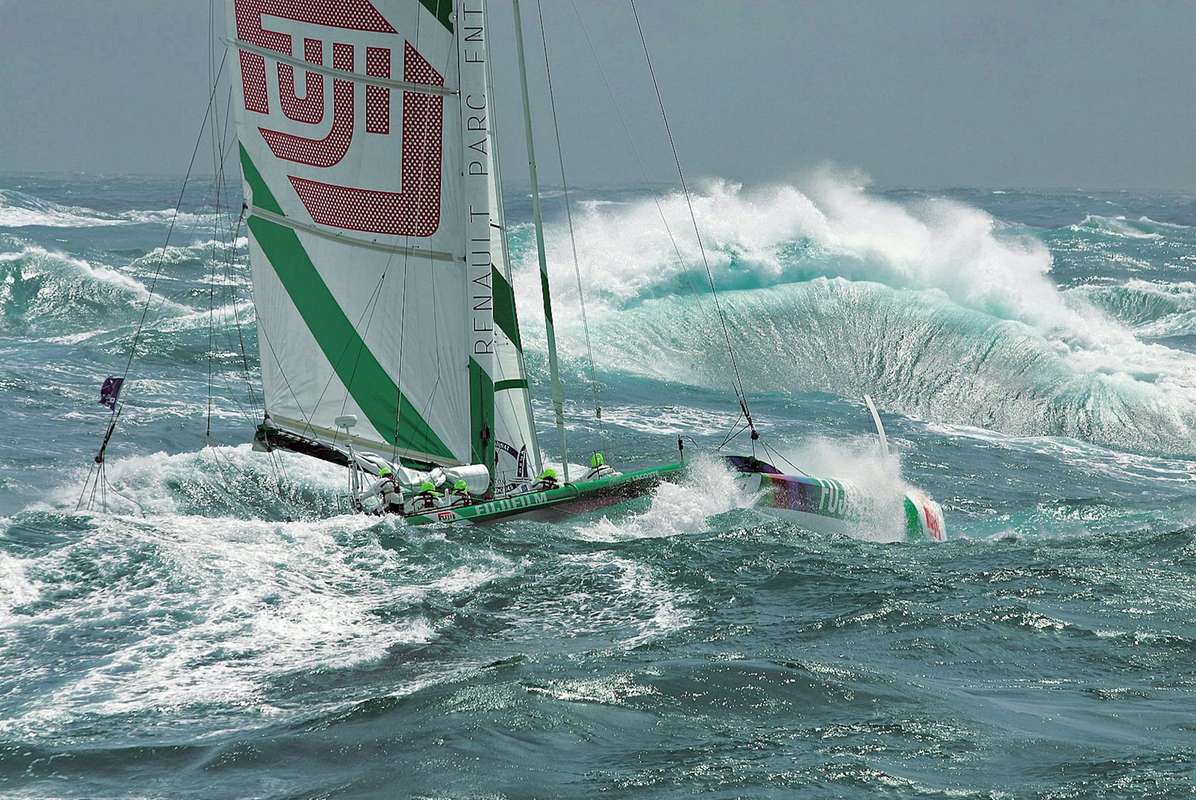
On Fujifilm, the wing mast alone was enough to lift a hull clear of the water. He was flying on one float through the night, in 45 knots, under bare pole.
The helming position on an ORMA was outside, on the beam between the main hull and the float. “If you capsize, you're definitely in a bad position,” he says. He kept the foils mostly up so the boat would skid sideways rather than trip. “That's why I have so many white hairs,” he jokes, “and I'm not so old.”
Three mistakes from disaster
At dawn the cold front came through and he gybed. But he had forgotten to lash the mainsail to the boom. The sail flogged free in the gale and tangled itself in the lazy jacks.
Now on starboard tack, he had the swell and breaking waves hitting him side-on. The plan was to hoist a triple-reefed main and build speed. But he had spent too long underpowered, and a trimaran without power bangs from side to side.
Then a breaking wave hit. It snapped the starboard float clean in two.
On those boats, the shrouds ran to the end of the aft beams, close to the floats. With the float broken, the rig began to move. Then the mast came down over the other side, smashing the port float and ripping away a rudder.
No floats. No mast. A wreck pitching in the Bay of Biscay.
The urge to sleep
So what next, in a life-or-death scenario? “The first reflex I had,” he says, “was to sleep.”
He explains it with the logic of a man who had been on the edge for days. The hull could not sink. There was no lead keel bulb to drag it down. For the first time since the start, there was no immediate risk and no noise.
“Imagine you are in a car at 600 kilometres an hour with a lot of noise, and suddenly there is no more engine. You're happy.” It was, he admits, almost a relief. He had felt exactly the same when he lost his mast in the 1994 race.
He did sleep, briefly. But the race organisers could see his position had stopped, and the phone calls began.
The leap
That afternoon a Russian cargo ship arrived, rolling heavily in the swell. The plan was standard: the ship comes up to windward, and the sailor jumps for a scramble net hanging down its side.
The problem was the two bare carbon beams sticking out where his starboard float had been. As the trimaran rolled and the freighter rolled, they swung like giant hooks. If the net snagged them, the wreck would flip and take him with it.
So he waited for the moment the net rose out of the water, ran along a beam no wider than a plank, and jumped. “It's a slow-motion story,” he says. He caught the net. Above him, Russian sailors hauled him up. “Pull, pull, please,” he remembers thinking. “I don't have any strength.”
And if he had missed? In his survival suit, he thinks he might have swum back to the wreck and tried again, “just before being swallowed by the propeller of the big cargo ship.”
One last search
The freighter dropped him in the Azores, and he flew straight to Spain. Fujifilm was a brand-new boat and he wanted her back.
But every salvage tug for miles was already busy. In the same storm, a huge oil tanker was sinking off the Spanish coast. Peyron eventually found an ancient tug in Portugal. He had lost track of the wreck, so he hired a small plane, flew it far offshore himself, and found her.
Two or three days later, he and a team-mate dived from the tug and climbed back aboard. She could not be towed. Fujifilm ended her life on a Portuguese beach.
Topics
Articles You Might Be Interested in
Who’s hurting and who’s leading 24 hours into the Route du Rhum
The sweeper of the Atlantic
Things that go bump in the night: Gitana 18 skipper Caudrelier on risk at 40 knots (Pt. 5/6)
How Gitana 18’s skipper learned to sleep (Pt. 4/6)
Why Gitana 18 is in the hands of a Figaro man, not an Olympian (Pt. 3/6)
Route du Rhum runners and riders: Vintage Mono
From Tabarly to Gitana 18: why France goes mad for solo sailing (Pt. 2/6)



Member Discussion