
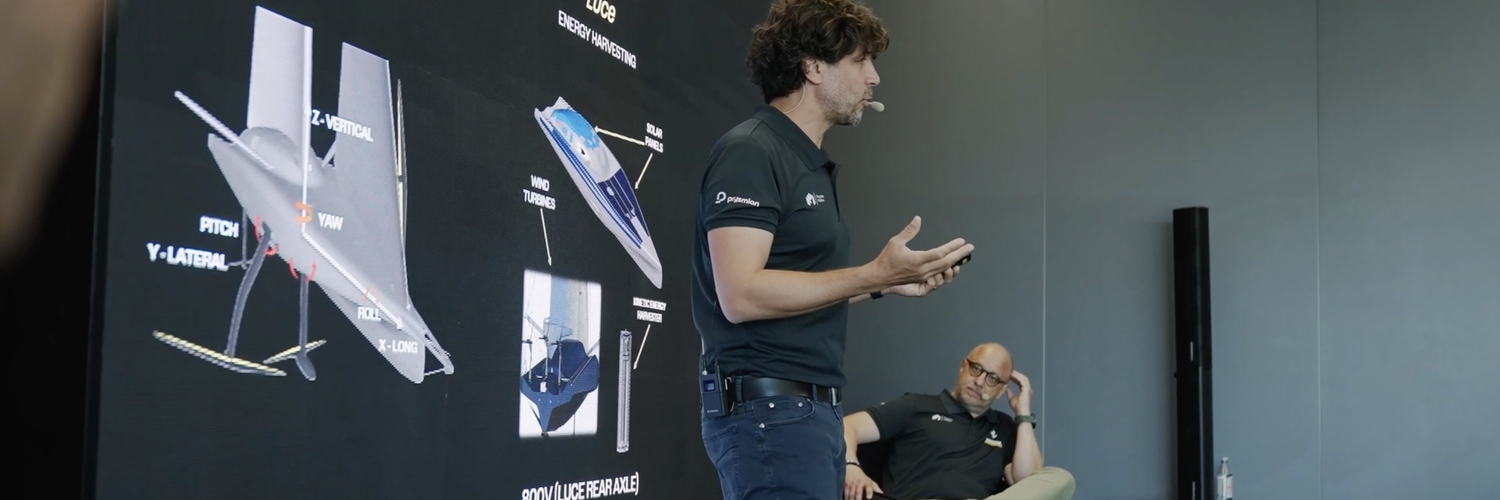
Ferrari Hypersail technical lead on flying tacks and beating the trimarans (Pt. 6/7)

Marco Ribigini, the windsurfer who leads the technical development of Ferrari Hypersail, talks about sleepless nights, numbers he won't share and the big unknown.
Marco Ribigini had already given a lot of interviews by the time I got to talk to him. So I asked him the question I like to ask at the end of a long press day: what is the one thing nobody has asked you?
He thought about it, then answered with a smile: “If I sleep well at night thinking about this project, and the answer is no.”
Why not? “Because it is a challenge,” he said. “Sometimes in the night you wake up and say, ‘Did I do this calculation correctly? And what if, what if, what if?’”
I suggested that these late-night thoughts were more a dream than a nightmare. “Luckily, most of the time it is a dream now,” he said. “But it could become a nightmare.”
When I was at the construction yard in Pisa, it was clear why the Technical Team Leader of Ferrari Hypersail might lie awake. He has been working on complex systems at Ferrari since 2006. He knows how good simulation can be, but he also knows its limits.
A windsurfer's instinct
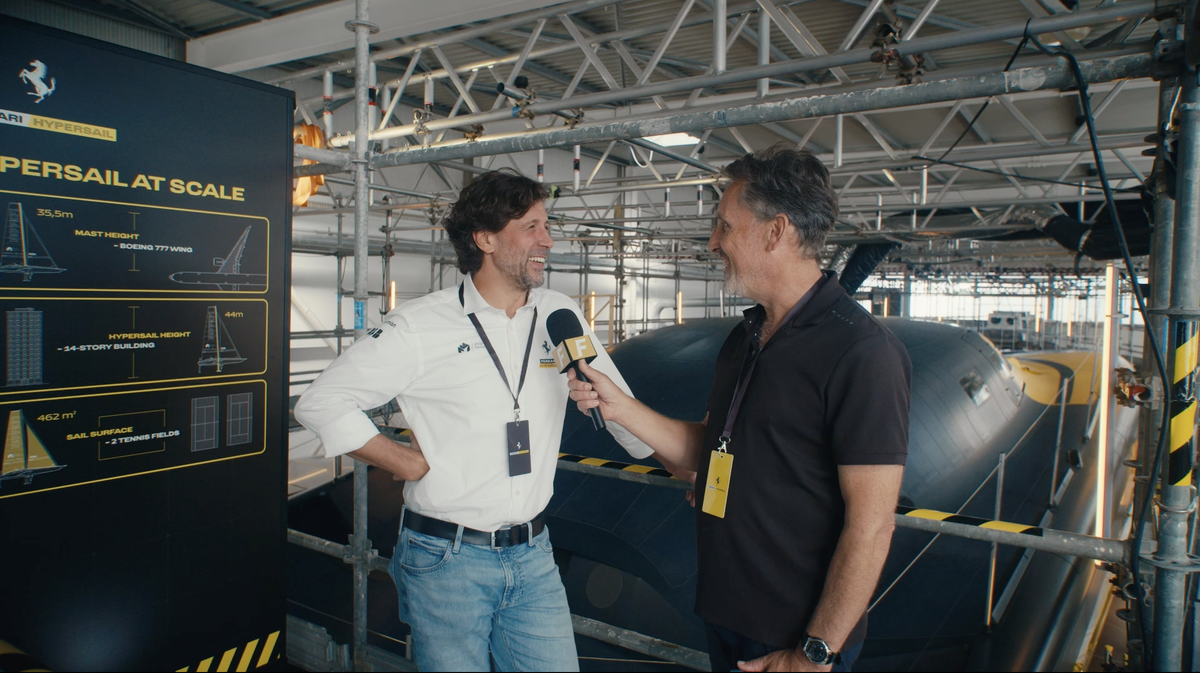
Ribigini's background is in windsurfing, and he says that was what made him say yes to the project. In the early days, there were only three people involved. He could understand what Giovanni Soldini was telling him about foiling and steering a boat, because he had felt it himself on the water.
"I love the contact with this world," he said. That passion, he says, is what drew him into the project.
Tacking in flight
I had recently sailed on Gitana 18, the brand-new foiling Ultim trimaran, and seen just how slow and ponderous it can be to tack a boat like that through the breeze. It’s almost like a three-point turn in a car, with the jib backed to help push the bow through the eye of the wind.
So I asked Ribigini whether Ferrari Hypersail is designed to tack and gybe without coming off its foils. I half expected a cautious answer. I didn’t get one. If anything, the question almost offended him.
“Of course, it’s more than an aspiration,” Ribigini said. “It’s what we designed the boat for.” All the systems have been designed to tack and gybe in flight. The team is already simulating flying tacks. The control systems have been redesigned more than once to make sure that, when the boat switches from port to starboard, it can keep flying through the manoeuvre. The winch-by-wire system that controls the jib, for example, is now twice as fast as the original version – quick enough to switch the sail from one side to the other without losing flight.
So is this an offshore AC75? Not quite. The America's Cup boats race for about half an hour in a narrow wind range, under a box rule. Ferrari Hypersail has different targets. But the reason for flying through manoeuvres is the same, and Ribigini explained it plainly.
If you come off the foils in a tack, and the wind is even one knot below what you need to take off again, you are stuck. "You start to be like a duck in the water," he said. In displacement mode, all that appendage drag makes the boat very slow. The point is not just to fly. It’s to stay flying.
The numbers he won't give
I pushed for a figure. In perfect conditions, what does the modelling say the boat could cover in 24 hours?
Ribigini politely declined. The team has the numbers from simulation, he said, but nothing real to compare them with yet. An error of one or two knots over 24 hours makes an enormous difference to a record. So the team is being strict with itself and will not publish predictions until it knows how the boat behaves in the water.
So when will he know the boat does what it should? Not on the first day, Ribigini said. The team will need most of 2027 to learn how the boat really works. The plan is to test every system step by step, find the problems and fix them. Perhaps by the second half of the year, everything will have been tested. Only then can the team start chasing the performance targets it set two years ago.
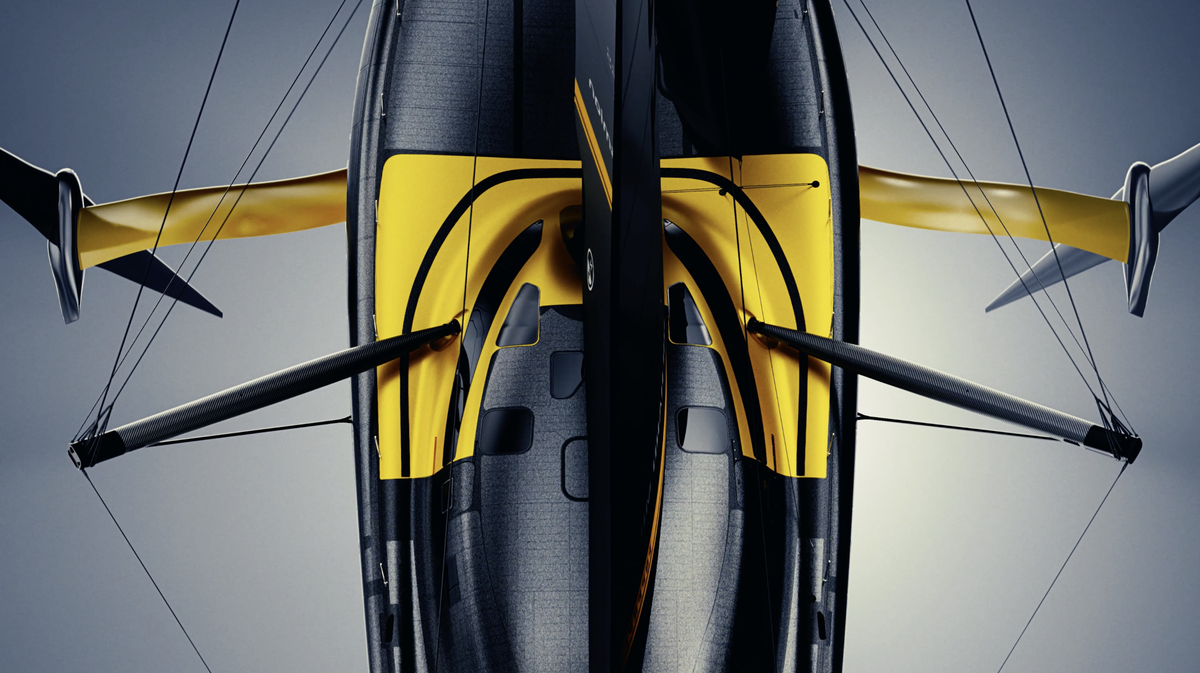
Some big offshore boats are deliberately capsized as part of their safety testing. Ribigini doesn't expect that here. It is not mandatory, he said, and most of it can be shown by calculation. In normal use the keel cants to 35 degrees each side. In a capsize, release valves let it swing to 60 degrees to help right the boat.
Monohull against multihull
Finally, the big question. Can a flying monohull really beat the giant trimarans that currently own the round-the-world record?
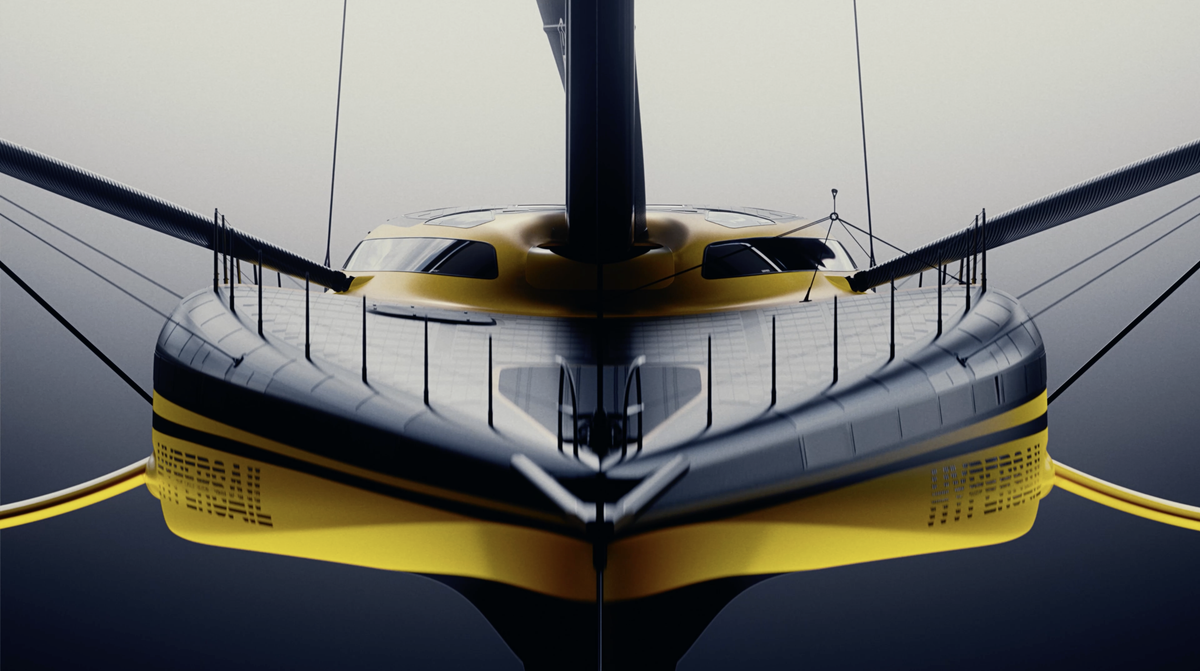
Ribigini believes in the concept. Aerodynamically, he said, the monohull is much more efficient. Trimarans carry a lot of drag, even if the engineering behind them is beautiful, with many clever details.
But he was careful. Aerodynamics is only part of the equation. What happens under the water matters just as much – in two-metre waves or rough seas that are hard to control. Air plus water, the boat has to work in both elements at once. Only then, Ribigini said, will the team be able to answer the big unknown.
In the final part of this series, I talk to the two men who will decide where this boat goes next: project leader Enrico Voltolini and CTO Matteo Lanzavecchia.
Topics
Articles You Might Be Interested in
Who’s hurting and who’s leading 24 hours into the Route du Rhum
The sweeper of the Atlantic
Things that go bump in the night: Gitana 18 skipper Caudrelier on risk at 40 knots (Pt. 5/6)
How Gitana 18’s skipper learned to sleep (Pt. 4/6)
Loïck Peyron on the night Fujifilm fell apart
Why Gitana 18 is in the hands of a Figaro man, not an Olympian (Pt. 3/6)
Route du Rhum runners and riders: Vintage Mono
From Tabarly to Gitana 18: why France goes mad for solo sailing (Pt. 2/6)



Member Discussion